What to check before buying
On a small desk, establish how the screen and input devices will fit, then check the connection to your computer. Resolution and stand adjustments matter once those requirements are met.
Laptop screen alone
Consider it when: Work sessions are short or infrequent and the laptop provides enough screen space.
Trade-off: It adds no display area; for prolonged laptop use, the Health and Safety Executive advises separate input devices and a separate screen as part of a good-posture setup.
HDMI monitor
Consider it when: Your computer has a compatible HDMI output and you want a separate display without relying on USB-C video support.
Trade-off: An HDMI display connection does not itself replace the laptop charger or connect USB accessories.
USB-C monitor
Consider it when: Your laptop supports display output over USB-C and the particular monitor provides the charging or hub functions you want.
Trade-off: The port shape alone does not confirm video, charging power or cable compatibility; compare the laptop and monitor specifications.
| Concern |
What to check |
Who this matters to |
| Desk fit and viewing position |
Measure usable desk width and depth against the monitor's dimensions with its stand. For an arm, check mounting and desk-clamp compatibility. |
On a shallow or shared surface, I need room for the screen without crowding my keyboard and mouse; about 33% of consumers put physical fit and viewing position first. |
| Computer connection and charging |
Confirm matching video ports. For USB-C charging, compare the monitor's stated power delivery with the laptop's requirement and check the cable. |
If my laptop is the main computer, I need the display connection to work and, if I want one cable, to meet its charging needs. Connection and power compatibility come first for about 42% of consumers. |
| Readable workspace and adjustment |
Compare native resolution and aspect ratio for your tasks, then check whether the stand can place the screen at a suitable height. |
For sustained work with documents and multiple windows, I want useful screen space without an awkward viewing position; roughly 25% of consumers prioritise workspace and screen adjustment. |
Joybuy monitors for compact workspaces
These monitors are options for adding a separate screen to a small home desk. Compare each one's stand footprint and computer connection with your own setup; a laptop-only arrangement remains an option for shorter sessions that do not need extra screen space.
 No image available
Dell P2425H 24-inch Full HD monitor
Consider this for an everyday second screen if your computer has a matching video output. The product name specifies a 24-inch, 1920 × 1080 IPS display at 100Hz, with USB-C, DisplayPort, HDMI and VGA listed; confirm what the USB-C connection can do before relying on it for video or charging. Check the dimensions with the stand against your desk.
View on Joybuy
 No image available
ASUS ProArt PA24ACRV IPS QHD monitor
Consider this model if QHD resolution is a priority for your work. Before planning a USB-C laptop setup, confirm the laptop's display output and charging requirement against the monitor's connections. Measure the available desk space and check the model's dimensions with its stand.
View on Joybuy
 No image available
ASUS ProArt PA248CRV IPS WUXGA monitor
This WUXGA model is worth considering when document space and screen positioning matter on a compact desk. Check its dimensions with the stand before ordering. If you intend to connect and charge a laptop over USB-C, confirm the computer's video support and charging requirement first.
View on Joybuy
 No image available
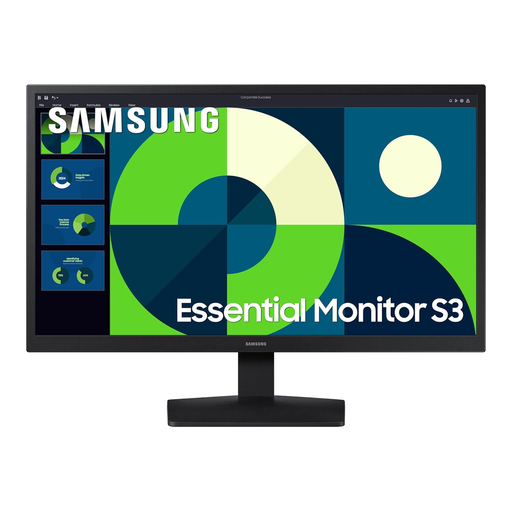
Samsung Essential S3 S31D (LS24D310EAUXXU) monitor
Consider this model if you want a separate display for everyday work and its connection suits your computer. Check the dimensions with the stand against your usable desk space. Its stated stand adjustment is tilt, so confirm that you can position the screen comfortably at your workstation.
View on Joybuy
Common questions
How much desk depth does a compact monitor need?
Measure the usable depth for your particular monitor, stand, keyboard and mouse rather than relying on a single depth figure. The Health and Safety Executive advises positioning the screen about an arm's length away and keeping the screen and keyboard central; compare that arrangement with the exact monitor's dimensions with its stand.
Will a monitor arm free up space on a shallow desk?
It can reduce the space taken by a stand if the monitor, arm and desk are compatible. Check the monitor's VESA mounting pattern and weight, the arm's load range and the desk's clamp clearance and suitability. VESA's display-mounting standard does not establish compatibility for the whole setup.
Will any USB-C laptop work with a USB-C monitor?
No: a USB-C socket alone does not confirm external-display output or suitable charging. Check the laptop's documented display capability, the monitor's USB-C functions and power delivery, and whether the cable supports the functions you intend to use.
When can I keep using the laptop screen instead?
For short or infrequent sessions, the laptop screen may be enough if you do not need more display space and can work comfortably. For prolonged laptop use, the Health and Safety Executive advises separate input devices so the screen can be elevated, and identifies a separate display as part of a good-posture setup.


