Dusk tent pitchers
When pegs, guylines and zips are the immediate job, look for light across the nearby work area while keeping both hands free. Petzl describes the TIKKA’s beam as wide and uniform for seeing close-up or around your feet.


For pitching a tent at dusk, start with a comfortable hands-free torch that lights the ground and nearby kit, rather than choosing by its highest lumen figure alone. Check its beam, lower brightness settings and runtime for close work; then choose a power system you can manage on your trip. If rain is likely, compare the exact model’s stated ingress-protection rating.
When pegs, guylines and zips are the immediate job, look for light across the nearby work area while keeping both hands free. Petzl describes the TIKKA’s beam as wide and uniform for seeing close-up or around your feet.
If pitching in rain is a realistic prospect, compare the exact torch’s ingress-protection rating and the maker’s instructions for use and charging in wet conditions. An IP rating describes specified protection, not an unrestricted waterproof guarantee.
When charging between outings is uncertain, check whether the model accepts replaceable AAA cells, an optional rechargeable pack or only an integrated battery. Petzl and Silva describe different battery options for their cited models, so compatibility needs checking model by model.
Decide whether close-range tent work or keeping the torch powered away from charging will drive your choice. Then check rain protection and red-light placement against the conditions in which you will use it.
| Concern | What to check when buying | Who this matters to |
|---|---|---|
| Light for close-up work | Look for a wide or proximity beam and a lower brightness setting; check whether the head tilts towards your work. | With pegs and zips to handle before dark, I want to see the area around my hands without aiming a narrow beam at each item. Around 40% of consumers put close-range setup lighting first. |
| Power away from charging | Confirm which batteries the exact model accepts, what comes with it and its stated runtime at the setting you expect to use. | If I cannot count on charging during a trip, being able to carry compatible spares shapes my choice. Power continuity comes first for around 30% of consumers. |
| Rain protection | Compare the exact model’s IP rating and its stated water-test conditions; follow the maker’s charging and drying instructions. | When I may have to pitch in rain, I need to know what exposure the torch is designed to withstand. Around 20% of consumers make wet-weather suitability their primary concern. |
| Red light near other campers | Check whether the red light faces forwards and how it is selected; a rear safety light serves a different purpose. | For small tasks beside other campers, I want a lower-glare option that lights what is in front of me. Around 10% of consumers put that need first. |
A high output figure does not tell you how evenly a torch lights pegs and kit nearby, or how long it runs at a useful setting. Ordnance Survey GetOutside advises weighing battery life against the brightness your activity needs.
Compare beam shape, lower settings, runtime by mode and whether you can direct the light onto the work area.
A rear red safety light is not necessarily a light for your hands or the tent entrance. Silva places the cited Trail Runner Free 2’s red safety light at the back of its headband.
If red light matters for camp tasks, check its position and how you switch it on before choosing a model.
Petzl explains that IP ratings classify protection against ingress by solids and liquids. The rating and test conditions apply to the specific product, not to every head torch from the same brand.
Check the exact rating and the manufacturer’s instructions for wet use, drying and charging.
A rechargeable pack may be optional, while an integrated rechargeable battery cannot be swapped for ordinary AAA cells. For example, Petzl lists the CORE battery as an optional alternative for the cited TIKKA.
Confirm the supplied batteries, compatible replacements, charging connection and runtime for your intended mode.
Petzl’s cited TIKKA is a compact camping-oriented example with a wide beam, continuous red lighting and a choice of power sources.
The cited Spot 400-R illustrates a rechargeable option with proximity and distance modes for campers comparing different lighting tasks.
The cited Trail Runner Free 2 combines focused and wide light for people considering a torch for both camp tasks and running or walking.
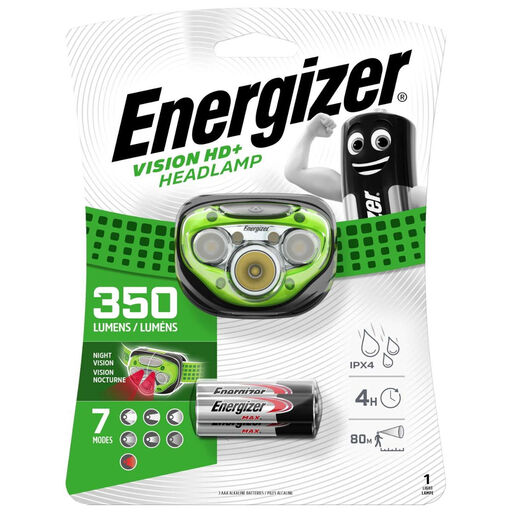
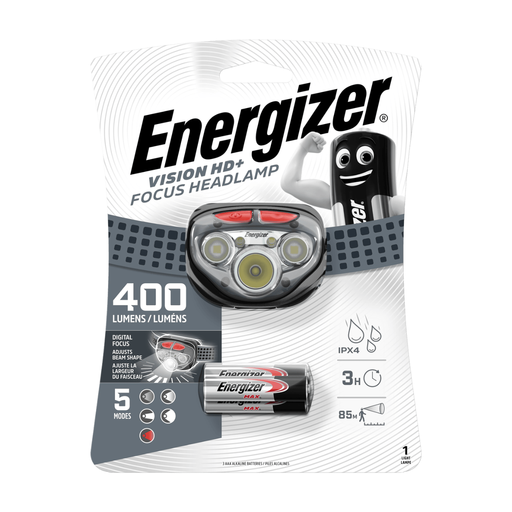
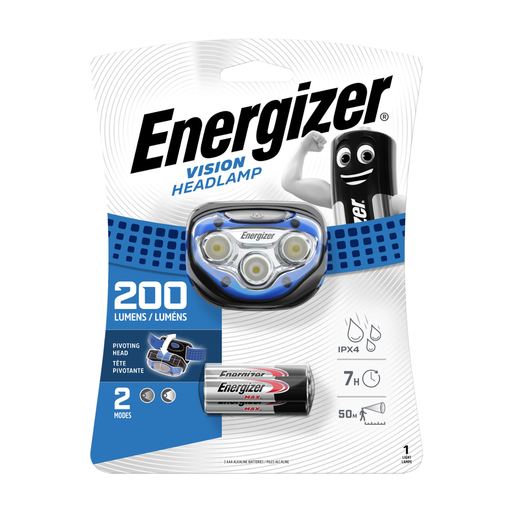
These Energizer Vision models are three-AAA head torches to consider for hands-free tent setup. Compare the beam and controls of the exact variant with the close-up jobs you expect to do.
 No image available
Consider this AAA-battery model if carrying replacement cells suits your camping plans. For tent work, check how its beam covers nearby tasks, how long your chosen setting runs and whether the red-light controls meet your needs.
 No image available
This is another replaceable-cell option for campers who want their hands free while pitching. Check its close-range beam setting and runtime rather than treating the 400-lumen figure alone as a measure of suitability; confirm how its red light operates if you plan to use it around camp.
 No image available
Consider this AAA-battery variant if a lower brightness setting is part of your plan for camp tasks. Check that its beam covers pegs and guylines at close range; if you need red light, confirm the exact lighting modes before choosing it.
No: a beam that covers nearby pegs, zips and kit, together with a usable lower setting, is a more relevant starting point for tent setup. Compare runtime at the setting you expect to use; maximum output alone does not describe either beam shape or battery life during close work.
Choose according to how reliably you can recharge during or between trips. An AAA-compatible model lets you carry suitable replacement cells, while an integrated rechargeable model needs a charging plan; check the exact model’s compatibility and what comes in the box.
A front-facing red mode can be useful for lower-glare work near other campers, but the position matters. Petzl describes continuous red lighting on the cited TIKKA, whereas Silva identifies the cited Trail Runner Free 2’s red light as a rear safety light.
Do not use the cited TIKKA as a substitute on that assumption: Petzl says it is not certified for road use. If you also plan to cycle, check the lighting requirements that apply to your journey and choose suitable cycle lights.
Keep batteries and electrical products marked with the crossed-out wheelie bin out of household rubbish. GOV.UK advises using an appropriate collection point for portable batteries, including AAA and rechargeable types.