Frequent bedding dryers
If sheets and duvet covers are regular loads, compare drum capacity and check whether the exact model offers a bed-linen programme or reversing drum action. Those features are not standard across all heat pump dryers.


For regular tumble-safe sheets and duvet covers, a heat pump dryer with enough drum space and a bed-linen programme with reversing action is a well-specified option; Bosch lists those features on its 9 kg WQG24502GB. If you regularly dry layered duvets, examine the exact model’s duvet programme and load guidance instead of relying on capacity alone. In either case, check care labels and the dryer’s installed depth, door clearance and airflow requirements before choosing extra capacity or specialised features.
If sheets and duvet covers are regular loads, compare drum capacity and check whether the exact model offers a bed-linen programme or reversing drum action. Those features are not standard across all heat pump dryers.
If you dry tumble-safe duvets or down-filled items, check for a suitable programme and follow both the bedding care label and the dryer’s load instructions. A feature intended for layered items may matter more to you than capacity alone.
If the dryer must fit an alcove or leave a walkway clear, measure for the appliance’s full depth and open door. Allow for the airflow and installation clearances specified for the model, as well as access for routine cleaning.
Start with the care labels and bulk of the bedding you actually dry, then compare programmes, utility-room fit and ongoing upkeep. The priorities below distinguish consumers by the need they would put first.
| Concern | What to check | Who this matters to |
|---|---|---|
| Bedding capacity and tangling | Compare the rated capacity with your usual load and look for a bed-linen programme with reversing drum action on the exact model. | If sheets and duvet covers bunch together in the drum, I want enough space and a programme intended to reduce tangling. Around 33% of consumers would put bedding handling first. |
| Layered duvet care | Check for a programme suitable for the item, its permitted load and any model-specific sensing feature; follow the care label. | When I dry a tumble-safe duvet, I need to consider its filling as well as its outer fabric. Specialised duvet care would be the primary concern for around 27% of consumers. |
| Utility-room fit and safety | Measure maximum depth and door clearance, then check the manual’s airflow requirements and electrical instructions. | A dryer that blocks the doorway or cannot be installed with the required clearance will not work for my room. For around 20% of consumers, fit and safe installation would come first. |
| Energy use and maintenance | Compare product-specific energy information for comparable loads and check the filter-cleaning routine. | If bedding is a frequent load, I want to understand the energy information and the cleaning I will need to keep up with. Around 20% of consumers would make that balance their first priority. |
Heat pump describes the drying system, not the programme list. Bosch UK specifies a bed-linen programme with reversing drum action on particular models; another dryer may handle bedding differently.
Read the exact model’s programme list and load instructions before deciding that it suits your sheets, covers or duvet.
A dryer may fit between cabinets yet obstruct a door, walkway or access point. Bosch UK lists the WQG24502GB at 613 mm deep, while AEG UK gives the TR959V6BC a maximum depth of 657 mm; neither figure includes the room you need to open the door.
Measure the route into the utility room, the intended position and front clearance. Check the manufacturer’s full dimensions and installation instructions.
LG UK describes an 81-minute TurboDry cycle for the RHX5010TWB. That model-specific claim does not establish how long a full load of bedding will take.
Compare the stated programme and load conditions behind a duration claim with the cycle you expect to use.
A self-cleaning condenser does not replace lint-filter care. The London Fire Brigade advises cleaning the tumble-dryer filter after every load.
Follow the model’s maintenance instructions and clean its accessible lint filter after each load.
Compare the named models or ranges rather than assuming that a feature applies to every dryer carrying the same brand.
A reference point for buyers comparing bed-linen programmes and reversing drum action.
Relevant if tumble-safe duvets and other layered items are a regular part of your laundry.
An option to examine when larger household loads make capacity and sensor-led programmes important.
A feature reference for buyers considering sensor drying and lower-temperature heat pump programmes.
A range to compare if model-specific fabric-care features are part of the decision.
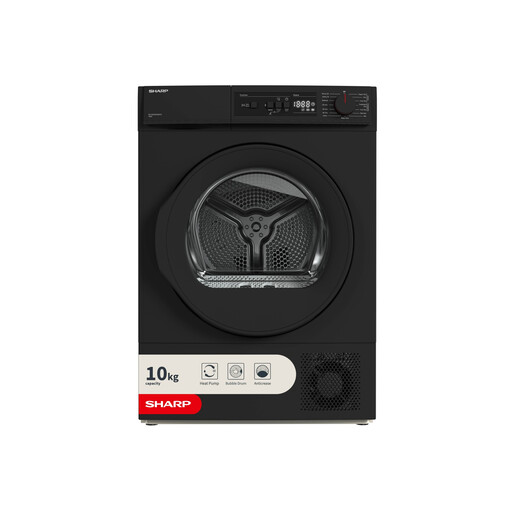
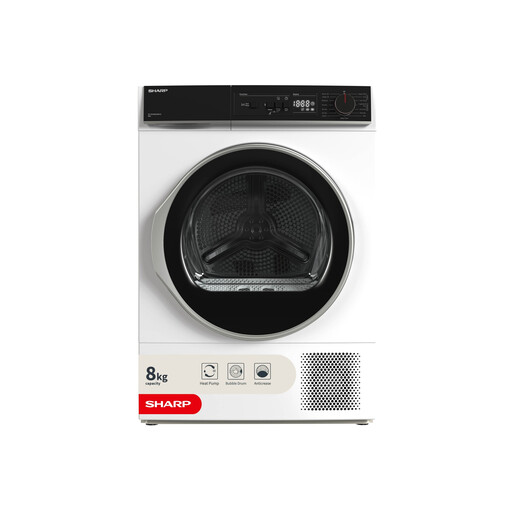
These Sharp models offer an 8 kg or 10 kg capacity to compare against your usual tumble-safe bedding loads. Check each model’s programme list and installation instructions before choosing either for a particular item or utility-room space.
 No image available
Consider the 10 kg rated capacity if larger tumble-safe bedding loads are common in your household, subject to the dryer’s instructions for the items concerned.
The product name states an A++ rating. Check the exact programme list for bedding or duvet settings; capacity alone does not establish how those items will dry.
Before installation, compare the model’s required depth, door clearance and airflow space with your utility room.
 No image available
Consider the 8 kg rated capacity for more modest tumble-safe bedding loads if the model’s load instructions allow the items you dry.
The product name states an A++ rating. Check for a suitable bedding programme rather than assuming that the smaller capacity or heat pump system provides one.
Measure your utility-room space against the model’s full installation dimensions, including the room needed for the door and airflow.
A heat pump dryer does not need the external vent hose used by a vented dryer. It still needs the airflow and installation clearances specified in its model-specific instructions, so check those against the proposed position.
Choose by the bulk of your tumble-safe items and the dryer’s permitted loads, not a universal capacity threshold. An 8 kg model may suit lighter bedding, while 9 kg or 10 kg gives a higher rated capacity for regular bulky loads; neither figure replaces programme and care-label checks.
Not by itself: a bed-linen programme with reversing action addresses the handling of sheets and covers, while a layered duvet may need different load guidance or a suitable model-specific programme. Check the duvet’s care label and the dryer’s instructions before putting it in the drum.
Clean it after every load, as advised by the London Fire Brigade, including when the dryer is described as having a self-cleaning condenser. Follow the appliance manual for any additional maintenance tasks.