For routine school clothes in a shared house, start with a heat-pump dryer whose capacity suits the usual laundry queue, then check its sensor programmes, dimensions and noise against the space. An 8 kg model is one route for everyday loads; if an urgent uniform is the recurring problem, compare rapid programmes by their stated load limits rather than assuming they dry a full drum quickly. Check the exact model’s energy label, water-handling arrangement and cleaning requirements before deciding.
Who is choosing the dryer?
Shared-house laundry coordinators
If several people use one machine, capacity, straightforward controls and an agreed cleaning routine can matter more than extra connected features. The usual load size and where the dryer will stand are the starting points.
Households with urgent uniforms
When a school shirt or PE kit needs drying before the next day, look for a rapid programme with a stated maximum load and duration. Beko, for example, limits its one-hour RapiDry claim for the B5T48231R to loads of up to 5 kg, despite the machine’s 8 kg rated capacity.
Households balancing fabric care and electricity use
Mixed uniforms and everyday clothes call for attention to garment care labels and the programmes available on the exact dryer. For electricity comparisons, Energy Saving Trust advises using appliance-label information; compare models of a suitable capacity rather than choosing by a letter grade alone.
What matters when buying?
Decide whether the usual shared load or the occasional urgent item drives the choice. Then check the installation space and the care requirements of the clothes that will actually go in the drum.
| Concern |
What to check |
Who this matters to |
| Next-day laundry |
Compare rated capacity with the usual load; check the maximum load and duration of any rapid programme. |
If several uniforms and everyday items are waiting, I need the next usable load ready before school. Around 33% of consumers put laundry throughput and next-day readiness first. |
| Electricity use |
Compare the exact models’ current A-to-G labels and product information at suitable capacities. |
With repeated wet-weather loads, I want to keep an eye on the electricity the household uses. For around 27% of consumers, that is the primary concern. |
| Shared-space fit |
Measure maximum depth and door clearance; compare published noise figures and decide how condensate will be emptied or drained. |
If the dryer stands near shared rooms, I need it to fit and have a water-emptying routine everyone can follow. Around 20% of consumers put those space and upkeep questions first. |
| Uniform fabric care |
Read garment care labels and check the model’s sensor, mixed-load and relevant fabric programmes. |
When a load contains sportswear or knitwear, I need to know which items can be tumble-dried and on which programme. Fabric care comes first for around 20% of consumers. |
Buying pitfalls
-
Assuming a rapid cycle takes a full load
A rapid programme can have a lower load limit than the drum’s rated capacity. Beko states that the one-hour RapiDry programme on its 8 kg B5T48231R applies to up to 5 kg.
Check both figures in the programme information: choose drum capacity for routine loads and judge the rapid cycle separately for urgent partial loads.
-
Checking capacity but not placement
Capacity alone does not establish whether a dryer fits or where its noise will be heard. AEG lists a maximum depth of 663 mm and a noise figure of 64 dB for the TR718AE4B; neither figure applies to every 8 kg model.
Measure the intended position and access route, allowing for the clearances in the exact model’s installation instructions. Check its published noise figure if it will run near a bedroom or communal room.
-
Leaving maintenance to the next person
Which? notes that a neglected lower filter can lengthen drying times. In a shared house, an unemptied water container can also interrupt the next person’s load.
Agree who empties the container and cleans each filter at the intervals in the manual. Follow the manufacturer’s electrical instructions; Electrical Safety First warns that a tumble dryer can overload an extension lead.
-
Choosing by energy grade alone
Energy Saving Trust explains that appliance labels provide energy-use, noise and performance information. A grade does not settle whether the capacity, programme time or dimensions suit the household.
Compare the current label and product information for the exact models alongside their practical fit. Do not treat an older A++ or A+++ description as directly interchangeable with a current A-to-G grade.
Brands to consider
These brands offer useful model-specific features to compare; check the specifications of the particular dryer you are considering.
AEG
The TR718AE4B is an 8 kg example for comparing sensor drying, mixed loads and installation dimensions.
- AEG lists humidity sensors, MixDry and maximum dimensions of 850 × 596 × 663 mm for this model.
- Its listed D energy class and 64 dB noise figure belong to the TR718AE4B; check other AEG models individually.
Beko
The B5T48231R is relevant when an urgent partial load is as important as routine 8 kg capacity.
- Beko states that its RapiDry programme can dry up to 5 kg in one hour and describes sensor drying to a selected dryness level.
- The one-hour claim must not be applied to a full 8 kg load.
Bosch
Bosch describes vent-free heat-pump drying and, on applicable models, features that may simplify routine use.
- Its WQH246DRIE example lists AutoDry, a self-cleaning condenser and a water-drain accessory.
- Bosch marks that example as no longer available; its 9 kg capacity and 59 dB figure are comparison points, not range-wide specifications.
Miele
The TEC645WP is an 8 kg example for comparing connected features and condensate handling.
- Miele lists Miele@home and integrated condensed-water drainage for this model.
- Confirm the exact model’s drain connection and installation requirements before planning to use direct drainage.
Joybuy heat-pump dryers
These heat-pump dryers cover 8 kg, 9 kg and 10 kg choices for routine shared laundry. If a rapid turnaround is essential, check the stated load and duration of the exact programme before choosing among them.
 No image available
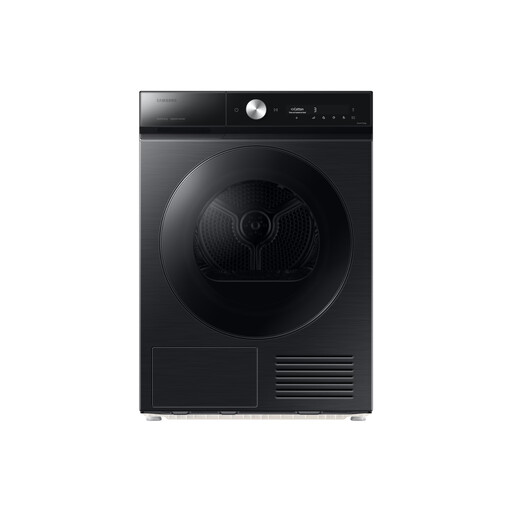
Samsung Series 8 AI Energy DV90BB9545GBS1, 9 kg, black
Consider this heat-pump dryer if the usual shared load calls for a 9 kg drum. Check the maximum load and duration of any quicker programme separately from its rated capacity, and measure the installation space before ordering.
View on Joybuy
 No image available
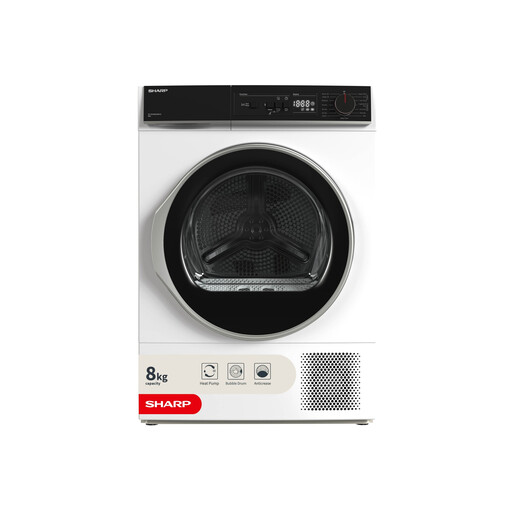
Sharp KD-NHA8S6GW1D-EN, 8 kg, white
This 8 kg heat-pump model is a capacity option for routine school clothes and household laundry. If an urgent shirt is the reason for buying, check the load limits and conditions of its named quick programmes before relying on them.
View on Joybuy
 No image available
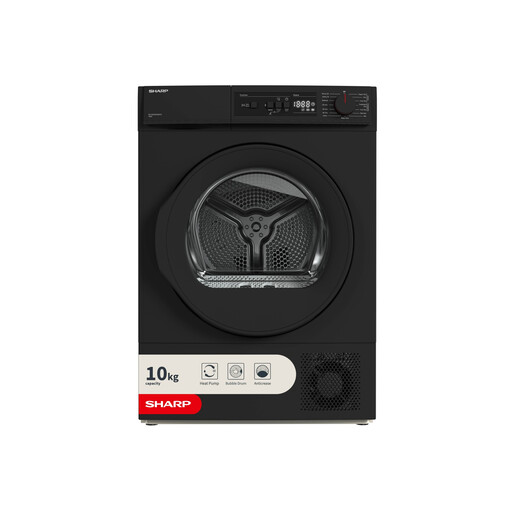
Sharp KD-NHA0S6GM1D-EN, 10 kg, matte black
Consider this 10 kg heat-pump model when the usual shared loads warrant that drum capacity. A larger rated load does not establish a faster school-uniform cycle: check quick-programme limits, maximum depth and required clearances.
View on Joybuy
 No image available
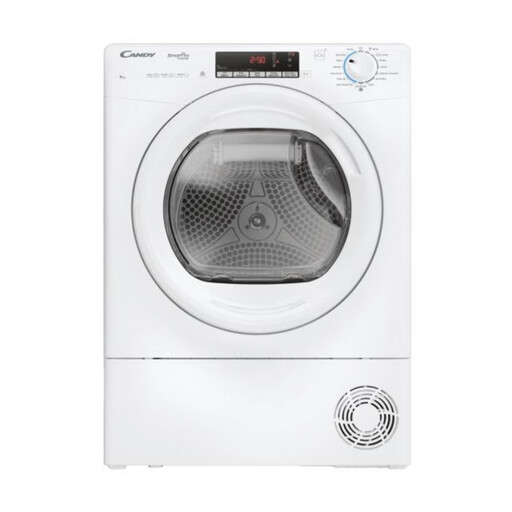
Candy CROE H9A3TE-80/N, 9 kg, white
This 9 kg heat-pump model is a choice for a household with substantial routine loads. Its name identifies sensor drying and Wi-Fi connectivity; assess any urgent-load programme by its own stated conditions rather than by drum capacity.
View on Joybuy
 No image available
Hoover HRE H9N2TE-80, 9 kg, white
Consider this 9 kg heat-pump model for regular shared loads. Its name identifies sensor drying and Wi-Fi connectivity; check programme limits, room fit and the current energy label for this exact model before deciding.
View on Joybuy
Frequently asked questions
Can I tumble-dry every school uniform item in a heat-pump dryer?
No: each garment’s care label still determines whether tumble drying is suitable. Sort specialist sports fabrics, woollens and other delicate items by their labels, then choose a compatible programme and dryness setting.
Does a heat-pump dryer need an external wall vent?
A vent-free heat-pump model does not need an external wall vent; Bosch describes its heat-pump dryers this way. Follow the exact machine’s instructions for placement, clearances and condensate handling rather than treating vent-free as permission to put it anywhere.
Should a shared house use a drain connection or empty the tank?
Use direct drainage only if the exact model supports it and a suitable connection can be installed in line with its instructions. Otherwise, agree who empties the condensate container so it does not hold up the next load.
Can the dryer run from an extension lead?
Do not treat an extension lead as the dryer’s permanent connection. Electrical Safety First warns that a tumble dryer can overload an extension lead and create a fire risk; follow the appliance manual and the property’s electrical-safety arrangements for a suitable fixed socket.
Which energy-label details should I compare?
Compare the current A-to-G label and product information for each exact model, including energy use and noise, at a capacity that suits the household. Energy Saving Trust explains what appliance labels show; an older A++ or A+++ description should not be used as a direct substitute for current-label information.


