For a student house drying tumble-safe sportswear, look for moisture-sensor drying and a gentle or sportswear programme that suits the garments’ care labels. Compare cycle conditions, capacity, noise and available space before choosing: Which? notes that lower-temperature heat-pump drying can take longer, even though Energy Saving Trust describes heat-pump dryers as a more energy-efficient option.
Who is this for?
Sports-kit care prioritiser
You mainly dry sportswear whose labels permit tumble drying and want to avoid unnecessary heat exposure or over-drying. Check the care symbols on each garment, then look for sensor drying and a suitable gentle or sportswear programme on the exact dryer.
Shared-bill student household
Several residents use the dryer and share electricity costs. The energy label, sensor controls and a capacity that fits your usual loads matter more than a feature list alone.
Fast-turnaround flat sharer
You need kit ready around training, work or classes while sharing access to the machine. Compare published programme times and their load limits rather than assuming a quick cycle applies to every load.
What matters when choosing?
Start with garment labels and programme suitability, then check the demands of a shared house: electricity use, time between loads and the space available for the dryer.
| Concern |
What to check |
Who this matters to |
| Sportswear care |
Check each garment’s tumble-dry symbol and temperature dots, then the exact model’s sensor and gentle or sportswear settings. |
If my kit is labelled tumble-safe, I want it dry without leaving it in unnecessary heat. Around 36% of consumers put that fabric-care need first. |
| Shared electricity use |
Compare the energy label and product information sheet for the exact model; consider the loads and programmes the house will use. |
When several of us use the dryer, I want to understand its electricity use before we share the bill. Roughly 29% of consumers make that their primary concern. |
| Turnaround time |
Check published cycle durations alongside their programme, load-size and dryness conditions. |
If kit needs to be ready before training or a shift, a quick cycle is useful only if it takes the load I need to dry. Around 21% of consumers prioritise turnaround. |
| Shared-space fit |
Measure the appliance space and delivery route; check published noise, water handling and filter-cleaning instructions. |
In a house with limited space, I need the dryer to fit, be manageable to live with and have a cleaning routine everyone follows. About 14% of consumers put those practical needs first. |
Buying and use pitfalls
-
Assuming all sportswear can be tumble dried
A heat pump’s lower-temperature operation does not override a garment label that prohibits tumble drying. GINETEX explains that the dots inside a tumble-dry symbol indicate the permitted temperature severity.
Check every garment’s symbol before loading it, and use a gentle or sportswear setting only where the label permits tumble drying.
-
Choosing by energy information alone
Which? notes that lower-temperature heat-pump drying can take longer. A busy household may still face queues if the cycles it needs do not fit its schedule.
Compare the duration and load conditions of the programmes you expect to use, especially quick or small-load cycles.
-
Checking the appliance space but not the delivery route
A dryer must pass through the property as well as fit in its final position. Samsung advises measuring doors, lifts and corridors for the packaged appliance.
Measure the full delivery route and intended space; also check the exact model’s published noise level and how its water container or drainage arrangement will work in the house.
-
Leaving filter cleaning to someone else
London Fire Brigade advises cleaning the tumble-dryer filter after every load, while Dorset & Wiltshire Fire and Rescue Service warns that lint build-up can become a fire risk.
Agree who cleans the filter after each use, follow the manual for other maintenance and stop using the dryer if it shows signs of a fault.
Brands to consider for relevant models
AEG
Its heat-pump range includes named models with low-temperature drying and speed-oriented programmes.
- AEG lists MixDry and ProSense+ on the TR728CT4B, and a SpeedDry programme for loads up to 4 kg on the TE718D4B.
- These features differ by model; check the programme and load conditions on the dryer you intend to buy.
Beko
Selected heat-pump models combine sensor drying with a stated faster-load function.
- Beko describes sensor programmes that stop at the selected dryness level and states a 5 kg, one-hour RapiDry condition for the B5T48231R.
- The RapiDry condition applies to that named model and load, not every programme or Beko dryer.
Bosch
Its range includes sensor-controlled dryers with selected half-load and quick-programme options.
- Bosch lists a 9 kg capacity, 61 dB noise specification and Half Load option for the WQG24502GB; the WTH85225GB lists Auto Dry and Super Quick 40.
- Confirm features against the exact Bosch model and variant rather than assuming both dryers have the same options.
Miele
The TWL780WP is a heat-pump model with programmes specifically named Sportswear and Outdoor.
- Miele also lists a SilenceDrum feature for the TWL780WP, relevant when the machine is near shared living space.
- Programme availability and the stated drum feature are model-specific; check the instructions and published noise specification for the exact dryer.
Samsung
Selected 9 kg heat-pump models offer load-responsive drying settings and connected features.
- According to Samsung’s product description, the DV90BB9445GBS1 adjusts drying time and temperature in response to the load.
- Check the programme list, dimensions, noise specification and energy information for the exact model rather than transferring features between variants.
Heat pump dryers on Joybuy
These heat pump dryers offer different stated drum capacities for shared-house laundry. Before choosing one for sportswear, check the exact model’s programmes against each garment’s care label, along with its energy information, cycle conditions and fit in the house.
 No image available
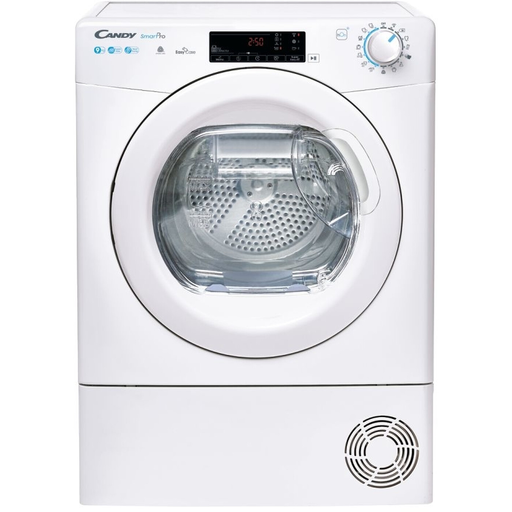
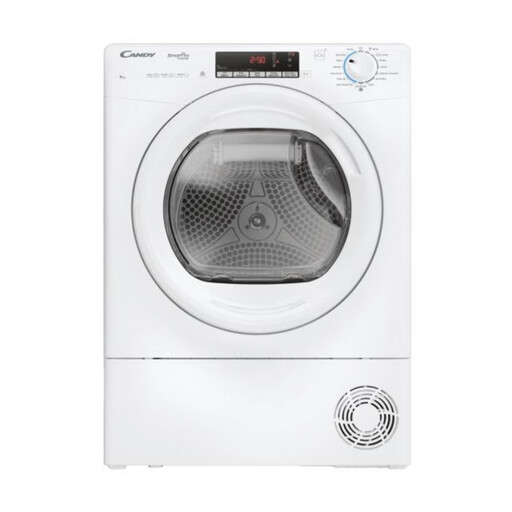
Candy CSOE H9A2TE-80 Smart Pro 9 kg Heat Pump Dryer
The stated 9 kg capacity may suit a house combining several residents’ laundry. Check the load conditions of any rapid programme you plan to use, and confirm that a suitable setting matches your sportswear labels.
White finish. Compare the exact energy label, dimensions and water-handling arrangement with your household’s requirements.
View on Joybuy
 No image available
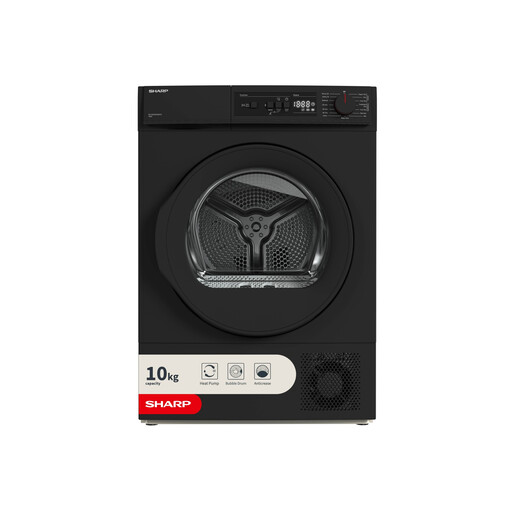
Sharp KD-NHA0S6GM1D-EN 10 kg Heat Pump Dryer
The stated 10 kg capacity is worth considering if the house regularly has larger laundry loads. For urgent kit, check the load limit and garment suitability of any express setting rather than using its timing as a full-load expectation.
Matte black finish. Confirm the energy label, dimensions and suitable sportswear setting for this exact model.
View on Joybuy
 No image available
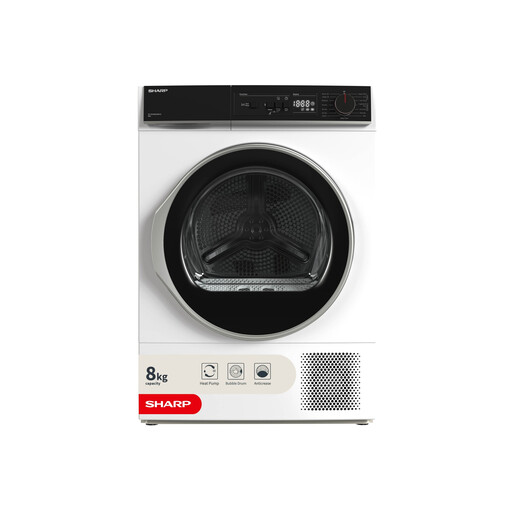
Sharp KD-NHA8S6GW1D-EN 8 kg Heat Pump Dryer
The stated 8 kg capacity may suit households that usually dry smaller loads. Check whether its programmes accommodate your labelled tumble-safe kit; assess any express-cycle timing against the load it permits.
White finish. Compare the exact energy label and appliance dimensions before deciding.
View on Joybuy
 No image available
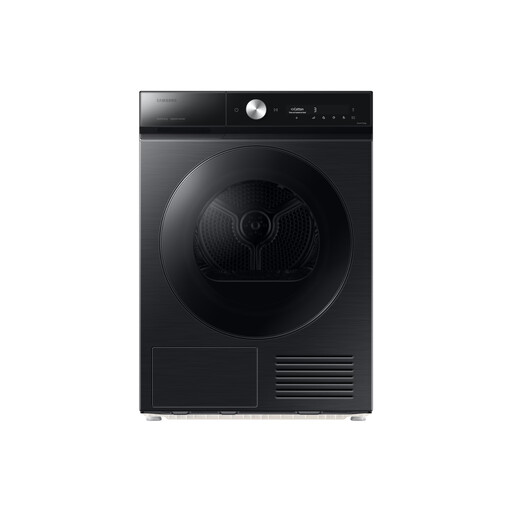
Samsung Series 8 DV90BB9545GBS1 9 kg Heat Pump Dryer
Its stated 9 kg capacity makes it an option to assess for shared laundry. Check the load and programme conditions of any advertised speed cycle, as well as whether the exact model offers a setting suitable for your garments.
Black finish. Review the exact energy label, published noise and dimensions for the space available.
View on Joybuy
 No image available
Candy CROE H9A3TE-80/N 9 kg Heat Pump Dryer with Sensor Dry
The stated 9 kg capacity and Sensor Dry feature may be relevant where housemates share loads and want automatic drying control. Check the exact programme instructions before putting labelled tumble-safe sportswear in the drum.
Wi-Fi connected; white finish. Compare the energy label, cycle durations, dimensions and filter-cleaning routine for your household.
View on Joybuy
Common questions
Can all sportswear go in a heat pump tumble dryer?
No. Follow each garment’s care label: GINETEX explains that the tumble-dry symbol and its dots indicate whether tumble drying is permitted and the temperature severity. A heat pump dryer does not override a do-not-tumble-dry instruction.
Does a heat pump dryer make sense for a shared electricity bill?
It can be worth considering if the house uses its dryer regularly: Energy Saving Trust describes heat-pump dryers as more energy-efficient because they recycle heat. Compare the exact model’s energy label and product information sheet; household electricity use also depends on loads, programmes and frequency.
Will a heat pump dryer get sportswear ready quickly?
Not necessarily. Which? notes that lower-temperature heat-pump drying can take longer. Check the stated duration, load limit and garment suitability of the programme you would actually use; a quick small-load cycle is not a promise for a full mixed load.
What dryer maintenance should housemates agree on?
Agree who will clean the lint filter after each load and follow the manual for other cleaning. London Fire Brigade recommends cleaning the filter after every load and avoiding overloaded sockets; Dorset & Wiltshire Fire and Rescue Service warns that accumulated lint can pose a fire risk.


