Small-space laundry users
If the dryer must fit a shallow utility area or fitted kitchen, its installation format and complete installed depth matter before drum capacity.


Choose the installation route before choosing drum capacity: measure the space, then decide whether a freestanding, integrated or manufacturer-approved stacked dryer can fit. For frequent small loads, check the exact model’s sensor settings or stated small-load programme; a larger drum can still make sense for occasional bedding if the appliance fits and its programmes suit your usual loads.
If the dryer must fit a shallow utility area or fitted kitchen, its installation format and complete installed depth matter before drum capacity.
If you regularly dry modest batches of everyday clothes, look for settings that respond to the load or a programme with a stated reduced-load limit.
If most loads are small but bedding or towels sometimes need drying, consider a larger-capacity model only after checking its footprint and small-load programmes.
Start with the space and installation method, then check how the exact dryer handles your usual load size.
| Concern | What to check | Who this matters to |
|---|---|---|
| Fit and installation | Measure height, width and installed depth, allowing for the door and required clearances. For an integrated or stacked dryer, confirm cabinet or stacking-kit compatibility by exact model. | I need the dryer to fit a shallow recess or share a washing machine’s footprint, so installation decides which formats I can consider. Around 46% of consumers put physical fit first. |
| Small-load settings | Check sensor or load-responsive settings and the permitted weight for any reduced-load or quick programme. | Most of my washes are small, so I want a programme suited to a light batch rather than choosing by maximum drum size alone. Roughly 27% of consumers prioritise small-load control. |
| Energy use and fabric care | Compare the exact models’ energy information, programme lengths and care instructions on a like-for-like basis. | Once I know a dryer will fit, I want to weigh its energy information and drying settings against the clothes I usually wash. Around 27% of consumers make these considerations their primary concern. |
Similar widths can conceal different depths. Beko UK specifies a 50.8 cm depth for its integrated DTIKP71131, while AEG UK gives a maximum depth of 661 mm for its freestanding TXH508A4R; those figures describe different installation formats.
Measure the whole installation area and check the exact model’s door opening and required clearances before ordering.
Maximum capacity does not tell you which programme suits a light everyday wash. AEG UK states that the TE718D4B SpeedDry programme takes up to 4 kg; that limit applies to that model and programme.
Read the programme table and check load-responsive settings on the dryer you intend to buy.
A matching width does not establish stacking compatibility. Bosch UK lists specific dryer models for individual stacking kits.
Check both appliance model numbers against the manufacturer’s kit guidance before installation.
A compatible stacking kit may require a separate purchase.
Choosing a heat-pump dryer does not remove routine fire-safety precautions.
Clean the filter after every load and do not overload sockets, as the London Fire Brigade advises. Follow the appliance instructions for its electrical connection.
Beko UK provides 7 kg heat-pump examples in both integrated and shallow freestanding formats.
AEG UK has standard-depth examples with load-responsive controls or a stated reduced-load programme.
Bosch UK is relevant when considering a heat-pump dryer stacked above a washing machine.
Hisense UK’s DH1Q902BW2 illustrates a larger-capacity freestanding route for households with occasional larger loads.
These choices cover integrated 7 kg dryers for suitable fitted spaces and a freestanding 8 kg dryer for a space that can accommodate it. Check the exact installation requirements before choosing between them.
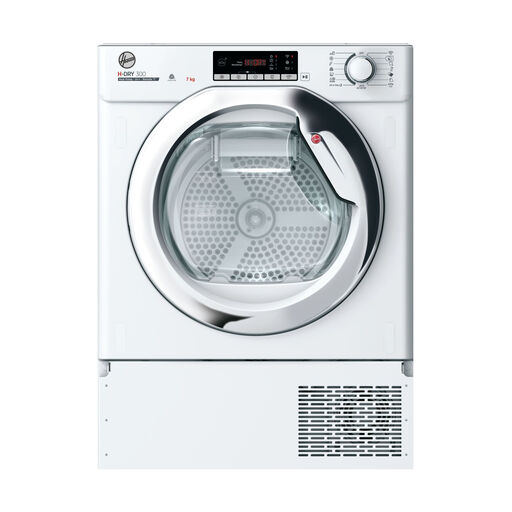 No image available
Consider this integrated model if you have suitable built-in housing and usually dry modest loads.
Check cabinet dimensions, ventilation and door clearance against the installation instructions. If a rapid cycle matters, confirm its permitted load.
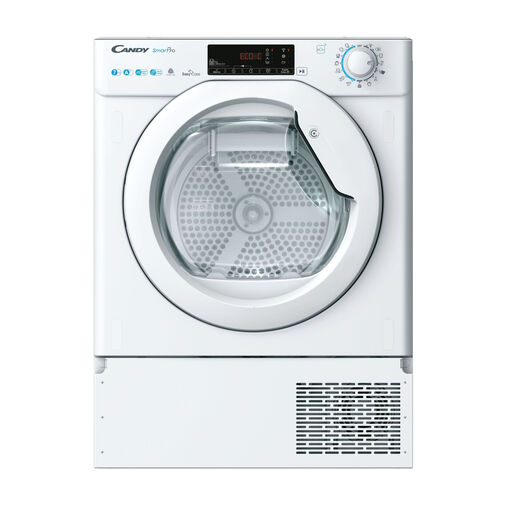 No image available
This is another fitted-space option for households whose regular laundry loads are modest.
Confirm cabinet fit, installed depth, door and pipe clearances, and ventilation for your setup. Check the programme table if you need a particular small-load limit.
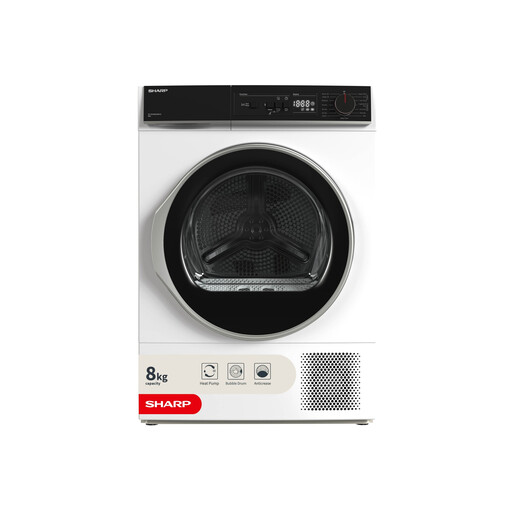 No image available
Consider this freestanding model if you want room for occasional larger loads and have space for its installation.
Measure the full footprint and door-opening area. Check the permitted load for its Express 34 programme before relying on it for a particular small batch.
A heat-pump dryer is a type of condenser dryer, rather than a conventional externally vented dryer. Bosch UK explains that it recirculates air and condenses moisture; follow the exact model’s instructions for room ventilation, drainage and clearance.
No: confirm that the manufacturer specifies a stacking kit for the exact washer and dryer models. Bosch UK’s kit information lists compatible models, so matching widths alone are not enough.
It may suit them if the exact model has appropriate load-responsive settings or a programme with a stated reduced-load limit. AEG UK says AutoSense adjusts by load size on the TXH508A4R and specifies a limit of up to 4 kg for the TE718D4B SpeedDry programme; check the programme table of the model you choose.
Clean the dryer filter after every load, as the London Fire Brigade advises. Follow the appliance’s other maintenance instructions and avoid overloading electrical sockets.
Compare the energy label and product information for the exact models, checking that any ratings use the same label format. Also consider the programmes you expect to use rather than treating a technology name or capacity as a running-cost figure.