Families drying mixed loads
If aprons go on the airer with school clothes, towels and everyday washing, compare hanging length and the maker’s maximum load together. A load rating alone does not tell you whether bulky items will fit on the bars.


Choose a three-tier heated airer if aprons regularly share space with towels, school clothes and other family washing: Lakeland and Dunelm list three-tier examples with 20–21m of drying space and stated loads of up to 15kg. A winged model may be easier to put away when loads are smaller, while a timer adds switch-off convenience rather than extra drying capacity. Whichever layout you choose, ventilate the room: GOV.UK and Energy Saving Trust guidance explains that moisture from indoor drying can contribute to condensation and damp when ventilation is inadequate.
The useful distinction is not household size alone, but what needs to hang at the same time and where the airer will stand.
If aprons go on the airer with school clothes, towels and everyday washing, compare hanging length and the maker’s maximum load together. A load rating alone does not tell you whether bulky items will fit on the bars.
When the airer must stand in a kitchen, utility area or spare room and be put away afterwards, check both its open dimensions and its folded size. A taller rack and a winged rack use space differently while open.
Plan where moisture from the washing will go as well as where the rack will fit. GOV.UK and Energy Saving Trust guidance links inadequate ventilation with trapped moisture, condensation and damp.
Start with the combined apron-and-laundry load and the available room space. Then compare electricity use and any timer features without overlooking ventilation during drying.
| Concern | What to check | Who this matters to |
|---|---|---|
| Space for a family load | Compare stated drying length and maximum load, then check whether long aprons and bulky items can hang without crowding. | If aprons need to dry with uniforms and towels, I want enough hanging room for the whole load rather than relying on a kilogram rating alone; around 27% of consumers put mixed-load capacity first. |
| Room fit and storage | Measure the airer’s open height, width and depth, plus its folded size and intended storage spot. | When the drying area is also a room the family uses, I need the rack to fit while open and go away afterwards; roughly 27% of consumers make room fit and storage their primary concern. |
| Electricity use | Check rated wattage and any timer; assess electricity use using your unit rate and the time the airer will be switched on. | If the airer will run regularly, I want to understand what it uses over a drying session rather than trust a fixed hourly-cost claim; about 20% of consumers prioritise electricity-use control. |
| Indoor moisture and safe use | Plan for room ventilation, follow the exact model’s instructions and check current recall information. | With washing drying indoors, I need a place where moisture can be managed and the electrical airer can be used as instructed; around 26% of consumers put moisture management and safe use first. |
Tier count does not tell you how much washing will fit. Lakeland’s Dry:Soon Deluxe lists 21m of drying space and a load of up to 15kg, while Dunelm’s winged model lists 11.5m and up to 10kg; their layouts also suit different spaces.
Compare drying length and load allowance, and check the open dimensions against the room and the length of your aprons.
Dunelm’s hourly-cost figures for its researched heated airers use a 26p/kWh tariff assumption dated 22 June 2026. Your unit rate and the time needed for your load may differ.
Check wattage and your current electricity unit rate. To estimate electricity used, multiply power in kilowatts by the hours switched on; that still does not predict how long a particular load will take to dry.
Drying washing indoors adds moisture to the air. GOV.UK and Energy Saving Trust guidance explains that without effective ventilation, moisture can be trapped and contribute to condensation and damp.
Choose a suitable ventilated position, keep existing trickle vents unobstructed and address persistent condensation or mould rather than extending drying time alone. Follow the model’s instructions if using a cover.
General product descriptions do not replace the instructions and safety information for the airer you receive. A recall may also identify a particular model rather than every airer from a brand.
Keep the model details and proof of purchase, follow the supplied instructions and check Office for Product Safety and Standards recall information for the exact model.
These examples illustrate different formats and stated specifications; check the exact model rather than assuming every airer from a brand has the same capacity or features.
Lakeland’s Dry:Soon range includes Mini, Standard and Deluxe three-tier formats. The named models offer different ways to balance storage and family-load space.
Dunelm lists both a three-tier heated airer and a smaller winged heated airer, giving buyers two layouts to measure against their room and washing load.
Status offers foldable heated-airer formats, including winged and three-tier designs. The specifications need to be checked by exact model.
These Joybuy choices include a foldable three-tier airer, a foldable winged airer and a three-tier winged design for drying aprons alongside other washing. Match the layout to your load and available room space; the title of an airer alone cannot establish how much hanging length your aprons will have.
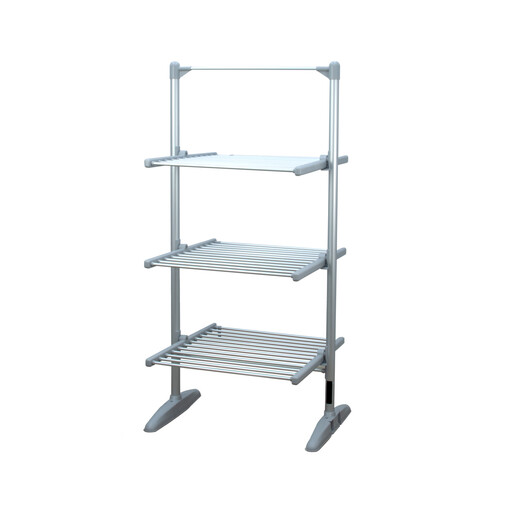 No image available
Consider this layout when aprons share a drying rack with other family washing and you have room for a three-tier unit. Check its open dimensions and usable hanging space for longer garments before choosing a position.
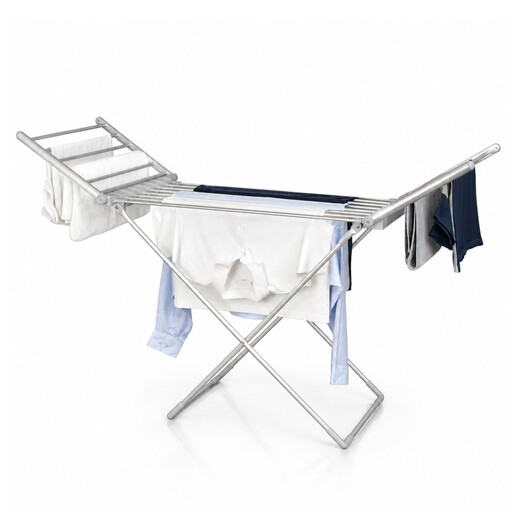 No image available
Consider a winged layout when you want to put the airer away between apron-led loads. Measure its open footprint and check that the hanging area accommodates your longer aprons.
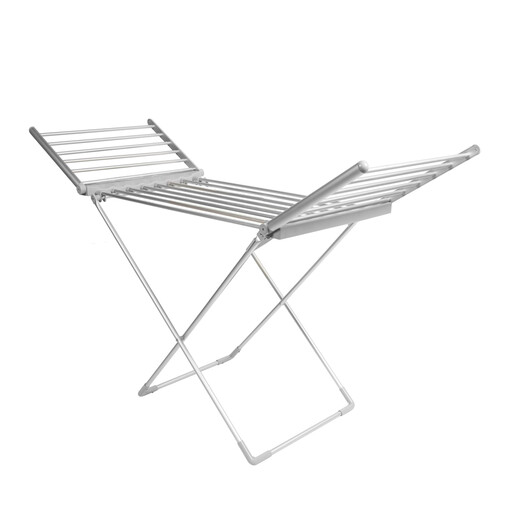 No image available
This combined tier-and-wing layout is an option for aprons with a lighter family load. Check the hanging length and rated wattage when comparing it with other airers. The listing describes a cover but also cautions against completely covering the airer, so clarify safe cover use in the supplied instructions before operating it.
Start with everything you intend to dry together, not household size alone. For aprons alongside towels and everyday clothes, Lakeland and Dunelm list three-tier examples with 20–21m of drying space and stated loads of up to 15kg; Dunelm’s smaller winged example lists 11.5m and up to 10kg. Check whether the bars can accommodate the shape and length of your garments as well as their combined weight.
No. A compatible cover may retain warmth around washing, but it does not remove moisture from the room. GOV.UK guidance explains that moisture from indoor drying can become trapped without effective ventilation and lead to condensation; follow the airer’s instructions for any cover.
Compare rated wattage, the time each airer would be switched on for your load and your own electricity unit rate. Dunelm’s advertised hourly-cost figures for its researched models use a 26p/kWh assumption dated 22 June 2026; an hourly figure does not tell you the cost of a completed load unless you also know its drying time.
Follow the instructions for the exact model and check current Office for Product Safety and Standards recall information. GOV.UK explains that the Electrical Equipment (Safety) Regulations 2016 set requirements for electrical equipment placed on the Great Britain market; Northern Ireland has distinct arrangements, so Great Britain-specific guidance should not be assumed to cover it.