Students short on storage space
If you mainly dry a few aprons or small garments and put the airer away afterwards, check both its open footprint and folded size. A rack that stores neatly still needs a clear, stable place to stand while in use.


For a few aprons and limited storage, start with a fold-flat airer that fits safely when open rather than choosing by size alone. If several housemates will share it, compare the stated load limit and drying space of three-tier models; whichever format you choose, wet laundry still adds moisture to the room, so ventilation and a suitable socket matter.
If you mainly dry a few aprons or small garments and put the airer away afterwards, check both its open footprint and folded size. A rack that stores neatly still needs a clear, stable place to stand while in use.
If aprons will dry alongside other washing, compare the exact model’s stated drying length and load limit. Arrange use between housemates rather than packing garments tightly or exceeding that limit.
If laundry dries in a bedroom or shared room, plan how the space will be ventilated and powered before buying. Check the appliance’s exact identification against recall notices, particularly if it is second-hand.
For aprons in a student house, work out where the airer can stand and whether it will serve one person or several. A tower offers multiple rails in a vertical frame, while a winged airer needs room for its open wings; a hanging pod is a more specialised option for garments kept on hangers.
Consider it when: Several aprons will dry alongside a shared wash load and the rack can be folded away afterwards.
Allow for: The full height and footprint while open, not just the folded depth.
Consider it when: You want a flat-folding rack for a smaller amount of laundry and have clear space for its wings.
Allow for: Wing clearance in the room; a lower wattage alone does not establish the total electricity used to dry a load.
Consider it when: Aprons can be kept on hangers and there is a suitable place for a garment-focused appliance.
Allow for: A specialised hanging format rather than rails for a mixed laundry load. Lakeland says its Dry:Soon Drying Pod holds up to 12 hangers.
| Concern | What to check | Who this matters to |
|---|---|---|
| Fit and storage | Measure the open position and storage space; compare open dimensions and folded depth for the exact model. | If the rack must be put away after drying a few aprons, I need one that fits both in use and in storage. Around 31% of consumers put fit and storage first. |
| Shared-load capacity | Compare the stated load limit, drying length and rail arrangement; leave room to hang apron straps without bunching wet fabric. | When several housemates share one airer, I need enough space for aprons alongside other laundry without exceeding its limit. Shared-load capacity comes first for around 38% of consumers. |
| Indoor moisture | Choose a place with effective ventilation and follow the accommodation’s ventilation instructions. | If I dry laundry indoors regularly, I need to avoid trapping the moisture it releases. Around 23% of consumers place moisture management first. |
| Electrical safety | Identify the exact model for recall checks; check the socket or extension rating and do not daisy-chain leads. | In a room with shared sockets, I need a safe power arrangement and an identifiable appliance. Electrical safety is the primary concern for around 8% of consumers. |
For a sense of the model-specific figures, Lakeland lists its Dry:Soon 3-Tier at 21 m of drying space, a 15 kg capacity and an 8 cm folded depth. Dunelm lists 20 m, up to 15 kg and a 10.5 cm collapsed depth for its 3 Tier Heated Airer. These figures help with fit and load planning, but do not establish how quickly either model will dry aprons.
Three-tier and A-frame airers can differ in drying length, load limit and folded size. A rail count will not tell you whether an apron hangs clear of other wet garments.
Compare the exact model’s open dimensions, folded depth, drying length and maximum load against the space and laundry it will actually serve.
Wet aprons still release moisture indoors. UK government guidance identifies laundry drying as a source of indoor moisture that can contribute to condensation and mould when ventilation is ineffective.
Use the property’s ventilation as intended, keep fitted trickle vents unblocked and raise persistent damp or mould with the accommodation provider or landlord.
The UK Office for Product Safety and Standards has published recalls for particular Dunelm and Lakeland heated airers. Those notices concern identified products, not every airer bearing either name.
Check the model, article number, batch and barcode where available against current recall notices before buying or using an inherited appliance.
Shared sockets can tempt housemates to connect several devices through one lead. Electrical Safety First warns against overloading extensions and connecting one extension lead to another.
Use a suitable wall socket where possible. If an extension is necessary, check its marked rating, use only one extension device per socket and do not use a damaged lead or plug.
Lakeland offers three-tier racks and a hanging drying pod, making the range relevant when deciding between shared-laundry rails and hanging garments.
Dunelm lists vertical three-tier and A-frame formats; compare their dimensions and capacity by model.
The freestanding three-tier 63099 is a reference point for checking whether a tower will fit the intended room.
The winged format is relevant when flat-folding storage is important and the room has space for open wings.
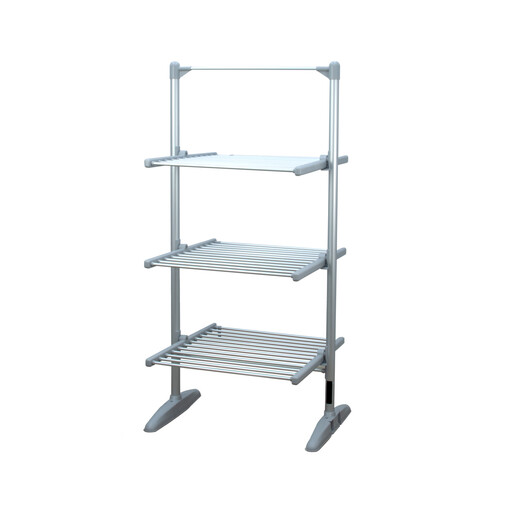
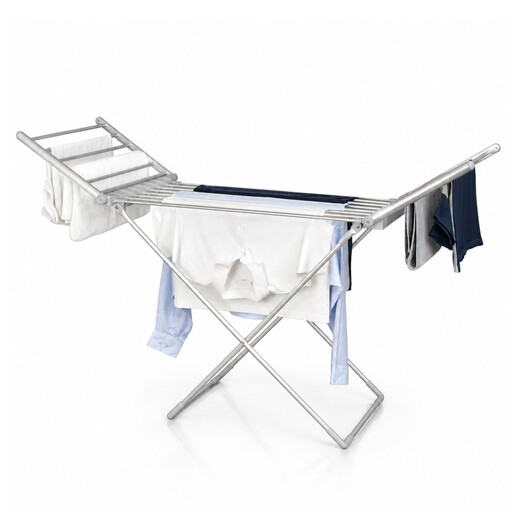
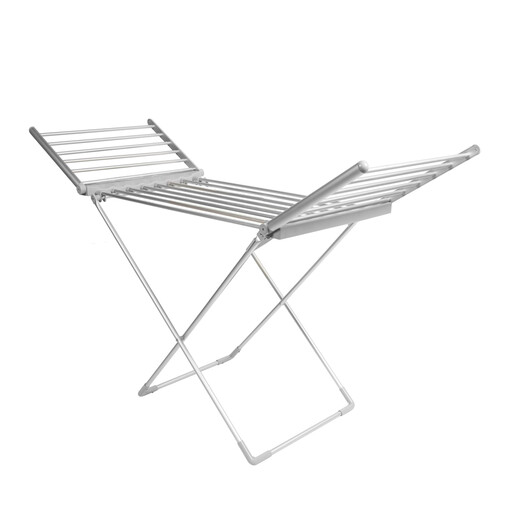
These foldable heated airers offer three-tier and winged layouts for drying aprons alongside other indoor laundry. Check each one’s open size against the available space, particularly where wings need clearance.
 No image available
Consider this three-tier format if aprons will dry alongside other laundry and the rack needs to fold away between uses.
The product name specifies a 248 W rating and aluminium construction. Check its open and folded dimensions against the intended space before buying.
 No image available
Consider the winged layout if you want flat-folding storage and can leave enough floor space for the open wings.
Joybuy lists 20 heated bars and a 15 kg maximum load for this model. Its 230 W rating does not, on its own, tell you how long a load will take to dry.
 No image available
This layout is worth considering if you want tiers as well as wings for aprons and other laundry.
Check the open dimensions, wing clearance and labelled load limit against the room and the amount you plan to dry.
No. Wet laundry still releases moisture into the room. UK government ventilation guidance identifies clothes drying as a source of indoor moisture, so use the property’s ventilation as intended and keep fitted trickle vents unblocked.
Only if the extension is suitable for the combined electrical load and is in sound condition. Electrical Safety First advises against overloading extensions or daisy-chaining them; check the airer’s rating and the lead’s marked rating.
Yes. Check your accommodation handbook, tenancy terms or building manager’s appliance policy for rules applying to bedrooms and shared areas before purchasing a heated airer.
Find its exact brand, model and any article, batch or barcode details, then compare them with UK Office for Product Safety and Standards recall notices. If the appliance matches a notice, stop using it and follow the stated corrective action.