Small-load utility-room users
If you mainly dry aprons, workwear or a few light items, the airer needs to fit while open and fold away without taking over the room.


For a few aprons at a time, consider a fold-away winged heated airer if it fits the utility room when fully open. A three- or four-tier airer makes more sense when aprons regularly share space with household laundry, provided there is room to load it and keep access clear. Whichever format you choose, compare its load limit and rated power, and ventilate the room while drying laundry indoors.
If you mainly dry aprons, workwear or a few light items, the airer needs to fit while open and fold away without taking over the room.
If aprons go on the airer with regular washing, drying length and load limits matter alongside the space a tiered frame occupies.
If indoor drying is routine, compare rated power and expected run time, and plan how the utility room will be ventilated.
Measure the space available for the open airer before comparing capacity; then consider how often you will dry mixed loads and how you will manage electricity use and ventilation.
| Concern | What to check | Who this matters to |
|---|---|---|
| Room fit and storage | Measure open width and depth against doors, appliances and walking space; compare folded dimensions with your storage gap. | If I dry just a few aprons, I need the frame out of the way when it is not in use. Around 36% of consumers put room fit and storage first. |
| Drying turnaround | Check whether aprons can be spaced apart and whether a cover is supplied and approved for the exact model; do not assume a fixed drying time. | When aprons need to be ready for the next task, I want room to spread them out rather than bunch them together. For roughly 29% of consumers, drying turnaround is the primary concern. |
| Mixed-load capacity | Compare drying length and stated load limits with the laundry you intend to dry together; check any limits for individual tiers. | If aprons usually share the airer with towels or uniforms, I need enough usable space for the combined load. Mixed-load capacity comes first for about 21% of consumers. |
| Electricity use and moisture | Compare rated watts and likely run time, and make sure the room has a usable ventilation route. | If I dry indoors regularly, I need to manage electricity use without letting moisture build up in the utility room. Around 14% of consumers make this their main concern. |
Capacity is little help if the open frame obstructs an appliance or doorway. Dunelm lists one winged model as 148cm wide when open; Minky lists its sureDRI four-tier model as 147cm high and 73.5cm wide.
Mark out the open footprint, check access to doors and appliances, and measure the storage space if you plan to put the airer away.
Minky lists a cover with its sureDRI four-tier airer, while Lakeland describes a custom cover for its three-tier Dry:Soon model. Claims about faster drying with covers are the brands' own, not a fixed result to expect from every load.
Check what comes with the exact airer, whether a separate cover fits it and what the instructions say about covered use.
A model-specific cover may need to be obtained separately.
Rated power describes electricity input while an airer is operating, but total use also depends on how long it runs. A timer is relevant only if the selected model has one.
Compare rated watts with your likely drying routine, and check any timer instructions before relying on an automatic shut-off.
Indoor laundry adds moisture to the home, according to UK government guidance. Energy Saving Trust advises ventilation to reduce the risk of condensation, damp and mould; an electrical lead also needs to be kept dry.
Use the room's ventilation route, position the plug and lead away from water, and do not connect one extension lead to another, as Electrical Safety First advises.
These ranges illustrate different heated-airer formats; compare the specifications and accessories of the particular model you are considering.
Lakeland's Dry:Soon range includes tiered designs for consumers who dry aprons with larger laundry loads but still need fold-away storage.
Minky's sureDRI four-tier model is a larger covered format for aprons dried alongside household washing.
Dunelm lists both winged and four-tier heated airers, making it useful to compare formats for small apron loads and mixed laundry.
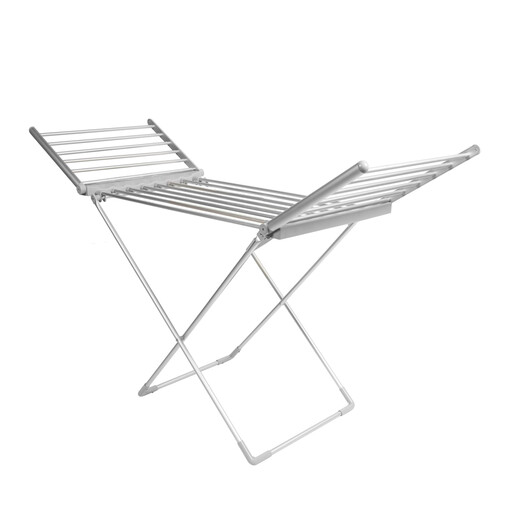
These winged and three-tier airers are options to consider for aprons alone or alongside other laundry. Check each frame's open dimensions before deciding it will fit your utility room.
 No image available
Consider this winged, three-tier format if you want to dry aprons with other items and have room for the frame when open.
If using a cover, check this model's instructions: its product information warns against covering the airer completely.
 No image available
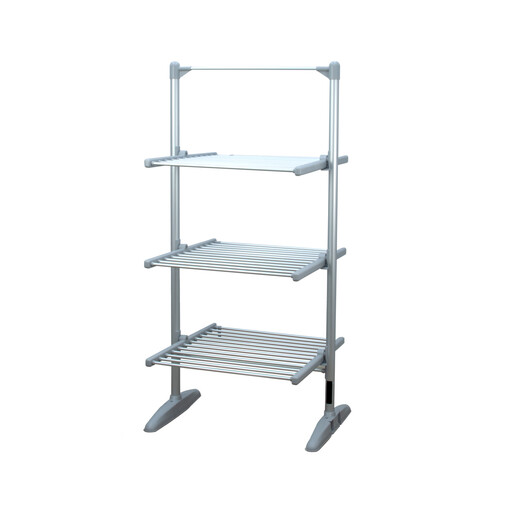
Consider this foldable three-tier format if aprons regularly share an airer with household laundry.
Rated power: 248W. Check open and folded dimensions and drying length against the space and load you have in mind.
 No image available
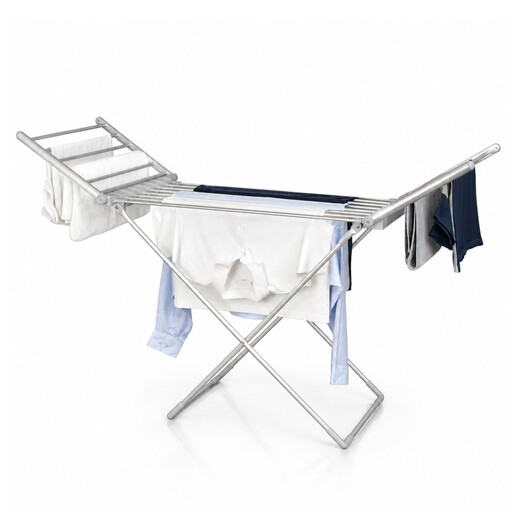
Consider this foldable winged format for aprons and smaller laundry loads if its open frame leaves enough access around the utility room.
Rated power: 230W. Check open and folded dimensions and drying length before choosing it for a narrow space.
Start with the space available when the airer is open and the size of your usual load. A winged format may suit a few aprons, but measure it first: Dunelm lists one winged model as 148cm wide when open. If aprons usually go on with household washing, compare the drying length and load limits of tiered models as well.
Yes, plan to ventilate the room when drying laundry indoors. UK government guidance identifies drying laundry as a source of indoor moisture, and Energy Saving Trust advises ventilation to help reduce condensation, damp and mould. Use an appropriate window or extractor where available rather than treating the heated airer as moisture control.
A utility room can be suitable if the chosen model's instructions allow indoor household use and you can keep its plug and lead dry. Position the airer clear of water and walking routes; follow its instructions for covers and avoid connecting one extension lead to another, as Electrical Safety First advises.
Look for clear instructions, safety information and identifiable manufacturer or seller details for the airer you are considering. The Office for Product Safety and Standards explains that the Electrical Equipment (Safety) Regulations 2016 set requirements for electrical equipment placed on the Great Britain market; Northern Ireland has different arrangements. A product listing alone should not be treated as proof that a particular airer meets those requirements.