Who each format suits

Households drying several thick towels

Look for enough drying length to separate towels rather than stacking them on the same rails. The tiered Dry:Soon and Minky models described by Lakeland and Minky Homecare offer examples of larger drying layouts; check that an open frame fits your room.

Small-home towel dryers

If the airer must be put away after each wash, compare its folded dimensions as well as its open footprint. A compact rail may mean drying fewer towels at a time.

Consumers needing a quicker turnaround

A fan-powered pod is an option for a smaller load that can hang inside its cover. Check that bath towels fit without crowding, and compare electricity use over the full drying session.

What matters when choosing

Covered tiered airer

Consider it when: several towels or a larger wash need separate hanging space.

Allow for: the open frame’s footprint and room ventilation; a cover does not take moisture out of the air.

Fan-powered drying pod

Consider it when: quicker turnaround for a limited hanging load matters more than maximum capacity.

Allow for: the space towels need inside the cover and electricity use across the whole cycle.

Winged heated airer

Consider it when: you usually dry a small towel load and want a frame that folds away.

Allow for: less room to spread out several thick towels than on the larger tiered examples.

ConcernWhat to checkWho this matters to
Room for towels Drying length, maximum load and whether towels can hang apart. When several thick towels need drying together, I want space around each one rather than a high load limit alone. Around 36% of consumers would put towel capacity and spacing first.
Turnaround Whether air is fan-circulated, how the load hangs and the full session length. If towels are needed again soon, I may favour a smaller hanging load that gets more air movement. Roughly 29% of consumers would make quicker turnaround their primary concern.
Placement and storage Open and folded dimensions, and a suitable socket in a dry room. Where the airer has to be put away between washes, I need it to fit both in use and in storage. Around 21% of consumers would prioritise workable placement and compact storage.
Electricity use Rated wattage and likely hours per load, including any other appliance used for moisture control. If I can manage a smaller load, I want to understand the electricity used across a complete drying session. Roughly 14% of consumers would put that control first.

Mistakes to avoid

  • Choosing by wattage alone

    A heated rail and a fan-powered pod handle different loads. Wattage by itself tells you neither how many towels will fit without crowding nor how long a session will take.

    Compare usable hanging space, load limits and likely session length alongside the power rating.

  • Expecting a cover to prevent condensation

    A cover can retain heat around laundry, but moisture still enters the home. GOV.UK’s existing-home ventilation guidance warns that moisture trapped without effective ventilation can cause condensation.

    Keep the room’s intended ventilation open and follow the airer’s cover instructions.

    Using a dehumidifier as well adds its electricity use to the drying session.

  • Putting a plug-in airer near bathroom water

    Wet bathroom conditions increase electrical risk. Electrical Safety First advises against using an extension lead to power an appliance in a bathroom without a suitable socket.

    Plan to dry towels in a ventilated, dry room, following the appliance instructions and keeping its plug and cable away from water.

  • Overlooking the exact model when checking safety alerts

    The Office for Product Safety and Standards reported a serious fire risk involving insecure wiring in a specific Mini 3 Tier Electric Heated Airer, model K130/SKU UK10529. That finding does not apply to every three-tier airer.

    Identify the model you are considering and check official product-safety alerts or recalls before use.

Brands to consider for these formats

Dry:Soon

Lakeland’s range includes tiered heated airers and a fan-powered drying pod, serving different towel-load sizes.

  • Lakeland specifies 21 m of drying space and a 15 kg load limit for its deluxe three-tier covered bundle.
  • Its drying pod holds up to 12 hanging items, so check whether bulky towels fit comfortably before choosing it for a household load.

Beldray

Beldray has both winged heated rails and a covered pod system.

  • Beldray specifies 12 m of drying space, a 15 kg load limit and 230 W for its researched winged rail.
  • Its covered pod system has a separately stated 7 kg limit; do not treat the two formats as having the same towel capacity.

Minky

Minky’s SureDRI four-tier airer with cover is a larger-format option for towels and other laundry.

  • Minky Homecare specifies 23 m of drying space for this model.
  • Measure its open footprint, and ventilate the room even when using the included cover.

Addis

The researched Addis winged airer is a fold-out alternative to a tower frame.

  • B&Q lists 18 heated bars and a 10 kg load limit for this model.
  • Its product instructions call for spun-dry laundry and an evenly distributed load; avoid piling heavy, dripping towels onto the rails.

STATUS

A STATUS winged heated airer is one fold-away rail option for a smaller towel load.

  • The Joybuy listing for the 230 W winged model states 20 heated bars and a 15 kg maximum load.
  • Check the dimensions and the instructions for the exact model you choose; its load limit does not describe how quickly towels will dry.

Joybuy product choices

These choices include a tiered airer, freestanding towel rails and a winged rail. Match the available hanging space and storage arrangement to your towel load; a stated load limit alone cannot tell you whether thick towels will fit apart.
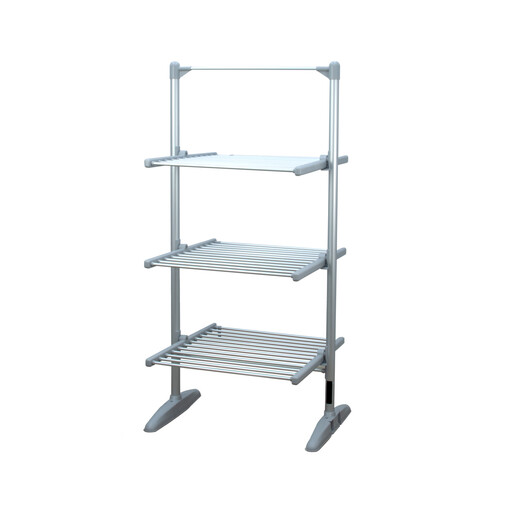
Status three-tier heated clothes airer

Status three-tier foldable heated airer, 248 W

Consider the tiered layout when towels need separate places to hang. The product name specifies 248 W and a foldable frame; check its open dimensions and usable rail space against your towels before choosing it.
View on Joybuy
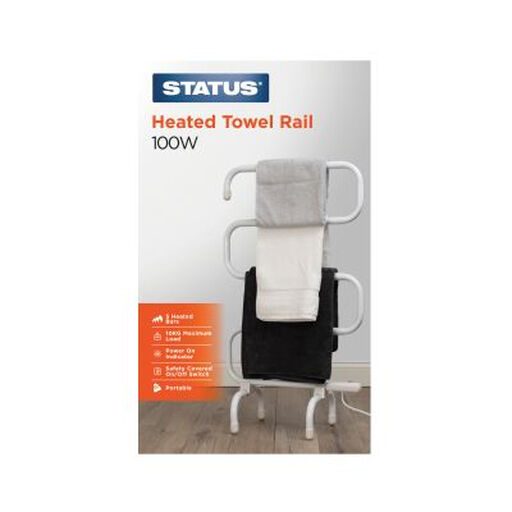
STATUS five-bar freestanding heated towel rail in white

STATUS five-bar freestanding heated towel rail, 100 W, white

This freestanding rail is worth considering for a smaller towel load. Its name specifies five bars and 100 W; check whether the bars leave enough room to hang your towels apart.
View on Joybuy
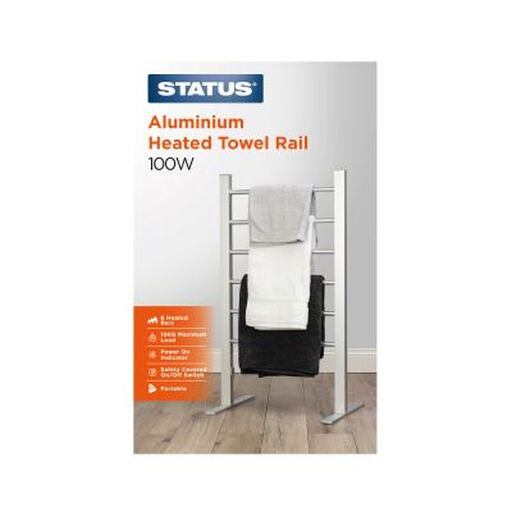
STATUS six-bar freestanding heated towel rail in silver

STATUS six-bar freestanding heated towel rail, 100 W, silver

For a smaller load, the six-bar layout offers another way to space towels on a freestanding rail. The product name states 100 W; confirm the rated power on the model documentation if comparing electricity use, and check the rail dimensions before purchase.
View on Joybuy
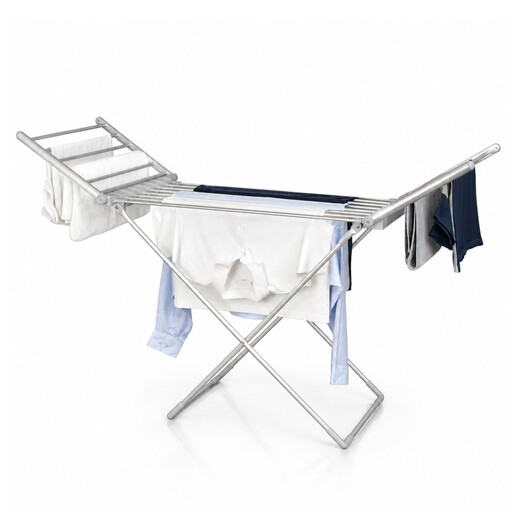
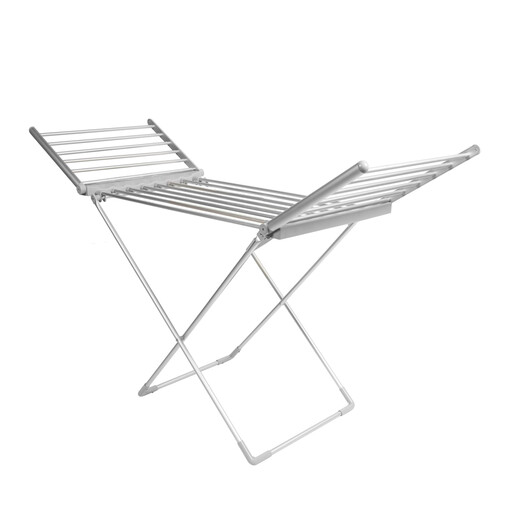
STATUS 230 W winged heated clothes airer in silver

STATUS foldable winged heated airer, 230 W, silver

Consider this winged rail if folding it away matters more than accommodating a large towel load. Its Joybuy listing states 20 heated bars and a 15 kg maximum load; check the open dimensions so towels can be spread out rather than crowded.
View on Joybuy
Pifco three-tier winged heated airer

Pifco three-tier winged heated airer

The three-tier winged format is relevant when you want more positions for towels than a short freestanding rail offers. Check its usable drying length, open footprint and supplied cover instructions before deciding how to arrange a towel load.

View on Joybuy

Questions about towel drying

What type of heated airer should I use for several bath towels?

Start by looking at tiered airers with enough drying length to hang the towels apart. Lakeland specifies 21 m for its covered three-tier bundle and Minky Homecare specifies 23 m for its covered four-tier model; their stated load limits are not promises of drying speed. Check the open footprint as well as the towel spacing.

Will a heated airer stop condensation?

No: drying towels still releases moisture indoors, even under an airer cover. GOV.UK’s existing-home ventilation guidance advises that moisture can become trapped without effective ventilation, so keep the room’s intended ventilation open and follow your home’s ventilation instructions.

Can I put a portable heated airer in the bathroom?

Plan to use it in a dry, ventilated room instead of powering it with a bathroom extension lead. Electrical Safety First warns against extension leads for appliances in bathrooms without suitable sockets; follow the airer’s instructions and keep electrical parts away from water.

How do I compare electricity use between heated airers?

Compare the rated power and the hours needed for your actual towel load, rather than wattage alone. As Uswitch explains, a 300 W appliance uses 0.3 kWh in one hour of continuous operation; multiply the energy used over the session by your own electricity unit rate, and include any dehumidifier you run alongside it.

What safety checks should I make before buying?

Identify the exact model, read its load and use instructions, and check official product-safety alerts or recalls. The Office for Product Safety and Standards reported a serious fire risk from insecure wiring in one Mini 3 Tier Electric Heated Airer, model K130/SKU UK10529; that model-specific alert is not a finding about all tiered airers.