Small-flat cover dryers
If the airer must fit around furniture and be put away after use, compare its fully open dimensions with its folded size. A long drying rail is little help if the frame blocks the space where you intend to use it.


Choose a heated airer by its open footprint and the space available to spread out your cushion covers, not by total rail length alone. A compact X-frame suits tight storage, a covered winged frame needs more width, and a tall tiered frame makes more sense for mixed laundry loads. Whichever format you choose, check the cover’s care label and plan how the room will be ventilated.
If the airer must fit around furniture and be put away after use, compare its fully open dimensions with its folded size. A long drying rail is little help if the frame blocks the space where you intend to use it.
If turnaround between washes matters, look for room to spread the fabric and, where appropriate, a cover made for the exact airer. You will still need to ventilate the room.
If cushion covers go in the wash with clothes or towels, a tiered frame offers more rails within a relatively square footprint. Check that you can reach and space items across its levels.
Start with the space the airer can occupy while open, then decide whether spreading out individual covers or accommodating a mixed load matters more.
Choose it when: You need a small open footprint, accessible flat-drying space and a frame that folds almost flat.
Allow for: Less rail length than the cited tiered examples; measure your largest cover before assuming it will lie flat.
Choose it when: You have room to open the wings and want a cover supplied for that frame.
Allow for: A wide span in use. The cited Minky Wing opens to 148 cm across.
Choose it when: Floor width is limited but you regularly dry covers alongside other laundry.
Allow for: Greater height and less uninterrupted space for spreading a large cover across one level.
| Concern | What to check | Who this matters to |
|---|---|---|
| Open footprint and storage | Compare fully open height, width and depth with the drying spot, then check folded dimensions against the storage space. | If I have to move furniture each time or cannot put the frame away afterwards, I need its size to work in both places. Around 42% of consumers may put space and storage first. |
| Room to dry covers | Check how a cover can be spread across the rails, and whether any supplied or compatible airer cover is permitted by the instructions. | When I need a clean cushion cover ready between washes, I want to avoid bunching wet fabric into thick layers. Around 33% of consumers may prioritise that drying arrangement. |
| Mixed-load capacity | Check the stated load limit alongside rail layout and access between tiers; rail length alone does not show how a large cover will fit. | If I wash covers with everyday laundry, I need enough accessible space for both without crowding the rails. Around 25% of consumers may make mixed-load capacity their main concern. |
A tiered airer can offer more rail length in a square footprint, while a winged frame needs width when fully open. Either could obstruct a small room if judged by rail length alone.
Measure the intended drying position, access around it and storage spot. Compare those measurements with the product’s open and folded dimensions.
Wet fabric still releases moisture into the room. GOV.UK advises that moisture trapped without effective ventilation can become condensation.
Use the room’s intended ventilation and keep vents unobstructed. Do not position the airer where damp air will be trapped behind furniture.
Electrical Safety First warns that overloaded extension leads and adaptors can overheat, and advises against daisy-chaining them.
Position the airer so its supplied lead reaches a suitable wall socket where possible. If an extension is necessary, follow the airer and extension instructions, check its rating and fully unwind any cable reel.
A wattage rating describes power input, not how quickly a particular cushion-cover fabric will dry. Loading, spacing and room conditions also matter.
Use the rating and your electricity unit rate to assess energy use, then check that the frame lets you hang the covers without dense folds.
Minky has covered winged and larger tiered heated-airer models for different loading layouts.
Its heated-airer formats include an X-frame suited to buyers comparing open footprint with folded storage.
Lakeland’s range includes a Mini 3-tier airer intended for tighter spaces as well as larger tiered formats.
The cited EcoDry model is a tall, covered 3-tier option for a comparatively square floor area.
Its cited 3-tier heated airer is relevant to consumers drying cushion covers as part of larger loads.
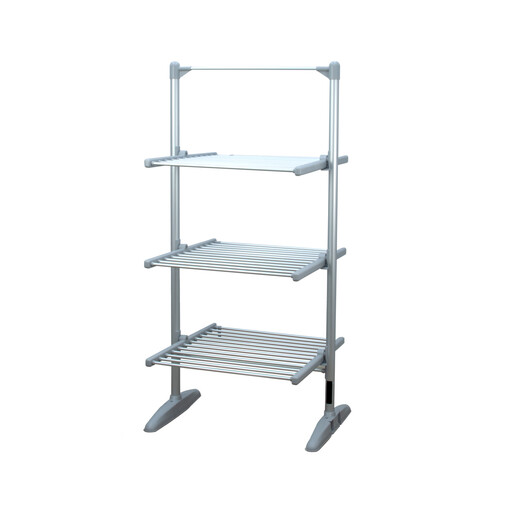
This tiered heated airer is worth considering if you dry cushion covers alongside other laundry and have room to open and load a three-level frame. Measure your drying and storage spaces before choosing it.
 No image available
Consider this three-tier frame for covers dried alongside other laundry if its open dimensions fit your room. It folds for storage and has a 248 W rating; follow its instructions, which say not to cover the heated bars during operation.
No. Cushion covers still release moisture as they dry, and GOV.UK advises that moisture can become trapped without effective ventilation. Use the room’s intended ventilation and keep fitted vents unobstructed.
Choose a cover only when it is supplied for, or explicitly compatible with, the exact frame and its instructions permit use. Check this model by model: the cited Minky Wing includes a cover, while the Status airer shown here instructs users not to cover its heated bars during operation. An airer cover does not replace room ventilation.
Divide its rated watts by 1,000 to get kilowatts, then multiply by the hours used to estimate kilowatt-hours. For example, a 300 W rating corresponds to 0.3 kWh over one hour of operation; your electricity unit rate determines the associated charge. This calculation does not predict drying time.
Check that the supplied plug and stated voltage suit your home, and follow the airer’s instructions. Use a suitable wall socket where possible; Electrical Safety First warns against overloading or daisy-chaining extension leads.