Small-flat cover dryers
If drying covers takes up a useful part of your room, check the airer’s open width and depth, height and folded depth before comparing its total drying capacity.


For cushion covers in a room with little floor space, start with a vertical tiered airer whose open footprint, height and folded depth fit the space. If a cover needs to lie flat, choose a model that explicitly supports flat drying; a hanger-based pod is an option only when the cover can hang without losing its shape. A cover, timer or lower stated wattage does not, by itself, establish how quickly the cover will dry.
If drying covers takes up a useful part of your room, check the airer’s open width and depth, height and folded depth before comparing its total drying capacity.
If covers take a long time to dry in damp or cool conditions, consider the rack layout, a compatible cover and any timer. Do not assume that all heated racks will dry the same load at the same speed.
If stretching, creasing or uneven drying is a concern, read each cover’s care label and look for a layout that accommodates it. Where flat drying is needed, check that the airer is stated to support it.
Check the cushion cover’s care label before choosing a drying layout, then measure the space the airer will occupy while open. Features intended to help with indoor drying matter only if the cover can be arranged with enough room around it.
| Concern | What to check | Who this matters to |
|---|---|---|
| Footprint and storage | Measure the open width, depth and height, including room to pass the rack. Compare folded depth with the intended storage gap. | I need to walk past the airer while covers dry and put it away afterwards; for around 42% of consumers, footprint and storage clearance would be the primary concern. |
| Indoor drying time | Check whether a compatible cover is included or available and how it is ventilated. Compare timer settings and rated wattage without treating either as a drying-time result. | When thick seams take longer to dry indoors, I want air to circulate around the covers rather than relying on heat alone; around 33% of consumers would put drying time first. |
| Fabric care and layout | Read the cover’s care label, check any stated flat-drying use and assess whether the cover fits without bunching or exceeding the rack’s load claim. | If hanging could distort a cover, I need a layout that lets me follow its care instructions; for roughly 25% of consumers, fabric handling would come first. |
A narrow stored rack can still take up substantial floor space when open. the Minky Wing airer is listed at 148 cm wide when open, illustrating why a winged layout needs its own space check.
Mark out the listed open dimensions in the intended room, allowing for doors, walking space and access to the covers.
Lakeland recommends a separate custom cover for its Dry:Soon Deluxe 3-Tier airer, while Dunelm lists a two-tier bundle with a cover that has a mesh bottom. Inclusion and ventilation are model-specific.
Check whether a cover comes with the exact airer and follow the maker’s instructions for fitting it and allowing airflow.
A stated load limit or total rail length does not show whether a particular cushion cover can lie or hang without bunching. Which? assesses drying speed, running costs, stability, capacity and floor-space efficiency as distinct measures.
Choose a layout that follows the cover’s care label, leave space between wet items and compare power use alongside the time you expect to run the airer.
The UK Office for Product Safety and Standards issued a January 2025 recall for a particular Dunelm Heated Winged Airer. That notice does not apply to every Dunelm airer.
Check the exact model or article number against current safety notices, inspect the plug and cable, and follow the supplied operating instructions.
Lakeland’s Dry:Soon range includes tiered racks and a hanger-based drying pod. The distinction matters if a cushion cover needs to lie flat rather than hang.
Dunelm lists vertical two-tier and three-tier heated airers for consumers comparing how much drying space fits within a contained floor rectangle.
Minky’s Sure Dri four-tier covered airer is relevant when a stated flat-drying option matters more than keeping the rack as low as possible.
This three-tier winged heated airer is an option to assess if your cushion covers can be dried on a rack. Check the space needed with its wings open and whether its layout follows each cover’s care label.
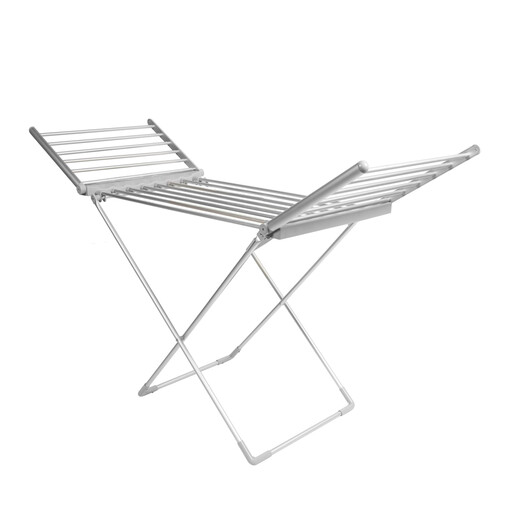 Image unavailable
Consider this three-tier winged format if the cover’s care label permits rack drying. Confirm the open floor dimensions and overhead clearance, and check how the particular cover would sit on the bars before choosing it for shape-sensitive fabrics.
Measure its open width and depth as well as its height. Lakeland and Dunelm list researched vertical models with open floor rectangles ranging from 73.5 × 67 cm to 72 × 78 cm and heights from 132.5 cm to 147 cm; the right fit also needs clearance for doors, walking past and loading covers.
Follow the care label of the particular cover. If it calls for flat drying, choose an airer with stated flat-drying suitability and enough usable space; the Minky Sure Dri 23m 4 Tier model is described as suitable for flat drying. A hanger-based pod is an option only if the cover can hang without distortion.
Multiply the airer’s rated power in kilowatts by the hours you expect to use it, then by your electricity tariff. Dunelm lists 220 W and 330 W tiered models, while the Minky Sure Dri four-tier model is listed at a maximum of 300 W; wattage alone does not tell you how long your covers will take to dry.
Stop using the affected model. In its January 2025 recall, the UK Office for Product Safety and Standards instructed consumers with the identified Dunelm Heated Winged Airer to stop using it immediately and return it to a Dunelm store for a full refund. Match your airer’s exact identifiers to the notice rather than applying it to other Dunelm models.