Frequent face-cloth dryer
If you wash a few cloths regularly, look for enough space to spread them out and a frame you can put away after use.


For a few face cloths, choose a heated airer that fits both its drying spot and its storage space rather than judging it by rail length alone. A winged or compact vertical layout can suit small loads, depending on the room available; consider a covered multi-tier model if you also dry regular clothing loads. Drying indoors still adds moisture to the flat, so plan for ventilation.
If you wash a few cloths regularly, look for enough space to spread them out and a frame you can put away after use.
If the airer cannot stay out between loads, check its folded dimensions against the gap where you intend to store it. A narrow stored profile matters as well as rail length.
If windows collect condensation or the flat has recurring damp, consider how you will ventilate the room while drying. GOV.UK identifies indoor laundry drying as a source of household moisture.
Measure the open drying spot and the storage gap before comparing capacity. A vertical frame uses a different shape of space from an open winged airer, while extra tiers are more relevant if face cloths share the rack with regular laundry.
| Concern | What to check | Who this matters to |
|---|---|---|
| Open fit and storage | Check the open footprint, height and folded dimensions against your drying spot and storage gap. | With little room to leave a rack open, I need somewhere to dry cloths and somewhere to put the frame afterwards; around 33% of consumers would put fit and storage first. |
| Repeated small loads | Check that cloths can be spaced across the bars, and whether a compatible cover is included or needed. | When I wash cloths frequently, I want room to spread them out between uses; roughly 27% of consumers would make repeated-load drying their primary concern. |
| Useful capacity | Compare rail length and load limit with the whole load you normally dry, not just the maximum stated capacity. | If I wash only a few cloths, I do not want a large frame that sits mostly unused; around 20% of consumers would prioritise capacity suited to light loads. |
| Moisture and electrical use | Plan ventilation and follow the chosen model’s loading and electrical instructions. | If condensation already collects on my windows, I need to manage indoor moisture while using the airer safely; roughly 20% of consumers would put moisture and electrical use first. |
A long rail length does not tell you whether an open airer will fit a small room or whether its folded frame will fit your storage space.
Measure both positions, then choose capacity for your usual combined load of cloths and other laundry.
Moisture released as laundry dries remains in the room. GOV.UK identifies indoor laundry drying as a moisture-producing activity; a cover does not remove that moisture from the flat.
Use appropriate ventilation or extraction and address recurring condensation, damp or mould rather than relying on the airer alone.
Too many wet items can exceed the airer’s stated load limit, while Electrical Safety First warns against overloading extension leads.
Follow the exact model’s loading instructions, spread items evenly and avoid daisy-chaining extension leads. Fully unwind a cable reel if you use one.
A power rating alone cannot tell you when face cloths will dry. Beldray notes that drying time varies with fabric thickness and room temperature.
Check how cloths will be spaced and whether any cover is compatible with the exact model; do not choose on rated watts alone.
These product lines illustrate different layouts and capacities; compare the dimensions and included accessories of the particular model you are considering.
Lakeland’s Dry:Soon range includes tiered heated airers and accessories for indoor laundry drying.
Beldray’s winged heated-airer format is an alternative to a tiered frame when you have room to open its wings.
Minky’s covered, multi-tier format is more relevant when face cloths are part of regular mixed laundry loads.
Dunelm’s vertical and winged formats offer two different ways to fit an airer into a compact drying space.
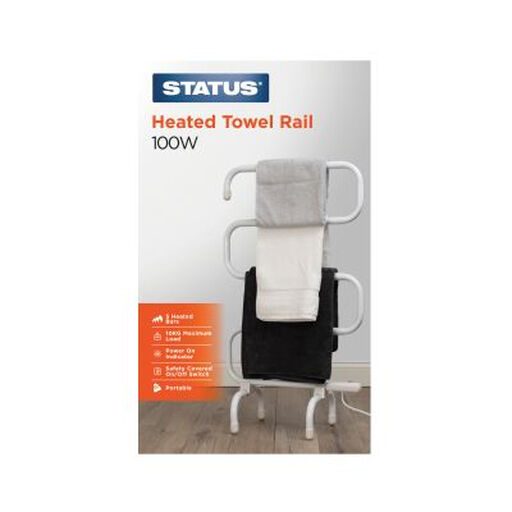
This freestanding heated towel rail is worth considering if you dry a few face cloths at a time. Check where it will stand and how you would store it between uses.
 No image available
Consider this freestanding towel rail for a small face-cloth load if you have a suitable place to leave it while in use. Check its dimensions and storage arrangement before ordering.
The product name specifies five bars, a 100W rating and aluminium construction.
Usually not if you dry only a few cloths at once. Choose enough room to spread out your typical load, and consider a larger tiered model if you also regularly dry clothing or other laundry; check its open and folded dimensions before buying.
No. A compatible cover can retain heat around the laundry, but the moisture released during indoor drying still needs to be managed. Use appropriate ventilation or extraction and investigate recurring damp or mould.
Place it on a stable, level surface and follow the exact model’s loading and cooling instructions. Remove excess water before hanging cloths, and do not overload or daisy-chain extension leads; any cable reel in use should be fully unwound.
They concern applicable product-market rules, not whether a particular airer fits your flat. GOV.UK guidance says CE marking continues to be recognised alongside or instead of UKCA marking under relevant Great Britain product regulations. Check the listing and product documentation for the model you intend to buy; rules for Northern Ireland differ.