For several bath towels alongside a family wash, start with a multi-tier heated airer whose stated rail space and load capacity suit what you dry together. A winged model offers fold-flat storage, while a compact towel rail makes more sense for a smaller towel rotation. Whichever format you choose, check its open footprint and instructions, and ventilate the room while towels dry indoors.
Who each format suits
Families drying several towels at once
If bath towels dry alongside other laundry, compare usable rail space and stated load rather than relying on the number of tiers. Lakeland lists a 21m three-tier Dry:Soon option, while Minky lists 21m three-tier and 23m four-tier formats.
Homes short on drying and storage space
A compact towel rail takes on a different job from a larger airer: drying a limited towel rotation. A winged airer can fold away between uses, but its fully open width still needs to fit the intended room.
Households managing indoor moisture
If towels regularly dry indoors, choose a position where ventilation can work effectively. GOV.UK guidance explains that moisture trapped in a poorly ventilated home can become condensation; heating an airer does not remove that moisture.
What to check before buying
Covered multi-tier airer
Choose when: Several towels need to dry alongside a regular family wash.
Trade-off: Larger rail-space options need room both on the floor and above the airer; a cover does not replace ventilation.
Winged airer
Choose when: You need space for several towels but want to fold the airer away afterwards.
Trade-off: Check its open width as well as its folded size; the cited winged models have less stated rail space than the 21m–23m multi-tier examples.
Compact towel rail
Choose when: The main job is drying a small number of towels and floor space is limited.
Trade-off: A compact rail should not be assumed to hold a family wash; check its usable rail space against your towel rotation.
Start with what must dry at the same time, then check where the airer can stand, how the room will be ventilated and how it will reach a suitable socket.
| Concern | Buying checks | Who this matters to |
|---|
| Towel capacity |
Compare stated drying space in metres and maximum load in kilograms; allow enough separate rail space for towels and any laundry dried with them. |
If several bath towels and a family wash need to dry together, I want room to spread them out rather than stack them. Around 36% of consumers put family-load capacity first. |
| Indoor moisture |
Choose a position where the home’s ventilation can work effectively; do not treat a cover as a moisture-extraction device. |
When towels dry indoors regularly, I need to manage condensation as well as find somewhere to hang them. For around 29% of consumers, moisture management is the primary concern. |
| Room and storage fit |
Measure the fully open height, width and depth, then check the folded size and cable route. |
I need the airer to fit a shared room while in use and somewhere to put it afterwards. Space and storage come first for around 21% of consumers. |
| Controls and socket access |
Check the exact model’s timer, rated power and cable reach; use a suitable socket without overloading an extension. |
If I expect to run the airer routinely, I want controls I can use and a safe way to connect it. Around 14% of consumers prioritise run-time control and electrical use. |
Mistakes to avoid
-
Treating load capacity as a drying-time promise
Rail metres and maximum load help you assess how much laundry an airer can hold, not when thick towels will be dry. The Minky Wing’s approximately 30-minute warm-up figure is time to full temperature, not drying time.
Use the capacity figures to plan towel spacing, and check the exact model’s controls and instructions instead of assuming a fixed drying duration.
-
Using a cover instead of ventilating
Drying laundry adds moisture indoors. GOV.UK guidance explains that, without effective ventilation, trapped moisture can lead to condensation, damp and mould.
Place the airer where ventilation can work effectively, keep trickle vents unblocked and address persistent damp rather than relying on the airer to resolve it.
-
Measuring only the folded airer
A fold-flat model still needs clear space when its wings are open. The Minky Wing example measures H94 × W148 × D54cm when open.
Measure both the drying spot and the storage spot, allowing for normal movement through the room and a safe cable route.
-
Stretching an overloaded extension arrangement to the airer
Electrical Safety First warns against overloading extension leads and connecting one extension lead to another.
Use a suitable wall socket where practical. If an extension is necessary, check its marked rating, do not daisy-chain leads and fully unwind a cable reel before use.
Relevant brands to compare
Dry:Soon
Lakeland’s Dry:Soon range includes compact towel-airer and larger multi-tier formats, as well as drying pods and a cabinet format.
- Lakeland lists a Deluxe three-tier option with 21m of drying space and a stated 15kg load.
- The cited compact towel-airer example has 2.7m of rail space and a stated 6kg load; it is marked discontinued, so compare current models on their own specifications.
Minky
Minky lists winged, three-tier and four-tier heated-airer formats.
- Minky’s range listing includes 21m three-tier and 23m four-tier sureDRI options, while a 12m Wing model comes with a cover.
- That Wing model has an open width of 148cm; check the dimensions of the particular model against your available space.
Tower
Tower’s T25003 is a covered winged heated airer for households considering fold-flat storage.
- Tower lists 12.6m drying space, a stated 15kg capacity and an included thermal cover for the T25003.
- Its stated rail space is less than the cited 21m–23m multi-tier options, so compare how many towels need separate space at once.
Heated airers and towel rails on Joybuy
These choices cover a three-tier airer, a foldable winged airer and a freestanding towel rail. Match the format to the number of towels you dry together, then confirm its usable rail space and room fit before buying.
 No image available
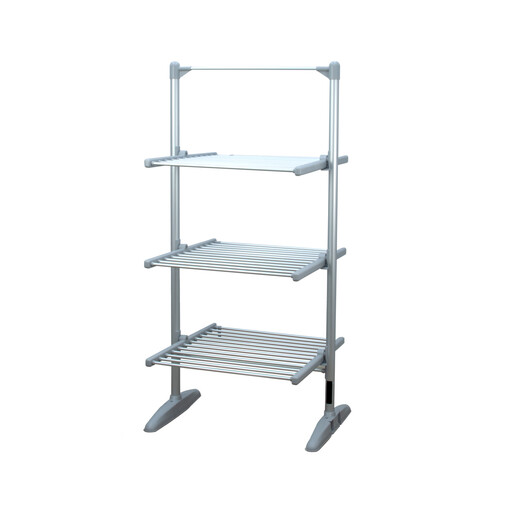
Status 248W Three-Tier Foldable Heated Airer
Consider this three-tier format when towels need to dry alongside other household laundry. The product name states 248W; check the usable rail space and open and folded dimensions against your routine. Follow the product instruction not to cover its heated bars during operation.
View on Joybuy
 No image available
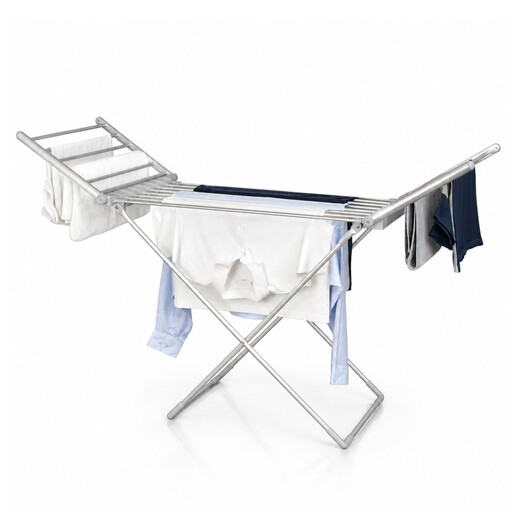
STATUS 230W Foldable Heated Airer with Wings
Consider the winged format if you need space for towels but want to fold the airer away after use. The product name states 230W; check its open footprint, storage fit and usable rail space. Follow the product instruction not to cover its heated bars during operation.
View on Joybuy
 No image available
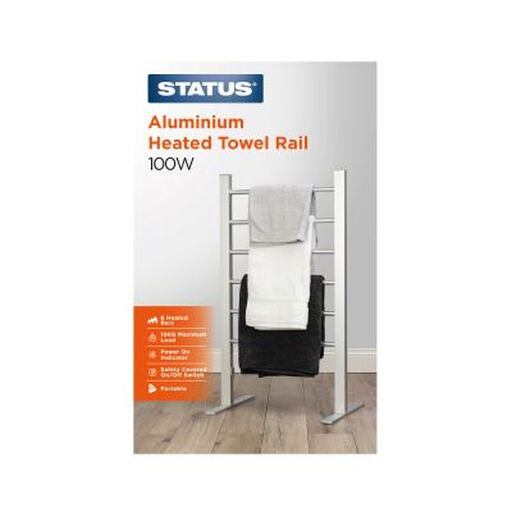
STATUS 100W Freestanding Six-Bar Heated Towel Rail
Consider this freestanding towel-rail format for a smaller rotation of towels rather than assuming it will hold a family wash. Its title says 100W; confirm the detailed power rating before comparing electricity use, and check the rail space and dimensions against your towels and room.
View on Joybuy
Common questions
How large should a heated airer be for a family’s bath towels?
Start with how many towels and other items must dry at once, then compare usable rail space and stated maximum load. Lakeland’s cited compact towel airer has 2.7m of drying space and a stated 6kg load, while Lakeland and Minky list multi-tier examples with 21m–23m of space. For towels alongside a family wash, a multi-tier format is the more relevant starting point if it fits your room.
Does a heated airer cover remove the need to ventilate?
No. GOV.UK guidance explains that indoor moisture can become trapped without effective ventilation and lead to condensation. Use the home’s ventilation while drying towels, keep trickle vents unblocked and do not treat a cover as a moisture-extraction device.
Can I use an extension lead with a heated airer?
Use one only if its marked rating suits the connected load and you can avoid an overloaded arrangement. Electrical Safety First advises against daisy-chaining extension leads; fully unwind a cable reel and use a suitable wall socket where practical.
Which product marking should I check in Great Britain or Northern Ireland?
Check the marking applicable to where the electrical equipment is supplied. GOV.UK’s March 2026 product-marking guidance lists UKCA or CE for electrical equipment in Great Britain, and CE, or CE alongside UKNI where applicable, in Northern Ireland. Also check the exact appliance’s instructions and suitability for your intended use.


