For regular family loads, start with a three- or four-tier heated airer, then check that your longest dresses can hang without bunching. A winged airer may suit lighter loads, but neither a cover nor heated rails remove the need to ventilate the drying room.
Who needs which layout?
Families drying substantial loads indoors
If several people’s laundry must dry at once, compare usable drying length, the stated load limit and the space the airer occupies when open. A compact rack may be easier to put away but offer fewer places to hang clothes.
Households drying longer dresses
For a summer dress, rail spacing and hanging clearance can matter more than total drying length. Check the garment’s care label before deciding whether to hang it or use a suitable flat-drying arrangement.
Households managing space and moisture
An airer needs a practical place to stand while in use and somewhere to store between loads. Indoor drying also releases moisture into the room, so ventilation belongs in the plan.
What matters when choosing?
Three- or four-tier airer
Consider it when: Several family members’ clothes need drying together.
Allow for: Its open footprint and limited clearance between some tiers; check whether a cover is included and permitted for the model.
Winged airer
Consider it when: Loads are lighter and you want individual rails for hanging garments.
Allow for: Less drying length than the 21–23m tiered models described by Lakeland, depending on the winged model chosen.
Drying pod
Consider it when: The usual load is a small batch of everyday clothes.
Allow for: Which? describes pods as lower-capacity options that are unsuitable for bedsheets or duvets, limiting their usefulness as a family’s main drying setup.
| Concern |
What to check |
Who this matters to |
| Family-load capacity |
Compare drying length in metres and the stated load limit in kg; check the open footprint as well. |
When several people’s clothes need drying together, I want enough rails without exceeding the frame’s load limit. Around 29% of consumers put family-load capacity first. |
| Dress handling |
Read the garment care label, then check hanging clearance and whether a suitable flat-drying option is available. |
If my longest dress bunches against a lower tier, total rail length will not solve the problem. Roughly 23% of consumers prioritise dress handling. |
| Room and storage fit |
Measure the airer open and folded, leaving room to move around it and reach a suitable socket. |
I need the rack to fit the drying room and have a place to go between washes; around 18% of consumers make room and storage fit their primary concern. |
| Electricity use |
Compare rated power in watts alongside the time needed to dry your usual load; wattage alone does not establish total electricity use. |
When I run an airer repeatedly, I care about how long each load takes as well as its power rating. Approximately 18% of consumers put electricity use first. |
| Indoor moisture |
Choose a stable, dry position where the room’s ventilation can remain effective. |
With laundry drying indoors regularly, I need moisture to leave the room rather than collect as condensation; around 12% of consumers prioritise moisture management. |
Buying pitfalls
-
Choosing by drying length alone
A 21m or 23m figure describes total drying space, not the vertical clearance available to a long dress between tiers.
Measure your longest dress and compare it with the open height, rail layout and any movable arms before ordering.
-
Assuming a cover comes with every tiered airer
The researched Minky and BLACK+DECKER models include covers, while the cover for its cited three-tier model is described as separate. Bundles differ.
Check what the exact product includes and follow its instructions on whether and how a cover can be used.
-
Expecting heated rails to control room moisture
Drying clothes releases moisture into indoor air. GOV.UK guidance explains that ineffective ventilation can allow moisture to become trapped and cause condensation.
Keep installed ventilation usable and address persistent damp rather than relying on the airer to manage it.
-
Judging electricity use by wattage alone
A lower power rating does not establish how much electricity a completed load will use if the airer needs to run for longer.
Consider rated watts together with the running time for your usual load and drying conditions.
Brands to consider for these layouts
Dry:Soon
Lakeland’s Dry:Soon range includes several three-tier formats. Its standard three-tier model is described as holding approximately two wash loads.
- Lakeland states 21m of drying space, a 15kg load limit and an 8cm folded depth for the standard model.
- Check the exact bundle: a compatible cover or flat-drying accessory should not be assumed to come with every base unit.
Minky
Minky has winged and tiered heated-airer formats relevant to different load sizes.
- The Minky Sure Dri four-tier model is listed with a cover, 23m of drying space and a stated 20kg capacity.
- Its listed 147cm open height and 15.5cm closed depth need checking against the drying room, storage space and longer dresses.
Status
The researched three-tier airer offers a straightforward tiered layout for household laundry.
- The product title identifies a foldable aluminium three-tier design with a 248W rating.
- Confirm the open size, folded depth and usable hanging clearance against your room and storage spot.
BLACK+DECKER
The researched BLACK+DECKER 63099 three-tier model is relevant when longer garments need a more flexible hanging arrangement.
- B&Q describes swivel arms for longer items, including dresses, and lists a cover and wheels with the model.
- Its listed 140cm height does not establish clearance for every dress; compare the garment length with the usable rail arrangement.
Joybuy heated airers
These tiered and winged options offer different arrangements for indoor family laundry. Before choosing one for summer dresses, check the clearance your garments need and follow the individual airer’s instructions.
 No image available
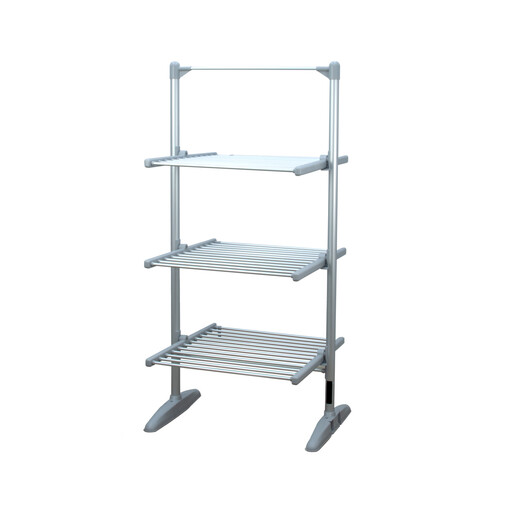
Status Three-Tier 248W Heated Clothes Airer
Consider this tiered layout for recurring household loads if its open size and rail spacing suit your room and dresses.
The listing states a 30kg maximum load, 30 heated bars, a 248W rating and fold-flat storage. Check the open dimensions and usable hanging clearance before choosing it for longer garments.
View on Joybuy
 No image available
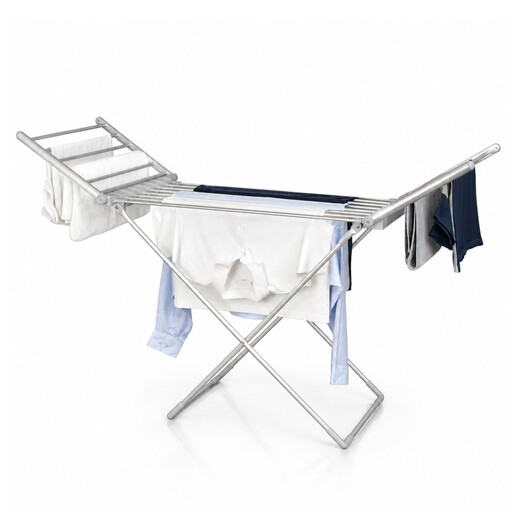
STATUS 230W Winged Heated Clothes Airer – Silver
The winged arrangement is worth considering for lighter loads when individual hanging rails matter more than a tiered layout.
The listing states a 15kg maximum load, 20 heated bars and fold-flat storage. Check its open dimensions and dress clearance. Its instructions say not to cover the heated bars while in use.
View on Joybuy
 No image available
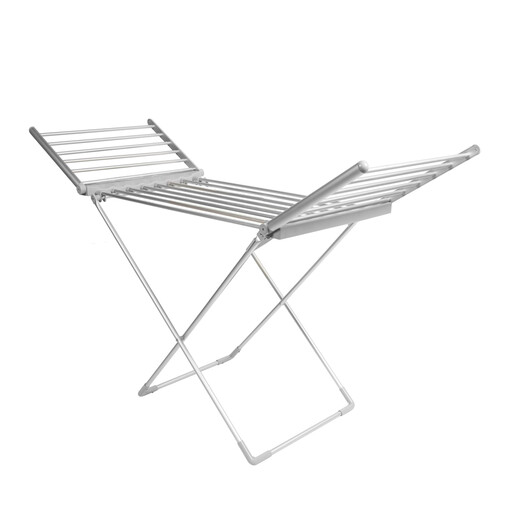
Pifco Three-Tier Winged Heated Airer
Consider this format if you want both tiers and wings, provided the arrangement gives your dresses enough hanging clearance.
The listing states a 12kg capacity, 20 heated bars and folded dimensions of 11.3 × 54.0 × 54.0cm. It describes an included fabric cover but also cautions against covering the airer completely; check the intended arrangement and follow the instructions.
View on Joybuy
Common questions
Can I dry summer dresses on a heated airer?
Yes, if the dress’s care instructions permit the drying method and the airer gives it suitable space. For a long dress, check usable hanging clearance rather than relying on total drying length; B&Q describes the BLACK+DECKER 63099’s swivel arms as suitable for longer items, including dresses.
Do I need a cover for a three-tier airer?
Not necessarily: A researched three-tier airer can be used without a cover, although a compatible cover can concentrate warmth around the clothing. Check whether one is included with your exact model and whether its instructions permit its use.
Does a heated airer mean I can keep the room closed up?
No. Drying laundry adds moisture to indoor air, and GOV.UK guidance warns that ineffective ventilation can trap that moisture and lead to condensation. Keep the home’s installed ventilation usable while drying.
Does a 300W airer always use more electricity per load than a lower-rated one?
Not necessarily. A 300W rating describes power while the airer is running; electricity used for a completed load also depends on how long it runs. Compare the rating alongside drying time for the loads you normally wash.


