For a few hand towels washed frequently, start by considering a compact winged or foldable heated airer that you can put away between loads. A covered dryer is worth considering if you prefer an enclosed setup, while a larger tiered airer makes more sense when it will regularly take household laundry too. Whichever format you choose, check its open size, storage space, socket reach and how you will ventilate the room.
Who is this for?
Frequent hand-towel washers with little space
If you dry a small towel load repeatedly, an airer you can set up and put away may matter more than room for a full wash. Measure both its open footprint and its storage space, and check that the cable reaches a suitable socket.
Households needing towels ready again sooner
If turnaround matters, you may be considering a compatible cover or an enclosed dryer. Check how towels hang inside it and keep the utility room ventilated: an enclosure does not remove moisture from the room.
Utility-room users drying mixed loads
If the same airer will regularly hold clothes as well as towels, compare usable drying space and the stated load limit alongside its height, open footprint and folded size.
What matters when choosing?
For a utility room used mainly for hand towels, decide how often the airer must handle other laundry before choosing its size. Compact open rails, enclosed dryers and larger tiered airers solve different space and loading problems.
Compact winged or foldable airer
Consider it: When a few hand towels are the usual load and the airer needs to be put away between washes.
Trade-off: Wings need clear floor width when open, even if the airer folds flat for storage.
Covered airer or drying pod
Consider it: When you prefer towels to hang inside a more contained setup rather than across accessible open rails.
Trade-off: A cover must fit its intended airer, and neither a cover nor a pod replaces room ventilation.
Three- or four-tier airer
Consider it: When the appliance will regularly dry household washing as well as hand towels.
Trade-off: The extra hanging positions come with a taller appliance to accommodate and store.
| Concern |
What to check |
Who this matters to |
| A small, stowable airer |
Measure the available floor and storage space; compare open and folded dimensions and cable reach. |
I wash just a few hand towels at a time and need the airer out of the way afterwards. Around 36% of consumers put a compact, stowable setup first. |
| Moisture indoors |
Check that room ventilation works and remains unobstructed; use only a cover designed for the airer. |
If towels dry indoors regularly, I do not want moisture trapped in the utility room. Roughly 29% of consumers prioritise managing that moisture. |
| Room for other laundry |
Compare drying space, maximum load and the height and depth of the open airer. |
I need the same appliance for towels and wider household washing, not just a small rotation. Around 21% of consumers put mixed-load capacity first. |
| Electricity use and placement |
Check rated wattage and socket reach; plan a dry, stable position without an overloaded extension setup. |
I want to account for how long I will run a plug-in airer and where I can connect it safely. Approximately 14% of consumers make electricity use and placement their primary concern. |
Buying pitfalls
-
Buying a large tiered airer for only a few hand towels
A tiered airer offers more hanging space, but its height and storage needs may be disproportionate to a small towel rotation.
Check how many towels you normally dry together. Choose the larger format when you will use its extra space for other laundry as well.
An unnecessarily large airer can occupy utility-room floor or storage space that you need for something else.
-
Expecting a cover to deal with room moisture
Drying towels still releases moisture into the room. GOV.UK guidance warns that, without effective ventilation, trapped moisture can contribute to condensation and mould.
Use a cover made for the airer, leave its vents clear and keep the utility room ventilated.
-
Judging electricity use from wattage alone
Rated watts describe power input, not how long a particular towel load will need. Towel thickness, spacing and room conditions also matter.
Compare each model’s rated power alongside how you expect to use it; do not treat a lower wattage as proof of lower electricity use for a completed load.
-
Using an overloaded or chained extension setup
Electrical Safety First warns that overloaded extension devices can overheat and advises against plugging one extension lead into another.
Use a suitable wall socket where practical. If you need an extension device, follow its marked rating and fully unwind a cable reel.
Brands to consider for this use
Dry:Soon
Lakeland’s Dry:Soon range is relevant if you want to compare compact and tiered airers with covered or enclosed formats.
- Lakeland describes its Mini three-tier airer as a choice for tighter spaces and also offers a drying pod that circulates heated air around hanging items.
- Check cover compatibility by model; Lakeland’s Standard two-tier cover has mesh vent panels, but it should not be assumed to fit another airer.
Daewoo
Daewoo has both a compact foldable airer and a larger three-tier model, giving shoppers two distinct load sizes to assess.
- Daewoo Electricals lists 6m of drying space and a 10kg maximum load for its foldable airer, compared with 20m and a 30kg maximum load for its large three-tier model.
- Those are stated specifications, not a comparison of drying time. Check the exact model’s dimensions against your utility room.
Minky
Minky is relevant if you are considering a covered, multi-tier airer for towels and other laundry.
- The Minky Sure Dri model with a cover is listed with 23m of drying space across four tiers.
- Consider whether a four-tier format suits your usual load if you mainly dry a few hand towels.
JML
JML’s DriBUDDI Compact is an enclosed alternative to spreading towels over open rails.
- An included cover, a 10kg drying capacity and a 1.4m cable are listed for this model.
- Check how your towels will hang inside it: an enclosed layout cannot be assessed by comparing its stated drying-space figure directly with open-rack rail lengths.
Joybuy products for this use
These heated towel rails and clothes airers offer different ways to dry hand towels in a utility room. The tiered models are more relevant if you will also use the appliance for larger laundry loads; check each product’s size and socket reach against your space.
 No image available
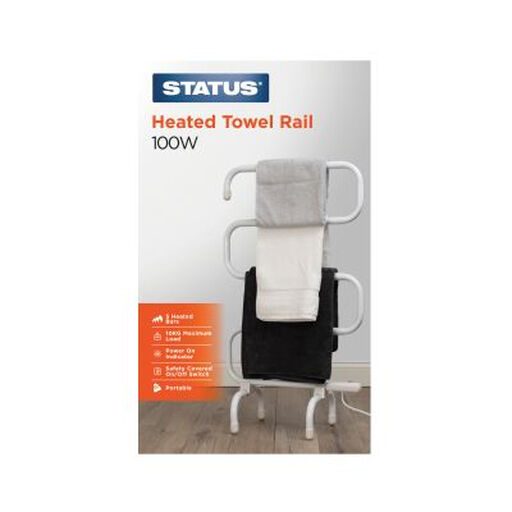
STATUS 100W Free-Standing Aluminium 5-Bar Heated Towel Rail – White
Consider this free-standing rail if hand towels, rather than a full laundry load, are your main use. Check that your towels fit with space between them and that the rail and its cable suit your chosen position; use it on a dry, stable surface and ventilate the room.
Joybuy
 No image available
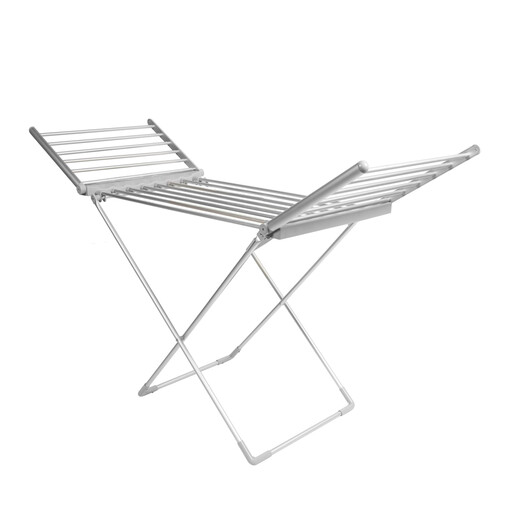
Pifco 3-Tier Winged Heated Airer
Consider the three-tier format if towels are part of a wider household laundry load. Check its open and folded dimensions against the utility room before choosing a larger airer for only a few hand towels, and keep the room ventilated during use.
Joybuy
 No image available
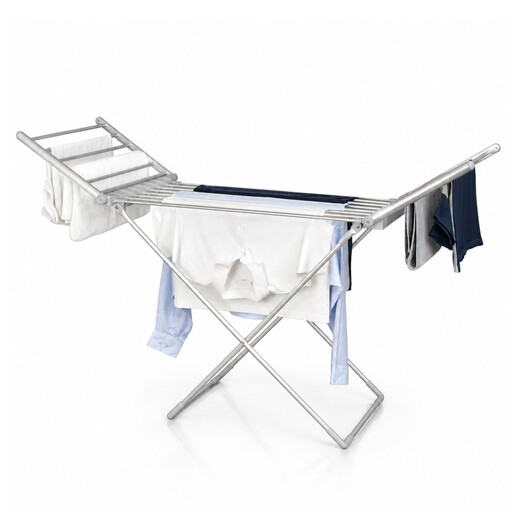
STATUS 230W Foldable Aluminium Heated Clothes Airer with Wings – Silver
This winged format is worth considering if you want an airer for towels and other laundry that folds away afterwards. Check its open and folded fit, cable reach and the room’s ventilation before choosing where to use it.
Joybuy
 No image available
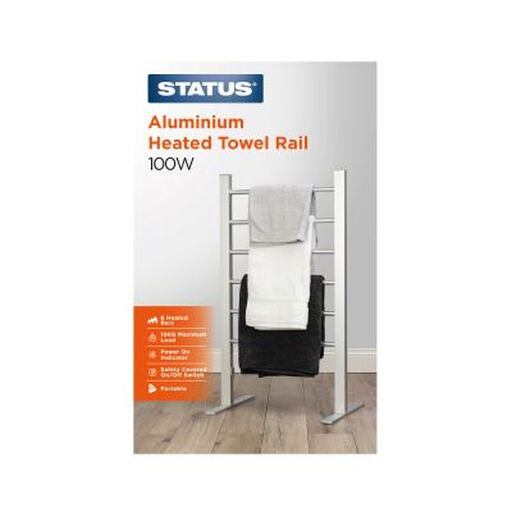
STATUS Free-Standing Aluminium 6-Bar Heated Towel Rail – Silver
A free-standing rail is a direct option for a small towel load when you have a dry, stable place to put it. Check its dimensions, cable reach and rated power for this six-bar variant before deciding whether it fits your room and usage.
Joybuy
 No image available
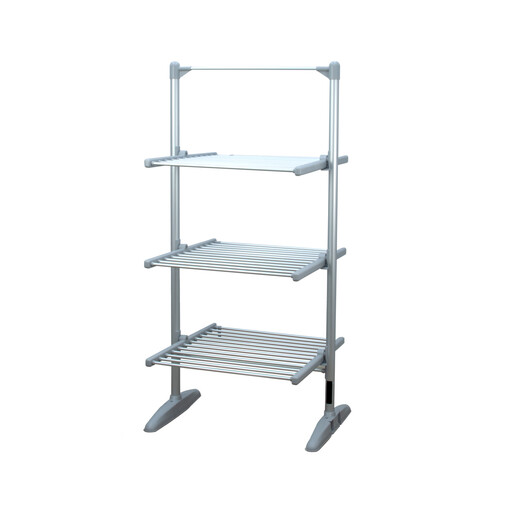
Status 248W Foldable Aluminium 3-Tier Heated Clothes Airer
Consider this three-tier airer when the appliance will regularly handle household laundry alongside hand towels. Confirm its open and stored dimensions and cable reach so the larger format works in your utility room, and ventilate the room while drying.
Joybuy
Frequently asked questions
What size heated airer do I need for a few hand towels?
Start with a compact format and check whether your usual towels can hang with space between them. For context, Daewoo Electricals lists 6m of drying space for one foldable airer, while an own-brand winged model is listed at 11m; those figures do not tell you how many of your towels will fit comfortably. A larger tiered airer is more useful if it will also take other laundry.
Does a heated-airer cover mean I can stop ventilating the utility room?
No. A compatible cover changes the drying enclosure, but moisture from the towels can still enter the room. GOV.UK guidance warns that moisture trapped without effective ventilation can contribute to condensation and mould, so keep room ventilation working and the cover’s vents clear.
Can wattage tell me how much electricity an airer will use?
Wattage tells you the airer’s rated power input, but electricity used over a drying session also depends on how long it runs. Compare the rating of the exact model and allow for differences in towel thickness, spacing and room conditions rather than assuming a fixed drying time.
Can I use an extension lead for a heated airer?
Use a suitable wall socket where practical. If an extension device is needed, Electrical Safety First advises keeping within its marked rating, not chaining extension leads and fully unwinding cable reels. Position the airer on a dry, stable surface away from water and follow its instructions.


