Frequent-changeover hosts
If several removable covers need washing between stays, usable rail space matters: the covers need room to hang apart rather than being stacked on a stated load capacity.


For repeated cushion-cover loads, compare multi-tier airers by how many covers you can spread out in the available room, rather than choosing by the stated weight limit alone. A compact tower is worth considering when storage is tight, while a winged rack may suit smaller, occasional loads. Whichever format you choose, indoor drying needs effective ventilation, and an airer supplied for use in a holiday let needs appropriate electrical-safety management.
If several removable covers need washing between stays, usable rail space matters: the covers need room to hang apart rather than being stacked on a stated load capacity.
A small utility room or narrow storage gap makes both the open footprint and folded size important. Check the airer in its working position, not just how neatly it folds away.
In a condensation-prone property, the drying location and its ventilation matter alongside the airer. GOV.UK advises that moisture can become trapped indoors without effective ventilation.
Choose a format that fits the size and frequency of your cover loads, then check its rail layout against the room where it will actually be used.
Consider it: When several covers need space between changeovers and a ventilated drying room can accommodate the open frame.
Allow for: The room it occupies; a cover does not remove moisture from indoor air. Check whether the cover is supplied and permitted by that model’s instructions.
Consider it: When covers are washed in smaller batches and storage space is the main constraint.
Allow for: Less room to separate large covers. Lakeland states 13m of drying space for its Dry:Soon Mini; check the actual rail layout against your covers.
Consider it: When cover washing is occasional and a folding rack suits the available drying space.
Allow for: A different arrangement of rails from a tower; check whether the opened wings leave enough clearance to hang covers apart.
| Concern | What to check | Who this matters to |
|---|---|---|
| Cover space and turnaround | Compare rail layout and drying length with your largest covers; check how many can hang without overlapping. | When several covers need washing between stays, I need room to hang them separately. Around 33% of consumers put cover space first. |
| Indoor moisture | Choose a drying location with effective ventilation; keep existing vents working. | If the property is prone to condensation, I need a way for moisture to leave the room while covers dry. Roughly 27% of consumers make moisture management their primary concern. |
| Room and storage fit | Measure the working area and storage gap; compare open dimensions as well as folded size. | With little space between bookings, I need an airer I can set up and put away without obstructing the room. About 20% of consumers prioritise fit and storage. |
| Electricity use and upkeep | Compare model wattage and likely running time; plan maintenance for an appliance supplied for use in the let. | For repeated changeovers, I want to manage electricity use and keep a supplied appliance in safe condition. Approximately 20% of consumers put these responsibilities first. |
A wet-laundry limit does not tell you whether several cushion covers can hang without overlapping. Lakeland, Dunelm and Minky publish different drying lengths for their referenced models.
Measure your largest covers and compare their size with the rail layout and the room available around the open airer.
Drying covers releases moisture into the room. GOV.UK advises that, without effective ventilation, indoor moisture can become trapped and contribute to condensation, damp and mould.
Use a ventilated drying location and keep installed vents functioning, even when the airer has a compatible cover.
Wattage describes electrical power while the airer is operating; it does not establish how long a particular cover load will take to dry.
Compare the model’s rated power alongside the space available to spread your covers, rather than treating one electrical figure as a complete measure of the task.
GOV.UK guidance for self-catering holiday homes in England points operators to Health and Safety Executive electrical-safety guidance. The Health and Safety Executive says electrical equipment must be maintained to prevent danger; it does not prescribe one annual testing schedule for every portable appliance.
Keep the model’s instructions, arrange inspection and maintenance appropriate to its use and condition, and take a damaged appliance out of service.
These product lines illustrate different sizes and layouts; their published capacities are model-specific, not a substitute for checking cover spacing.
A range that includes the compact Mini three-tier airer as well as larger formats.
Own-label options include standard three-tier and extra-large square three-tier formats.
Its SureDRI four-tier airer is a covered option for buyers comparing more rail length.
The EH3786BLK is a three-tier format with a model-specific stated load limit.
These three-tier and winged airers are options to consider for drying cushion covers indoors. Compare each one with your cover sizes, available floor space and the ventilation in the drying room.
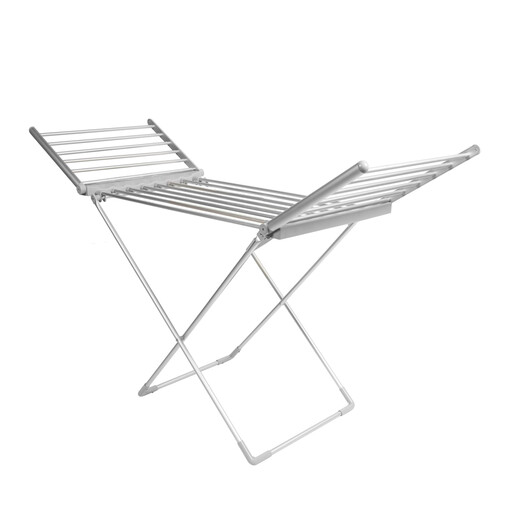 Image unavailable
Consider this three-tier winged format if you need to put the airer away between cover loads. Check the rail arrangement against your largest covers. If using its supplied fabric cover, follow the model’s instructions, including the warning not to cover the airer completely.
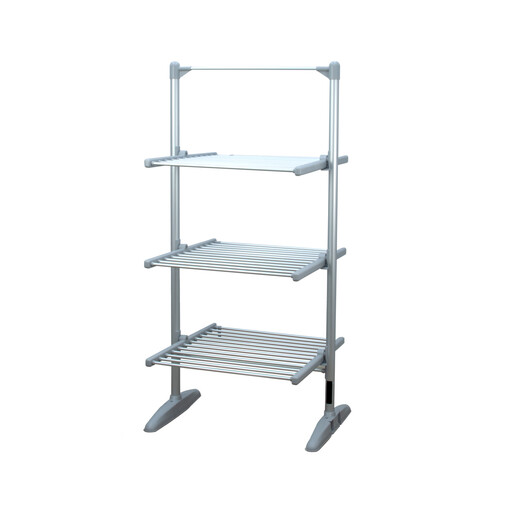 Image unavailable
This folding three-tier model is relevant when storage between changeovers matters. Its stated power is 248W; check the open dimensions and rail layout against your room and covers. Follow the model’s instructions on heated-bar use and unplugging after use.
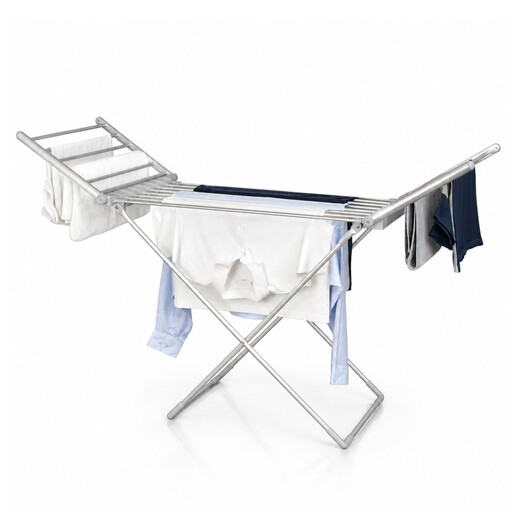 Image unavailable
Consider this winged, foldable model for occasional cover loads where storage matters. Its stated power is 230W; check its opened size and whether your covers can hang apart. The model instructions call for placement away from water, uncovered heated bars during use and unplugging when not in use.
Yes. GOV.UK ventilation guidance warns that moisture can become trapped indoors without effective ventilation, contributing to condensation, damp and mould. Keep the room’s existing ventilation working; a heated airer or compatible cover does not remove moisture from the air.
No. A model’s wet-laundry limit does not tell you whether bulky covers can hang separately. Compare your cover dimensions with its rail layout and the room available around the airer.
Do not assume there is one annual testing rule for every portable airer. The Health and Safety Executive says electrical equipment must be maintained to prevent danger, but does not prescribe the same test or interval for every appliance. GOV.UK guidance for self-catering holiday homes in England directs operators to that electrical-safety guidance; arrange inspection and maintenance appropriate to the airer’s use and condition.
Make that decision only after you can provide a suitable location and clear instructions for the specific appliance. The STATUS winged model’s instructions call for a stable, flat position away from water, uncovered heated bars during operation and unplugging when not in use. If those conditions cannot be managed for guest use, keep the airer for host or cleaning-staff use.