Choose a tiered heated airer if you regularly need to spread out leggings alongside a larger mixed wash; consider a winged model if folding the airer away matters more, or a covered warm-air cabinet if you prefer hanging garments inside a cover. Check each model’s usable space, load limit and room fit, and plan for ventilation: heating wet laundry does not remove its moisture from the home.
Who a heated airer suits
Family-load organisers
If leggings usually share a wash with schoolwear, towels or other garments, compare usable rail space and the stated load limit rather than choosing by folded size alone. Lakeland and Minky publish these measurements for the models discussed below.
Space-conscious indoor dryers
If the airer will stand in a shared room, check its open dimensions as well as where it will go after use. A fold-away design does not tell you how much space the airer needs while loaded.
Households managing condensation
If condensation or mould is already a concern, choose a drying location with a workable ventilation plan. UK government guidance identifies indoor laundry drying as a source of moisture in the home; an airer is not a stand-alone moisture-control measure.
What matters when choosing
Three-tier heated airer
Consider it: When several pairs of leggings must share drying space with a larger mixed wash and you have room for an upright rack.
Trade-off: Check the full set-up height and floor area, even if the rack folds away compactly.
Winged heated airer
Consider it: When a fold-away, lower-profile rail layout suits where you dry everyday garments.
Trade-off: Minky states 12m of drying space for its cited winged model, compared with Lakeland’s stated 21m for its cited three-tier model; compare the actual models’ rail layouts before deciding how to space a mixed load.
Covered warm-air cabinet
Consider it: When you would rather hang garments inside a covered cabinet than drape them over open rails.
Trade-off: JML states a 10kg damp-clothing limit and a 1200W rating for DriBUDDi; assess its capacity and electricity use over your expected running time.
For leggings and recurring family laundry, start with garment spacing, then check whether the loaded airer can be positioned, powered and stored safely.
| Concern | What to check | Who this matters to |
|---|
| Space for a mixed load |
Compare drying length, rail layout and the stated wet-load limit; check whether leggings can sit apart from thicker items. |
If leggings regularly go on the airer with towels and schoolwear, I need room to spread the wash rather than stack it. Roughly 31% of consumers put this mixed-load space first. |
| Indoor moisture |
Choose a drying location with workable ventilation, particularly where condensation or mould is already present. |
Where a room already shows condensation, I need a way to manage moisture while laundry dries. For roughly 25% of consumers, that is the primary concern. |
| Drying routine |
Check loading access, timer availability and rated power; watts alone cannot establish drying time. |
When leggings or uniforms are needed again soon, I want a drying routine I can manage without assuming a timer guarantees dry clothes. Around 25% of consumers prioritise that day-to-day control. |
| Placement and storage |
Measure open and folded dimensions, and check for a dry, stable position near a suitable power supply. |
If the airer must leave a shared room after use, I need to know it fits both while open and in storage. Roughly 19% of consumers make practical placement their first priority. |
Mistakes to avoid
-
Assuming heat removes moisture from the room
Wet laundry still releases moisture indoors. UK government guidance identifies drying laundry as an activity that can contribute to damp conditions.
Decide where you can ventilate while drying. If condensation or mould persists, address the underlying moisture problem rather than relying on the airer alone.
-
Judging energy use by wattage alone
Rated power describes electrical input, not how long a particular load will take to dry. A lower rating does not by itself establish lower energy use for a completed load.
Compare rated power alongside the running time you expect to need, keeping load size and garment spacing in mind.
-
Choosing by maximum load without measuring the rack
A weight limit does not show how easily leggings and thicker items can be separated. A folded measurement does not describe the space needed during use.
Measure the intended location and compare open size, drying length and rail layout before buying.
-
Treating the airer like an unpowered clothes horse
A heated airer needs an appropriate electrical set-up. Electrical Safety First warns against overloading or daisy-chaining extension devices and advises fully unwinding cable reels.
Follow the product instructions, keep plugs and cables dry, and check the marked rating of any extension device against everything connected to it.
Brands worth considering
Dry:Soon
Lakeland’s Dry:Soon range includes a tiered format for households comparing drying space for larger mixed loads.
- Lakeland states 21m of drying space, a 15kg maximum load, a 1–12-hour timer and an 8cm folded depth for its Deluxe 3-Tier model.
- Those folded dimensions do not replace a check of the space needed to set up and load the airer.
Minky
Minky’s cited heated airer offers a winged, fold-away alternative to an upright tiered rack.
- Minky states 12m of drying space, 19 rails and a 16kg wet-laundry capacity for this model.
- Check whether its rail arrangement gives your usual mix of garments enough separation space.
JML
JML’s DriBUDDi represents a covered warm-air hanging cabinet rather than an open heated-rail layout.
- JML states a limit of 10kg of damp clothing and a 1200W heating element for DriBUDDi.
- Confirm that its hanging capacity suits your wash and check availability before planning around this particular model.
Heated airers for family laundry
These Joybuy choices cover tiered and winged heated-rail layouts for drying leggings alongside family laundry. Compare their set-up space and usable rails for your own wash; they are not covered warm-air cabinets.
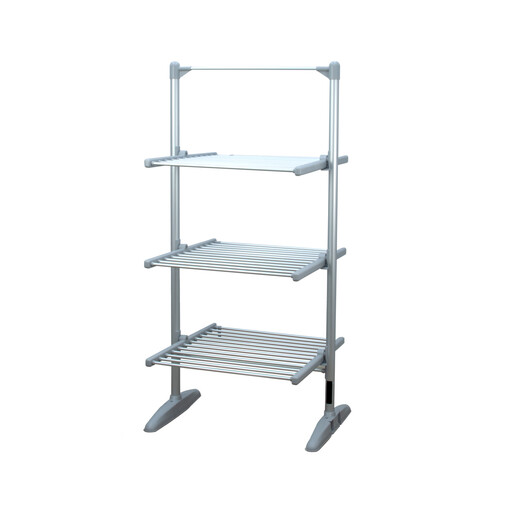 Image unavailable
Status 248W Three-Tier Heated Clothes Airer
Consider this foldable tiered layout when a mixed family wash needs space across several levels. Its stated power is 248W; check the open footprint and rail arrangement against your drying location and usual load.
View on Joybuy
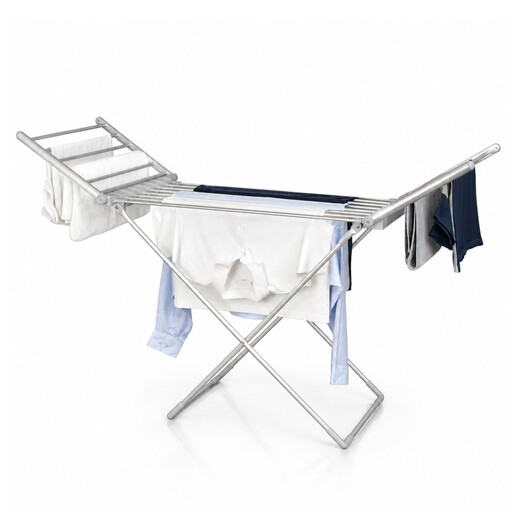 Image unavailable
STATUS 230W Foldable Winged Heated Clothes Airer
Consider the winged layout if folding the airer away between family washes matters to you. Its stated power is 230W; check the open footprint and how much room its rails give leggings and thicker garments.
View on Joybuy
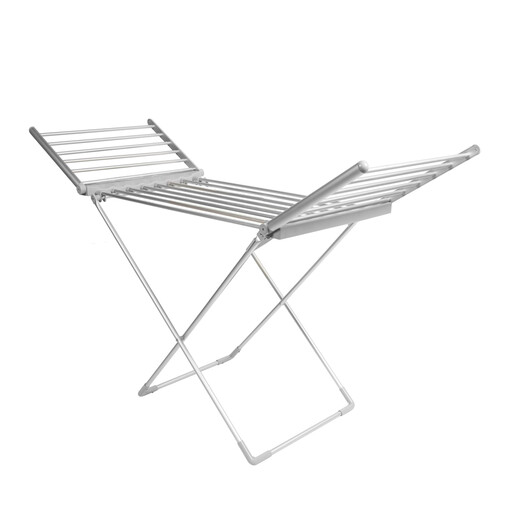 Image unavailable
Pifco Three-Tier Winged Heated Airer
This tiered, winged layout is worth considering when family laundry needs a fold-away airer; Joybuy describes it as folding flat. Check the rail space for your garments and confirm its rated power before comparing energy use. If using a fabric cover, follow the product instructions, which caution against completely covering the airer.
View on Joybuy
Common questions
Will a heated airer stop condensation when I dry leggings indoors?
No. Drying wet laundry still adds moisture to indoor air, as UK government guidance explains. Choose a location you can ventilate, and address persistent condensation or mould separately.
How can I compare heated airers’ energy use?
Compare rated power over the same running period, then consider how long your load may need. For an hour at rated power, Joybuy’s stated 248W Status model corresponds to 0.248kWh, while JML’s stated 1200W DriBUDDi corresponds to 1.2kWh; those figures do not establish the energy needed to dry a complete load.
Can I use a heated airer with an extension lead?
Use one only if it is suitable and the combined load of connected appliances stays within its marked rating. Electrical Safety First advises against overloading or daisy-chaining extension devices and says cable reels should be fully unwound.
Does a cover make a heated airer suitable for a family wash?
Not on its own. Check the particular airer’s load limit, garment space and instructions for using its cover, as well as where you will ventilate the room. JML states a 10kg damp-clothing limit for its covered DriBUDDi cabinet; a cover does not remove moisture from the home.


