Students short on space
If you mainly dry pillowcases and a few everyday items, an airer that fits while open and folds away afterwards matters more than capacity for several full loads.


For a few pillowcases and everyday items, start by considering a folding winged heated airer, provided it fits the room while open. A tiered airer makes more sense if housemates regularly need to dry larger loads; either way, allow for ventilation, storage and a safe electrical connection.
If you mainly dry pillowcases and a few everyday items, an airer that fits while open and folds away afterwards matters more than capacity for several full loads.
If several people use the same airer for clothing and bedding, a tiered frame may offer useful drying space, provided there is somewhere to leave it without blocking the room.
If quicker drying is a priority and you already have a suitable three-tier airer, a compatible conversion system is another option. Check the required airer, its power rating and the space needed to use it.
Decide where the airer can stand while in use, then consider whether it needs to handle only your pillowcases or recurring shared-house loads.
| Concern | What to check | Who this matters to |
|---|---|---|
| Room fit and storage | Compare open width, depth and height with the intended space; check folded dimensions separately. | If I need to put the airer away after drying pillowcases, I cannot have it blocking a doorway or study area while it runs. Around 40% of consumers would put room fit and storage first. |
| Shared-load capacity | Check stated drying length and maximum load, leaving enough space between items rather than layering them. | When housemates will use the airer for clothing and towels too, I need room for more than my own pillowcases; shared-load capacity would be the main concern for around 30% of consumers. |
| Drying time and moisture | Check cover compatibility, rated power and any timer; make sure the room can be ventilated. | If pillowcases need drying again soon, I want to weigh drying time against electricity use and moisture in the room. Around 30% of consumers would prioritise that balance. |
A larger airer may accommodate shared laundry yet obstruct a bedroom or communal area. Dunelm lists its winged model at 148cm wide when open, while the cited tiered examples are substantially taller.
Measure the place where the airer will stand, including access to doors and sockets, and check its folded size before choosing a format.
Lakeland specifies its Dry:Soon Standard 3-Tier cover for that particular airer; its mesh panels are part of the intended airflow arrangement.
Use only a cover specified for the exact model and follow its instructions rather than improvising an enclosure.
A compatible cover may need to be obtained separately.
Rated power indicates electricity use while a heater is running, but the length of a drying session also matters. Beldray lists its Quick-Dry conversion system at 1200W; it is a different heating arrangement from a heated-rail airer.
Compare rated power and likely running time for the load you intend to dry. Check that any conversion system fits an airer you own or plan to use.
The Office for Product Safety and Standards reported a serious fire risk for the Mini 3 Tier Electric Heated Airer, model K130, SKU UK10529. Electrical Safety First also warns against overloading or daisy-chaining extension leads.
Do not choose the named K130 product. Check the airer’s plug and cable, and use an electrical connection suitable for its rated load.
Lakeland offers Dry:Soon airers in several formats, including tiered models and a model-specific cover.
Beldray offers winged heated-rail airers and a separate Quick-Dry hot-air conversion system.
Dunelm lists both winged and larger tiered heated airers, which address different load and room-space needs.
Minky’s Sure Dri range includes a covered four-tier airer for people considering larger shared loads.
These choices include folding winged airers to consider for pillowcases and a three-tier airer to consider if the same frame will also serve larger shared-house loads. Check each model’s open and folded dimensions against your space.
 No image available
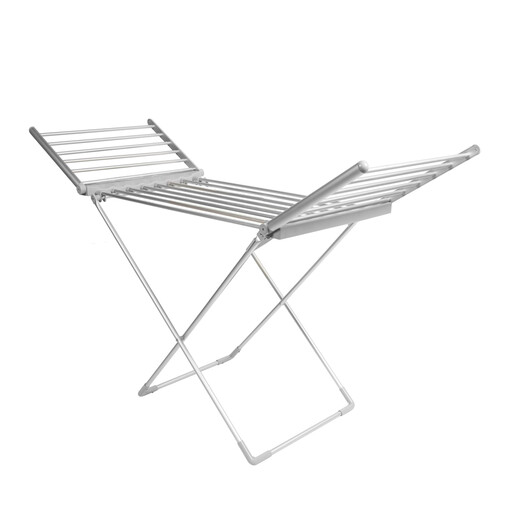
Consider this winged airer for pillowcases and small laundry loads if its three-tier frame fits the room while open.
Check the open dimensions and rated power before buying. If using a cover, follow the airer’s instructions.
 No image available
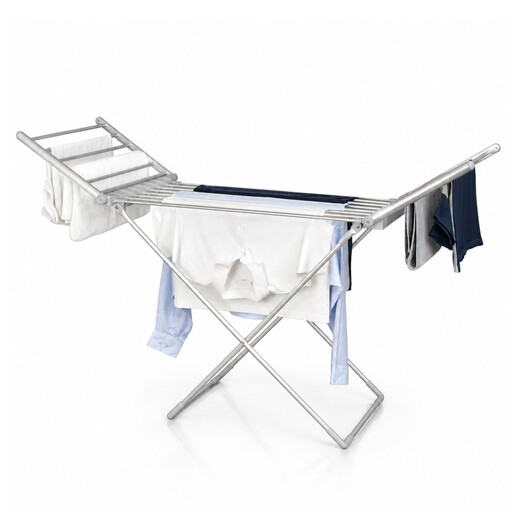
For pillowcases and everyday laundry, this folding winged format is worth considering if you need to put the airer away between uses.
The stated rating is 230W. Check both open and folded dimensions against your available space.
 No image available
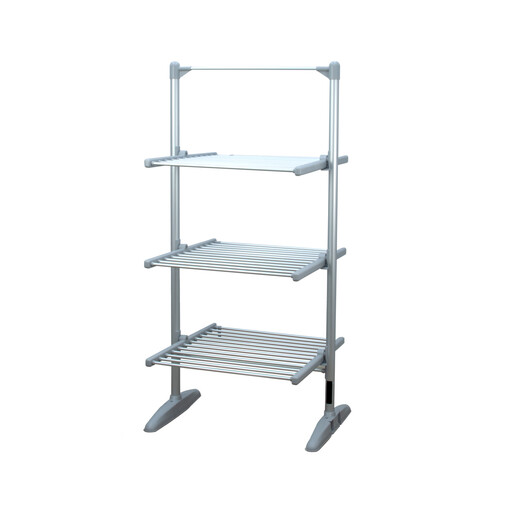
Consider this three-tier airer if the house needs to dry shared laundry as well as pillowcases, and there is room to operate and store it.
The stated rating is 248W. Check its open and folded dimensions before choosing a place for it.
A winged airer is a proportionate option if pillowcases and a few everyday items are your usual load. Check its open width as carefully as its storage size: Dunelm lists its cited winged model at 148cm wide when open.
Use a cover only if it is specified for the exact airer and follow its instructions. Lakeland specifies its mesh-panel Dry:Soon Standard 3-Tier cover for that model; do not assume it fits another airer.
Compare the airers’ rated wattage alongside how long you expect to run them. Rated power alone does not establish drying time, so consider the load and the way each system dries it.
Ventilate the room as appropriate, but do not treat a heated airer as a remedy for a persistent housing problem. The UK Health Security Agency advises that damp and mould can affect health; record where the problem occurs and report it to your landlord. The next reporting steps depend on your tenancy and location.
Use one only if it is suitable for the airer and the combined connected load remains within the lead’s marked rating. Electrical Safety First warns against overloaded and daisy-chained extensions; stop using equipment with a damaged lead or plug.