Small-load utility-room dryers
If you mainly dry pyjamas, underwear and other small items, an airer’s open footprint and folded size may matter more to you than its maximum load rating.


For a regular pyjama load, choose a heated airer that fits the utility room when open and can be stored conveniently; extra stated capacity matters more if you also dry larger loads. A compatible cover is worth considering if you want an enclosed drying space, but it does not replace room ventilation. Compare rated wattage alongside your likely hours of use, not as a measure of drying speed.
If you mainly dry pyjamas, underwear and other small items, an airer’s open footprint and folded size may matter more to you than its maximum load rating.
If turnaround between washes is your priority, you may consider a cover designed for the exact airer you choose. You still need to keep the utility room ventilated while laundry dries.
If pyjamas share the airer with towels, bedding or another wash load, compare drying length and the stated load limit as well as the space the airer occupies.
For regular pyjama drying in a utility room, establish where the airer can stand and be stored before weighing up a cover, electricity use or capacity for other laundry.
| Concern | What to check | Who this matters to |
|---|---|---|
| Footprint and storage | Measure clear floor space, height and door clearance; compare open dimensions and folded depth. | If I need access to cupboards and appliances, the airer must fit both while open and when put away. Around 36% of consumers put usable space first. |
| Drying and ventilation | Check that any cover matches the exact airer and that the room’s ventilation remains usable. | When pyjamas need to be ready between washes, I want to consider an enclosed drying space without leaving moisture trapped indoors. Around 29% of consumers make drying and moisture management their primary concern. |
| Electricity use and controls | Compare rated watts with your tariff and expected hours of use; check whether you want a timer. | If I use the airer regularly, I want to understand the electricity used over a drying session rather than rely on a headline hourly figure. Around 21% of consumers prioritise running costs and controls. |
| Space for mixed loads | Compare stated drying length and load limit with the largest load you realistically plan to hang. | Pyjamas are only part of my laundry, so I need room for other garments without choosing on the kilogram rating alone. Around 14% of consumers put mixed-load capacity first. |
A stated 15kg limit will not tell you whether an airer can stand in your utility room without obstructing a door, appliance or walkway.
Measure the intended position and storage gap, then compare the model’s open and folded dimensions with your usual laundry load.
Dunelm describes an enclosed drying space for its matched A-frame airer and cover; that description does not establish the fit or effect of a different combination. Government home-ventilation guidance also explains that drying laundry adds moisture to indoor air.
Check compatibility with the exact model and keep the room’s ventilation routes usable. Treat recurring condensation or mould as a separate issue to address.
A compatible cover may need to be obtained separately unless it is part of a bundle.
Dunelm lists its standard three-tier airer at 330W and its XL model at 400W. Those input ratings alone do not establish which will use less electricity to finish a particular load.
Use each model’s rated watts, your own electricity tariff and likely hours of use to assess a drying session.
The warning for Joybuy’s BLACK+DECKER 63099 heated airer specifies a dry, level position away from water and says to unplug it and let it cool before folding or storing it.
Follow the instructions for the model you buy, particularly where sinks or wet floors affect the available position.
Lakeland offers several heated-airer formats, including its Deluxe three-tier model for larger loads.
Minky’s sureDRI three-tier model is an adjustable-arm tower for buyers comparing space for mixed laundry loads.
Dunelm’s range includes standard and XL three-tier airers, alongside airer-and-cover bundles.
The three-tier BLACK+DECKER 63099 illustrates a tower format with a stated 15kg weight limit.
These winged and three-tier heated airers offer formats to consider for indoor pyjama drying. Check each one’s open and folded size against your utility room before choosing.
 No image available
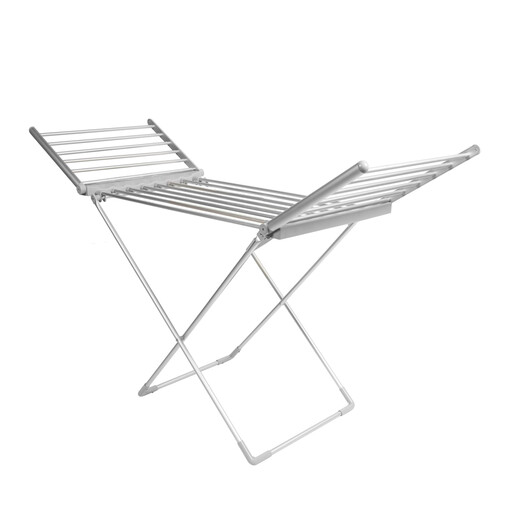
Consider this winged, three-tier format if you want sections for a regular pyjama load. Check its open footprint and storage space before buying.
 No image available
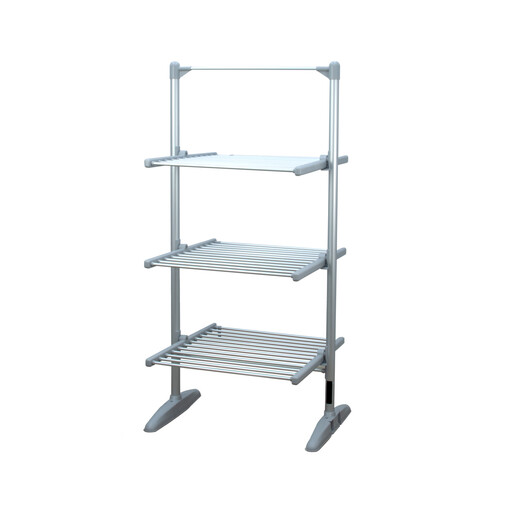
A foldable three-tier option if you want vertical hanging space for pyjamas and other laundry. Rated input: 248W. Confirm its open and folded dimensions against your available space.
 No image available
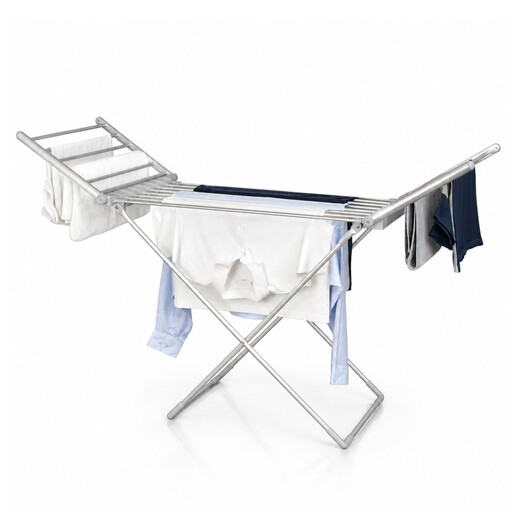
A foldable winged option for indoor pyjama drying. Rated input: 230W. Check its open and folded dimensions before deciding whether it suits your utility room.
Choose by the space available for the open airer and your usual load, rather than by the maximum kilogram rating alone. As reference points, Dunelm lists its standard three-tier model at 138cm high by 72cm wide by 78cm long when open, while Minky lists its sureDRI three-tier model at 147cm high by 72cm wide by 67cm deep. Check folded dimensions too if the airer must fit in a storage gap.
A cover designed for the exact airer may be worth considering, but a faster drying time for your pyjamas should not be assumed. Dunelm describes its matched A-frame cover as creating a warm enclosed space with a mesh bottom intended to promote airflow; keep the room ventilated while laundry dries.
Multiply the rated watts divided by 1,000 by the hours used to estimate electricity use in kWh, then multiply by your tariff to estimate the cost. This uses the rated input as a guide; compare likely drying sessions rather than treating wattage as a drying-speed measure.
Keep the room’s designed ventilation usable while drying laundry indoors. Government home-ventilation guidance explains that clothes drying adds moisture to indoor air; if condensation or mould persists, address that separately rather than assuming a different airer or cover will resolve it.