What should you check?
Start with the space available while the airer is open, then consider how much of the regular uniform wash its rails can hold. Treat ventilation as part of the drying plan, whichever format you choose.
| Concern |
What to check |
Who this matters to |
| Next-day uniform turnaround |
Check the stated load limit and drying length, then allow space between the garments you wash most often. |
If shirts, trousers and PE items all need hanging after one wash, a rack for only a few pieces will not meet my routine. Around 25% of consumers put next-day uniform space first. |
| Fit and fold-away storage |
Measure the open width, depth and height in the intended position; check folded depth separately. |
When the rack cannot stay out between washes, I need it to fit the room in use and the storage space afterwards. Fit and storage come first for around 31% of consumers. |
| Space for a larger wash |
Compare the exact models’ stated maximum loads and drying metres; check whether bulky garments can hang without heavy overlap. |
Uniforms washed alongside other household laundry need enough separate rail space. For around 19% of consumers, accommodating the larger combined load is the primary concern. |
| Indoor moisture and electricity use |
Check whether the room can be ventilated and use the model’s rated wattage with expected operating hours to assess electricity use. |
In a small room, I need a workable way to manage laundry moisture and understand how long the appliance will run. Around 25% of consumers put these practicalities first. |
Joybuy product choices
These three-tier heated airers are options to assess for indoor uniform loads: one has a winged layout, while both need their open position checked against the space available in your flat.
 No image available
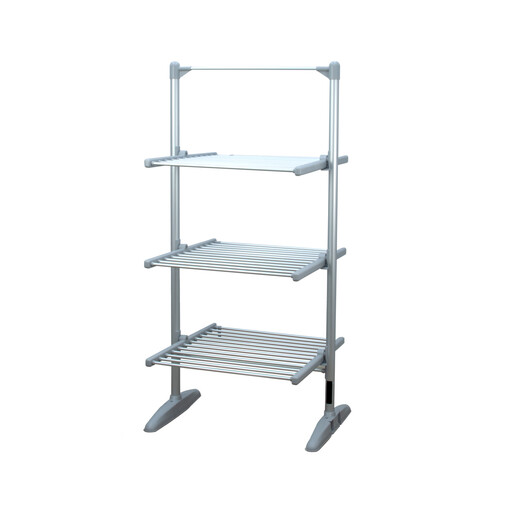
Status 248W Three-Tier Heated Clothes Airer
Consider this three-tier format when several uniform pieces need hanging at once, provided its open size fits your drying spot.
Rated power: 248 W. Check the exact listing’s load limit and rail space against your usual wash, and use it in a room that can be ventilated.
View on Joybuy
 No image available
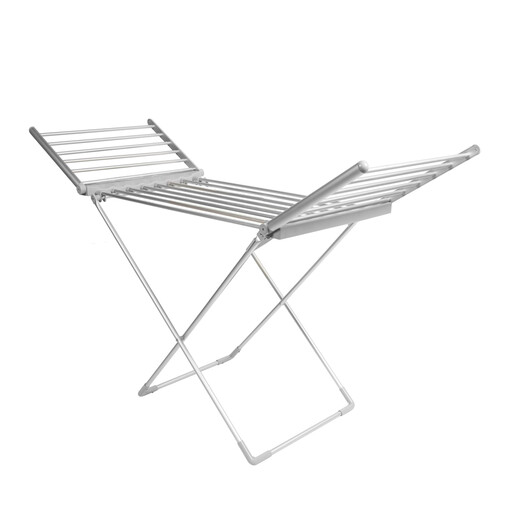
Pifco Three-Tier Winged Heated Airer
The winged, fold-away format is worth considering for a modest uniform wash when the airer must be stored after use.
Check the open footprint, load limit and rated power for this exact model before choosing a position. Indoor drying still calls for effective ventilation.
View on Joybuy
Common questions
What size heated airer is practical in a small flat?
The practical size is one that fits while open without obstructing movement or garment loading, and can be stored where you intend. For scale, Lakeland lists its Standard Dry:Soon at 73 × 75 × 137 cm, while a covered Status three-tier example listed by Robert Dyas measures 62 cm wide, 58 cm deep and 130 cm high. Measure against the exact model you plan to buy.
Will a heated airer prevent condensation?
No: heating the rails does not remove the moisture released by laundry. GOV.UK guidance says moisture from washing clothes can become trapped and condense without effective ventilation. Plan where the airer will stand and how that room will be ventilated; address persistent damp separately.
How can I compare electricity use?
Compare the exact airers’ rated wattage alongside the hours you expect to run them, rather than wattage alone. Divide watts by 1,000 and multiply by operating hours to estimate energy use in kWh at rated power; actual operating time depends on the wash and drying conditions.
Can I use a heated airer near water or move it while it is hot?
Follow the instructions for your exact model and choose a stable position away from water. The Joybuy listing for the BLACK+DECKER three-tier airer instructs users to let it cool after use before folding or moving it. Check the cord’s route as well as the space around the rack.
Do I need a cover for school uniforms?
No cover is necessary for every uniform-drying setup. A covered three-tier format may suit a dedicated drying spot, but check whether a cover is included or fits the exact model, allow for loading and unloading it, and keep the room ventilated. Do not assume a cover removes moisture from the flat.


