Families washing uniforms during the school week
If shirts, trousers, jumpers or PE kit need drying between school days, compare rail space and stated load capacity so you can spread out the garments you need in the same load.


Choose a heated airer by the uniform load you need to dry, the space available when the frame is open and how you will ventilate the room. A covered multi-tier model offers more room for a recurring family load, while a winged model can suit a smaller load if its open width fits; neither format guarantees a particular drying time. Compare the exact model’s capacity, dimensions and electricity use before choosing.
If shirts, trousers, jumpers or PE kit need drying between school days, compare rail space and stated load capacity so you can spread out the garments you need in the same load.
An airer needs a practical place to stand without obstructing a doorway or walking route. Check its open footprint as well as its folded dimensions before deciding between a tall frame and a winged one.
If uniforms dry inside, plan how the room will be ventilated. The UK government’s existing-home ventilation guidance explains that moisture can become trapped indoors and turn into condensation without effective ventilation.
Start with the load and the room: the right layout depends on both. A drying pod is a different decision if you already have a compatible three-tier rack.
Consider it: Several uniforms, PE items and other laundry need rail space in the same load, and a tall frame fits the room.
Trade-off: The frame and its cover need space in use; check the exact model’s folded size and whether the cover is included or sold separately.
Consider it: You usually have a smaller uniform load and have enough floor width to open the wings.
Trade-off: A lower stated capacity may mean separating a larger family wash into loads.
Consider it: You already own a three-tier airer that meets the pod maker’s compatibility instructions.
Trade-off: The rack may not be included. The Minky Sure Dri Heat Pod is listed at 850W, so compare its electricity use over a whole drying session, not wattage alone.
| Concern | What to check | Who this matters to |
|---|---|---|
| Space for the uniform load | Compare drying length in metres and the stated load limit in kilograms; check whether garments can be spaced across the rails. | When several uniforms and PE items need drying together, I want enough room to spread them out rather than leave part of the wash waiting. Around 31% of consumers put load capacity first. |
| Room and storage fit | Measure the intended position against open height, width and depth, then check folded dimensions and the cable route. | A frame that blocks my walkway will be awkward to use, even if it holds more clothes. Room fit is the main concern for roughly 25% of consumers. |
| Indoor moisture | Choose a location with usable ventilation and keep existing vents unblocked; a cover does not remove moisture from the room. | If I regularly dry uniforms indoors, I need to manage condensation as well as find space for the airer. About 25% of consumers primarily focus on moisture management. |
| Electricity use | Check wattage and consider how long your usual load may need the airer; a wattage figure alone does not establish energy used per load. | With frequent school-week washing, I want to understand the electricity used across each drying session. For around 19% of consumers, that is the primary deciding factor. |
A multi-tier frame needs adequate height and clearance, while opened wings can take up considerable floor width. Either can obstruct the place you intended to use it.
Measure the open position, storage space, socket location and walking route, then compare them with the exact model’s dimensions.
Clothes still release moisture into the room. UK government ventilation guidance explains that moisture can become trapped and form condensation without effective ventilation.
Use a room you can ventilate as instructed for your home, keep ventilation features unblocked and address existing damp separately.
Wattage describes power draw, not how long a particular uniform load will take to dry. Which? notes that the value of a heated airer depends in part on drying frequency and the method it replaces.
Compare the exact model’s wattage alongside your typical load and likely time in use rather than assuming that the lowest-wattage option uses the least electricity per load.
Electrical Safety First warns that overloaded extension equipment can overheat. The UK Office for Product Safety and Standards has also reported a serious fire risk for a specific Mini 3 Tier Electric Heated Airer; that report does not apply to every heated airer.
Check current notices for the exact model, inspect its plug and cable, follow its instructions and avoid overloading or daisy-chaining extension leads.
Lakeland’s three-tier Dry:Soon model is a reference point for households considering a larger uniform load.
Minky offers both a covered four-tier airer and a separate Heat Pod for a suitable existing three-tier rack.
Dunelm’s winged heated-airer format offers a comparison for smaller uniform loads where a wide frame can be opened.
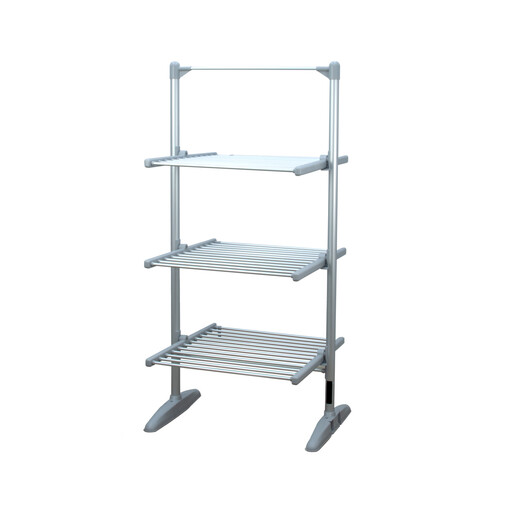
A fold-flat three-tier aluminium airer, offered as a way to spread several uniform garments across one indoor load.
These two fold-away heated airers offer different rail layouts for indoor uniform drying: a three-tier frame and a three-tier winged frame. Check the open dimensions against your room before choosing either one.
 No image available
Consider this fold-flat three-tier frame if you need to spread several uniform garments across one indoor load.
The listing describes 30 heated bars, a 30kg maximum load and a 248W rating. Check its open and folded dimensions and drying length against your room and laundry; the load limit does not indicate drying time. Ventilate the room while laundry dries.
 No image available
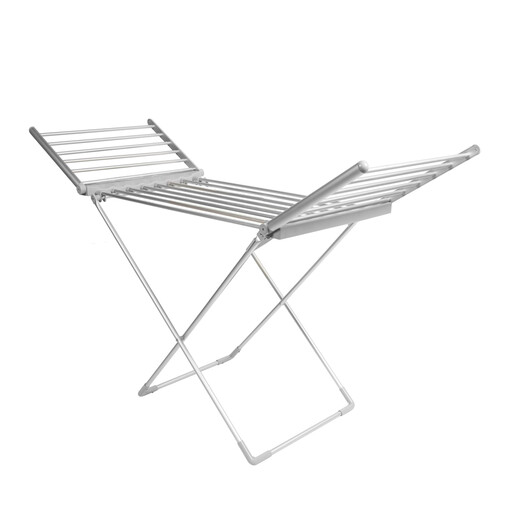
Consider the winged, fold-flat layout for uniform drying if there is room to open it safely.
The listing describes 20 heated bars, a 12kg capacity and an included fabric cover. Check the open dimensions, wattage and drying length before comparing it with another model. The description cautions against covering the airer completely, so follow the product instructions for using its cover; ventilate the room while drying.
A heated airer does not remove the need for effective ventilation. UK government existing-home guidance explains that moisture from indoor activities can become trapped and form condensation; follow your home’s ventilation instructions and keep installed vents unblocked.
For each airer, divide its wattage by 1,000 and multiply by the hours it runs to estimate electricity use in kWh. The time needed for a uniform load can vary, so a lower wattage alone does not establish which airer will use less electricity for that load.
A cover is an option only if it is compatible with the exact airer and used as its instructions direct. It does not guarantee a drying time or replace room ventilation; check particularly carefully where a listing includes a cover but cautions against covering the airer completely.
Use a wall socket where practical. If an extension lead is necessary, check its rating and the combined load, do not daisy-chain leads and fully unwind a cable reel; Electrical Safety First warns that overloaded extension equipment can overheat.
Do not assume the Great Britain rules apply unchanged in Northern Ireland. The UK Office for Product Safety and Standards explains that electrical equipment placed on the Great Britain market must meet the applicable Electrical Equipment (Safety) Regulations 2016 requirements; buyers in Northern Ireland should check the product-marking and seller information applicable there.