For several school uniforms alongside regular laundry, start by comparing three-tier heated airers with around 20m of stated drying space and a 15kg stated load limit, then check whether one fits your room when open. If the priority is one urgent outfit rather than a family load, a compact covered pod is another option, but it holds less; either way, indoor drying needs effective ventilation and a suitable electrical setup.
Who needs which setup?
Families drying several uniforms at once
If shirts, trousers and PE kit need space alongside other washing, compare stated rail length and wet-load limits before choosing a format. Measure the airer when open as well as the space available to store it folded.
Households facing a next-day uniform rush
When one outfit matters more than a full wash load, a compatible cover or a compact covered pod may be relevant. Check how the actual garments can be arranged and do not assume a particular drying time.
Families concerned about indoor moisture or sockets
Choose the drying location as carefully as the airer. GOV.UK guidance explains that moisture from drying clothes can become trapped without effective ventilation, while Electrical Safety First advises care with bathroom electrical use and extension leads.
What matters when choosing?
Decide whether a full family load or an urgent smaller load drives the purchase, then check that the airer can be used and stored safely in the available space.
| Concern |
What to check |
Who this matters to |
| Family-load capacity |
Compare the exact airer’s stated rail length, wet-load limit and open dimensions. Lakeland’s Dry:Soon three-tier model lists 21m and 15kg; Dunelm’s standard three-tier model lists 20m and 15kg. |
I need several uniforms and ordinary washing to fit without crowding the rails. Roughly 36% of consumers put family-load capacity first. |
| Urgent uniform turnaround |
Check whether a matching cover is included or sold separately and whether garments can be spaced as directed. Which? describes drying pods as faster but lower-capacity than other heated-airer formats, not as a fixed-time solution. |
When tomorrow’s shirt or PE kit is the priority, I would accept a smaller load if the setup suits those items. Around 29% of consumers put urgent turnaround first. |
| Room and storage space |
Measure the intended spot against the open height, width and depth, then check the folded dimensions. The Dry:Soon three-tier model, for example, is listed by Lakeland as folding to 8cm deep. |
I need to put the airer away between loads without leaving it in the way while it runs. About 21% of consumers place usable room and storage space first. |
| Moisture and electrical setup |
Choose an effectively ventilated location and follow the appliance instructions. Electrical Safety First advises against extension leads in bathrooms without socket outlets and against overloading or daisy-chaining leads. |
If the available drying spot is damp or awkward to power, I need to resolve that before choosing an airer. Roughly 14% of consumers make moisture and electrical setup their first concern. |
Mistakes to avoid
-
Choosing by wattage alone
Wattage describes electrical input, not how quickly a particular shirt will dry. Garment spacing, load size, the presence of a cover and room conditions also matter.
Compare the airer’s usable layout and stated load limit with the uniforms you normally wash, and check the manufacturer’s instructions for arranging garments.
-
Assuming a cover comes with the airer
Lakeland and Dunelm list compatible covers separately from the three-tier base airers discussed here. A covered setup therefore depends on the exact products selected, not just the airer’s shape.
If enclosed drying matters, confirm that a cover is included or identify the one made for the exact model. Allow somewhere to store it between uses.
-
Drying indoors without planning ventilation
GOV.UK guidance says moisture from drying clothes can be trapped in a poorly ventilated home and contribute to condensation, damp and mould.
Use a suitable ventilated room, keep trickle vents open where fitted and address persistent condensation rather than relying on the airer to manage moisture.
-
Relying on an unsuitable extension lead
Electrical Safety First warns that overloaded or daisy-chained extension leads can overheat. It also advises against powering appliances with extension leads in bathrooms without socket outlets.
Use a suitable wall socket where possible. If a lead is necessary in a dry room, check its marked rating against the combined load, avoid daisy-chaining and follow the instructions for any cable reel.
Brands to consider for heated airers
Dry:Soon by Lakeland
Lakeland’s three-tier Dry:Soon range includes a family-load airer and matching covers.
- Lakeland lists 21m of drying space, a 15kg load limit and an 8cm folded depth for its standard three-tier model.
- Check the cover separately if enclosed drying is part of your plan; it is not included with the base airer discussed here.
Dunelm
Dunelm offers standard and extra-large three-tier heated-airer formats alongside other airer shapes.
- Its standard three-tier listing states 20m of drying space, a 15kg load limit and 330W.
- Check the current overview and specifications for the exact extra-large model: its listing gives conflicting drying-space and capacity figures in different places. Compatible covers are separate products.
JML
JML’s DriBUDDI Compact is an enclosed pod format to consider for smaller, urgent loads rather than long-rail family drying.
- The DriBUDDI Compact has an included cover, a 10kg capacity and a 2.5kg assembled weight.
- It is described as holding one wash load, with 0.4m of drying space; check whether its garment arrangement suits the uniforms you need to dry.
BLACK+DECKER
The 63099 is a retailer-listed three-tier heated airer with a fold-flat design.
- Robert Dyas lists 21m of drying space, a 15kg maximum load and 300W for this model.
- Use those figures to check layout and load suitability, rather than treating retailer running-cost language as a result for your household.
Three-tier airers on Joybuy
These three-tier heated airers are relevant to drying school uniforms indoors. Compare their usable hanging space and open dimensions with your usual load and the room where you plan to use one.
 No image available
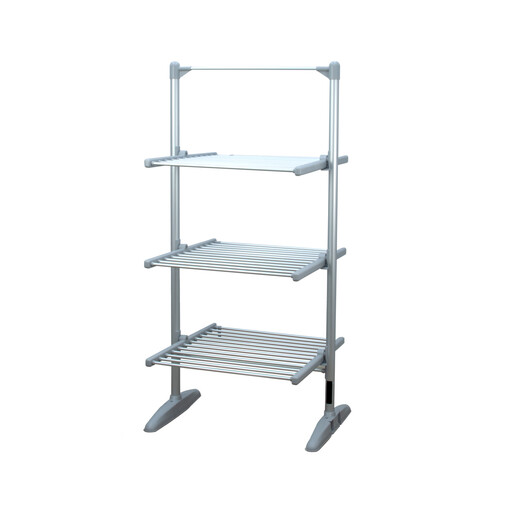
Status Three-Tier Heated Clothes Airer, 248W
Consider this three-tier airer if several uniform items need hanging space in one indoor setup; check its usable rail length and open dimensions against your load and room.
The product name specifies 248W, a foldable design and aluminium construction. Check whether a compatible cover is included if covered drying matters to you.
View on Joybuy
 No image available
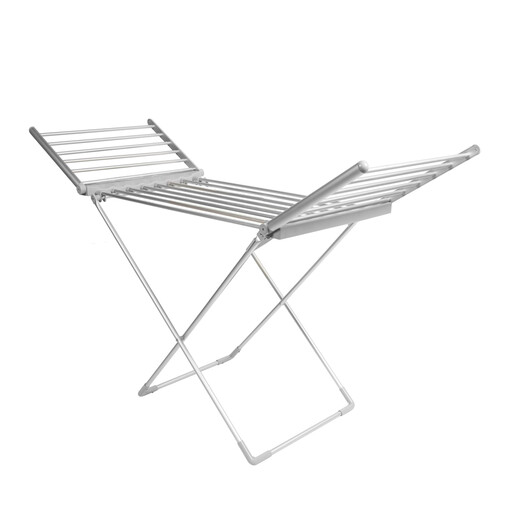
Pifco Three-Tier Winged Heated Airer
The winged, three-tier layout is worth checking if you need to arrange several school garments at once; compare its usable hanging space and load limit with your usual wash.
Check the airer’s open dimensions against your drying spot and confirm the electrical rating if you need it for planning use.
View on Joybuy
Questions about drying uniforms
What size heated airer works for several school uniforms?
Start with stated rail length and wet-load capacity, then measure the open airer against the room. Lakeland and Dunelm list 20–21m of drying space and 15kg load limits for the standard three-tier models discussed here, but the right size depends on how many garments you need to space out.
Will a cover make uniforms dry faster?
A matching cover may help retain warmth around a heated airer, according to Lakeland’s and Dunelm’s product descriptions, but that does not establish a drying time for a particular uniform. Check that the cover is designed for your exact model and whether it is included.
Can I run a heated airer in a bathroom?
Do not use an extension lead to power an airer in a bathroom without a socket outlet: Electrical Safety First says this increases electric-shock risk. Follow the airer’s placement instructions and use a suitable dry location where possible.
How can I limit condensation while uniforms dry indoors?
Ventilate the drying area and follow the home’s ventilation instructions. GOV.UK guidance explains that moisture from drying clothes can become trapped without effective ventilation and lead to condensation; keep trickle vents open where fitted.


