Small-load sock dryers
If you usually dry cotton socks, underwear and a few everyday items, accessible rungs and a compact folded size may matter more than maximum capacity. Winged airers are described as offering wide arms and flat-drying areas.


For regular loads of cotton socks and a few small items, a fold-flat winged heated airer offers accessible rungs without the bulk of a larger tiered model. Consider a covered winged model if you want warmth retained around the laundry, or a tiered model if socks routinely share the airer with larger loads; whichever you choose, check its open dimensions, socket reach and the utility room’s ventilation.
If you usually dry cotton socks, underwear and a few everyday items, accessible rungs and a compact folded size may matter more than maximum capacity. Winged airers are described as offering wide arms and flat-drying areas.
If the utility room also handles towels, uniforms or larger washes, compare drying length and rated load capacity as well as the space the airer occupies when open. Tiered examples are listed with greater stated drying length than the compact winged example.
If the room is enclosed or has a history of condensation, plan how moisture will leave it. UK government ventilation guidance explains that moisture can become trapped indoors without effective ventilation.
Start with the load you normally dry, then check whether the airer fits both open and folded and can be placed near a suitable socket in a ventilated room.
| Concern | What to check | Who this matters to |
|---|---|---|
| Small-load access and storage | Check rung access, open footprint and folded depth; compare drying length with the size of your usual load. | If I mostly dry socks and underwear, I want room to spread them out without storing a bulky rack afterwards. Around 31% of consumers would put this small-load need first. |
| Mixed-load capacity | Compare stated drying length, load limit and open height before choosing a tiered format. | When socks share the airer with towels or a larger wash, I need space for both rather than a rack sized only for small items. For around 25% of consumers, mixed-load capacity comes first. |
| Indoor moisture | Check how the utility room is ventilated, including whether existing vents are unobstructed; a cover does not replace room ventilation. | If condensation is already a concern, I need a workable way for laundry moisture to leave the room. Moisture management would be the primary concern for around 25% of consumers. |
| Power and placement | Compare rated wattage, cable reach and any timer controls, then follow the model’s electrical instructions. | To choose where the airer can stand and manage how long it runs, I need to consider the socket and the stated power rating. Around 19% of consumers would prioritise powered placement and running control. |
A tiered airer can provide more space for laundry but may be unnecessarily tall for sock-only loads in a restricted utility room.
Measure the space available when the airer is open and where it will go when folded. Choose extra capacity when you expect to use it for regular mixed loads.
Heating laundry does not remove its moisture from the room. UK government ventilation guidance warns that moisture trapped indoors can lead to condensation.
Keep applicable vents open and unobstructed, follow your home’s ventilation instructions and address recurring damp rather than relying on the airer to resolve it.
UK government fire-safety guidance says not to use portable heaters to dry clothes. Electrical Safety First warns that overloaded extension leads can overheat and cause a fire.
Use a purpose-designed heated airer according to its instructions, and do not overload or daisy-chain extension leads.
Covers can retain warmth, but the way laundry is spaced and the room is ventilated still matters.
Check whether a cover is included and suitable for the model. Spread socks rather than layering them, and maintain room ventilation.
Lakeland’s Dry:Soon range includes compact and tiered heated airers and accessories for indoor drying.
STATUS offers a foldable aluminium winged airer and a foldable three-tier model, so two drying layouts can be compared within one range.
The cited Minky models include covered winged and four-tier heated airers.
These winged and tiered heated airers offer options for sock loads and mixed laundry. Compare their stated features with your usual load, available floor space and storage space.
 No image available
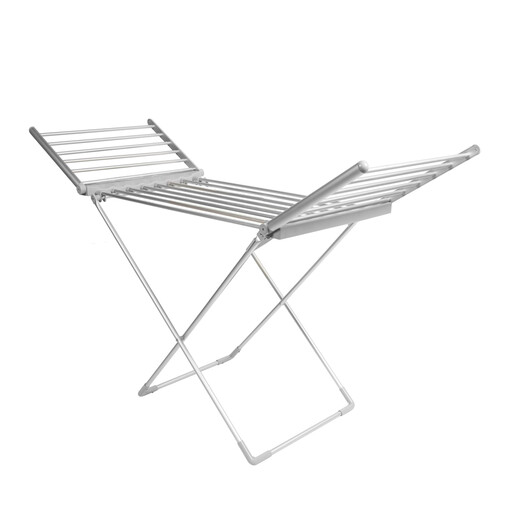
Consider this winged, three-tier layout if socks regularly share the airer with other laundry. Check its open and folded dimensions against your utility-room space, and follow the supplied instructions for using the airer and covering laundry.
 No image available
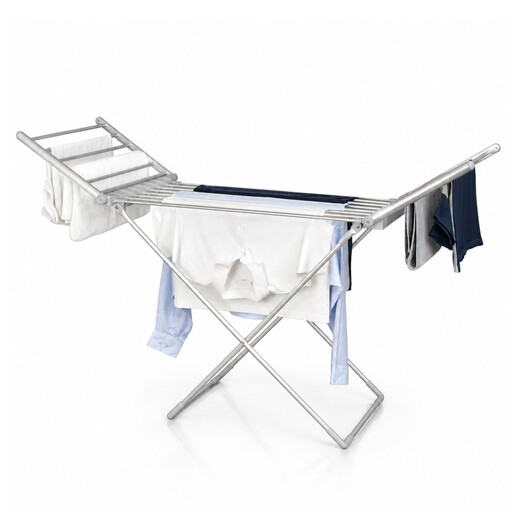
The winged format is worth considering if you want access to individual rungs for small sock loads. Its title states a 230W rating and foldable aluminium construction; check the open and folded dimensions before deciding where it will stand and be stored.
 No image available
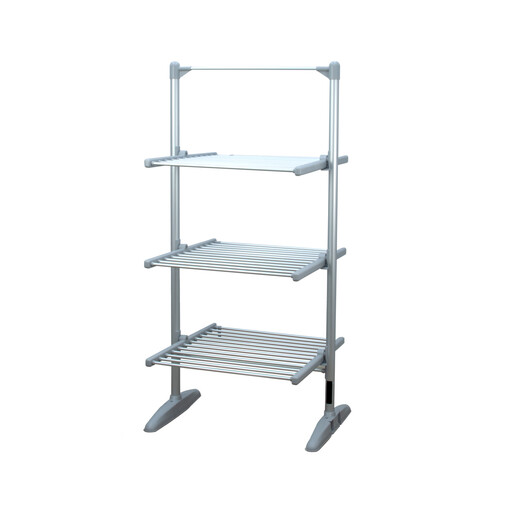
Consider the three-tier layout if the utility room regularly handles socks alongside larger items. Its title states a 248W rating and foldable aluminium construction; check its drying length and open and folded dimensions to judge whether the extra tiers suit your space.
No. Drying laundry still releases moisture into the room. UK government ventilation guidance says moisture can become trapped without effective ventilation, so keep applicable vents unobstructed and follow your home’s ventilation instructions.
Choose a winged format if accessible rungs and compact storage are your priorities; consider tiers when socks routinely dry alongside larger loads. Check the specific model’s open dimensions before assuming either format will fit your utility room.
Compare rated wattage alongside how long you expect to run each airer. Rated power in kilowatts multiplied by hours gives an energy estimate: at the stated 220W maximum, the cited winged example would use 0.22kWh over one hour at that rating. Actual use depends on operation, and a wattage figure alone does not establish the energy needed to dry a load.
No. UK government fire-safety guidance says not to use portable heaters for drying clothes. Use a purpose-designed airer according to its instructions, and keep laundry away from heaters and open fires.
Check the terms for the exact airer rather than assuming every model from a brand has the same cover. Lakeland advertises a three-year guarantee for its Dry:Soon range, while the cited winged and Minky examples state one-year manufacturer guarantees.