Small-flat sports-top dryers
If you wash light loads of technical tops regularly, look for an airer you can position without blocking the room and put away afterwards. Adjustable shelves may also help when a garment needs to lie flat.


Choose a compact folding tiered airer if you need to put it away between loads or lay some sports tops flat. A covered warm-air pod is worth considering if you mainly dry a few tops on hangers and want timed operation; a full-size rack makes more sense when the same appliance must handle larger mixed loads. In every case, check the space it occupies while open and follow each garment’s care label.
If you wash light loads of technical tops regularly, look for an airer you can position without blocking the room and put away afterwards. Adjustable shelves may also help when a garment needs to lie flat.
If a few tops need to be ready for the next session, a covered, hanger-based warm-air format and timer may matter more to you than maximum rail length. Check that hanging suits the garments’ care instructions.
If the airer must also accommodate everyday washing, towels or bedding, consider the drying layout and stated capacity alongside the space available while it is open.
Start with the space the airer can occupy during a load, then decide whether your tops need rails, a flat surface or hangers. Compare controls and electricity demand only after you have found a layout that works for the clothes and the room.
| Concern | What to check | Who this matters to |
|---|---|---|
| Floor space and storage | Measure the intended position against the open dimensions, then compare folded depth with your storage gap. | I need to move around the flat while clothes dry and put the airer away afterwards. Around 31% of consumers put usable floor space and storage first. |
| Turnaround between washes | Compare heated rails with covered warm-air drying, and check hanger capacity and timer controls where relevant. Wattage alone does not establish drying time. | When training sessions are close together, I need a few washed tops ready again without choosing a rack for a large load. Roughly 25% of consumers prioritise turnaround. |
| Sportswear drying layout | Read each garment’s care label, then check for a suitable flat shelf or hanger arrangement. | If a top should not be stretched across a rail, I need a layout that lets it dry as instructed. About 25% of consumers place garment layout first. |
| Electricity and controls | Check rated wattage, likely running time, timer functions and cable reach. Use the appliance instructions and a suitable socket arrangement. | I want to plan when the airer runs and position it safely near a socket. Around 19% of consumers make electricity demand and controls their primary concern. |
A larger three-tier rack may hold more washing but take up too much living space while open, even if it folds flat later.
Measure both its drying position and its storage gap, and check whether the supplied cable reaches a suitable socket.
Some tiered airers have a compatible cover supplied separately, so a picture of a covered rack does not establish what is in the package.
Check the exact listing’s contents and the cover’s compatibility with that model.
Electrical Safety First warns that exceeding an extension lead’s current rating can cause overheating.
Use a wall socket where practical. If you need an extension, check its rating against the connected load, do not daisy-chain leads and fully unwind any cable reel.
A manufacturer’s description of gentle drying cannot establish that heated rails or warm air suit every technical fabric, print or bonded seam.
Follow the top’s care label first, including any instruction to dry it flat or avoid heat.
Lakeland’s range covers folding tiered rail airers and a covered, hanger-based drying pod.
The JML DriBUDDi Compact offers a covered, freestanding format for clothes dried on hangers.
Beldray’s researched three-tier rail airer is an option to compare if the same appliance must handle sports tops and larger mixed loads.
These folding heated rail airers are relevant if you want to store the appliance between sportswear loads. Check each model’s open and folded dimensions, drying layout and cable reach against your flat before choosing; neither listing establishes a flat-drying surface for a particular top.
 No image available
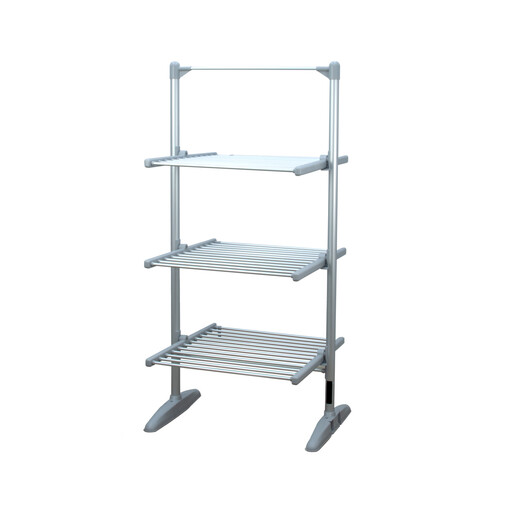
Consider this folding three-tier format if you need to put an airer away between indoor drying loads.
The product name specifies aluminium construction and a 248 W rating. Check the open and folded dimensions, whether its layout suits your tops and whether the cable reaches your intended socket; the power rating alone does not establish drying time or running cost.
 No image available
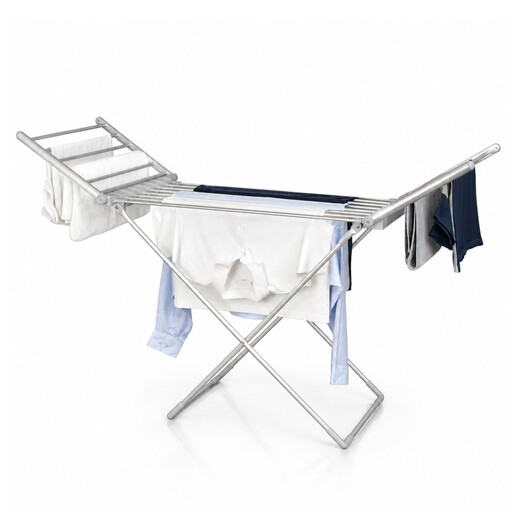
Consider the winged, folding layout if you prefer a rail airer that can be put away between loads.
The product name specifies aluminium construction and a 230 W rating. Measure the space needed with the wings open and check the folded size, sports-top drying layout and cable reach before ordering.
Choose a folding rail airer if flexible shelves, possible flat drying and storage between loads matter most; consider a covered pod if you usually dry a few tops on hangers and want timed operation. Confirm the exact model’s layout and follow each top’s care label.
Use its rated watts ÷ 1,000 × hours run × your electricity tariff per kWh to estimate the cost of a session. Actual running time matters, so a lower wattage alone does not establish which drying format will cost less for your loads.
Use one only if it is suitable for the total connected load and can be positioned safely. Electrical Safety First warns against exceeding the lead’s current rating or daisy-chaining extension leads; fully unwind a cable reel before use.
For electrical equipment placed on the Great Britain market, Department for Business and Trade guidance dated 31 March 2026 lists UKCA or CE marking. Its Northern Ireland route is different—CE, or UKNI together with CE—so check the seller’s information for the market where the airer will be supplied.