Sports-club students with frequent kit turnover
When tops, shorts and base layers are needed between training sessions, look for enough hanging space to separate garments rather than relying on a wet-load rating alone.


For smaller sports-top loads, consider a fold-away winged heated airer; when several housemates need drying space at once, compare three-tier racks for usable rail space and storage fit. A covered rack or warm-air pod may suit tops that need to hang separately, but check what equipment it requires and do not assume a particular drying time. Every indoor option still needs ventilation.
When tops, shorts and base layers are needed between training sessions, look for enough hanging space to separate garments rather than relying on a wet-load rating alone.
If an airer must be put away after use, check its erected footprint and folded dimensions as well as its total rail length.
Compare a model’s rated wattage against your household electricity tariff, and plan where laundry can dry with suitable ventilation.
Choose the format around the number of tops drying at once and the space available; then check the exact model’s storage dimensions, electrical rating and instructions.
Consider it when: Smaller loads need a rack that folds away between uses.
Bear in mind: Check whether its rail layout leaves enough room when more than one housemate has kit to dry.
Consider it when: Several people need rail space and floor space is limited.
Bear in mind: A wet-load limit does not tell you how many tops can hang without crowding.
Consider it when: You want to hang sports tops separately within a covered setup.
Bear in mind: Covers and pods have model-specific fitting requirements, and the airer may be a separate item.
| Concern | What to check | Who this matters to |
|---|---|---|
| Kit turnaround | Check room to hang tops apart and whether a suitable cover or pod is part of the setup. | If a top is needed again after training, I want space around it rather than a tightly packed rack. Around 31% of consumers put kit turnaround first. |
| Capacity and storage | Compare drying length and wet-load limit with the erected footprint and folded dimensions. | With several housemates sharing a drying area, I need room for our laundry without leaving a rack out permanently; roughly 25% of consumers prioritise capacity and storage. |
| Electricity use | Check the exact model’s rated wattage and calculate usage against your household tariff and operating hours. | When household bills are shared, I want to understand what running the airer will add. About 25% of consumers make electricity use their main concern. |
| Moisture and safety | Choose a ventilated drying room, keep vents clear and check the exact product identifier against recall notices. | If laundry dries indoors regularly, I need to manage condensation and avoid recalled electrical equipment; around 19% of consumers put moisture and safety first. |
A wet-load rating describes how much laundry a rack is designed to hold, not how quickly closely packed sports tops will dry.
Check that your usual load can hang with gaps between garments, and consider the rack’s layout as well as its stated capacity.
An illustration based on one electricity tariff will change with your household tariff and the hours you run the airer.
Use the exact model’s wattage and your tariff to work out an hourly figure, then consider how long your usual load needs.
Indoor laundry releases moisture even when it sits on a heated airer. Energy Saving Trust advises using available extraction and keeping vents clear to reduce the risk of condensation, damp and mould.
Choose a room with suitable ventilation and report recurring damp or mould to the housing provider rather than relying on the airer to resolve it.
The Office for Product Safety and Standards identifies a specific Dunelm Heated Winged Airer, article number 30752153 and barcode 5057722844042, as presenting a serious fire risk. It is not the Dunelm three-tier model discussed here.
Do not buy or continue using the recalled airer; follow the recall instruction to return it to Dunelm. Check exact identifiers when considering used equipment or older stock.
These ranges illustrate different airer formats; compare specifications for the particular model you intend to use.
Lakeland offers three-tier heated airers and hanging-garment drying formats for different space and storage needs.
Minky offers winged heated airers alongside covered and add-on drying systems.
Dunelm offers winged and vertical heated-airer formats, making exact model identification important.
These winged and three-tier heated airers are options to assess for drying sports tops indoors. Check how each one fits your available drying and storage space.
 No image available
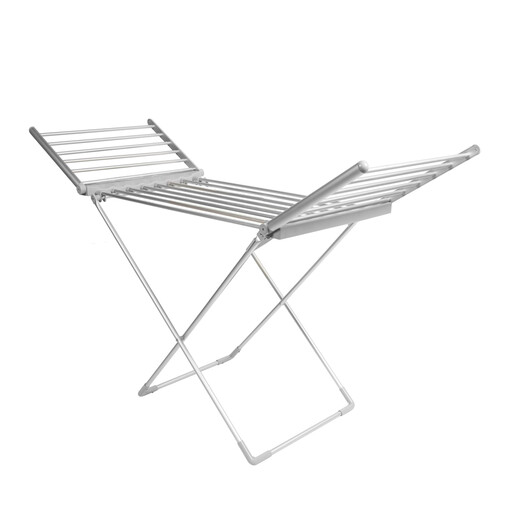
For sports tops in a shared house, check whether the winged layout leaves enough space to hang each top apart.
Confirm the open and folded dimensions for your room, and follow the product instructions when using a cover so that controls remain unobstructed.
 No image available
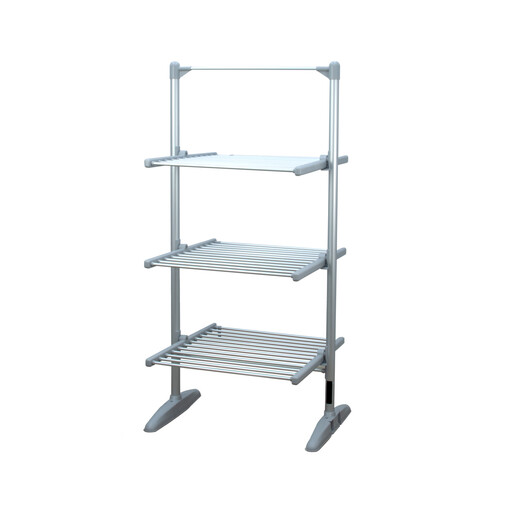
If several housemates need to dry kit, check how many tops its three-tier layout can hold without crowding and whether it fits your storage area when folded.
Rated power: 248W. Use that rating with your tariff to estimate hourly electricity use; it does not establish the energy needed to dry a complete load.
No: drying laundry indoors still releases moisture. Energy Saving Trust advises using available extractor fans and keeping vents clear to reduce the risk of condensation, damp and mould; report recurring problems to the housing provider.
Use each exact model’s rated watts divided by 1,000, multiplied by your tariff per kilowatt-hour, to estimate its hourly electricity cost. Then account for actual operating hours; an hourly figure alone cannot tell you the cost of drying a whole load.
Check its exact make, model and product identifiers against recall notices before buying. The Office for Product Safety and Standards says Dunelm Heated Winged Airer article number 30752153 can overheat and presents a serious fire risk; do not buy or use that recalled product, and follow the instruction to return it to Dunelm.
Not necessarily: start by checking whether the tops can hang separately on the rack. If you want a covered setup, confirm that the cover is intended for that airer and follow its instructions; do not assume that drying-time claims for one system apply to another.