Regular swimmers with a small wet kit
If you usually dry one or two costumes, pairs of trunks or rash vests, a rack that folds away between sessions may matter more than capacity for a full wash load.


For one or two swimsuits, a folding winged airer is a sensible starting point if its open footprint fits your utility room. Consider a covered drying pod for a larger hanging load, or a multi-tier rail airer if it will also handle household laundry. Whichever format you choose, check each garment’s care label and ventilate the room: heating the load does not remove moisture from the home.
If you usually dry one or two costumes, pairs of trunks or rash vests, a rack that folds away between sessions may matter more than capacity for a full wash load.
If condensation or persistent moisture is already a concern, plan how the room will be ventilated as well as where the airer will stand. Energy Saving Trust advises increasing ventilation when tackling condensation at home.
If towels and ordinary laundry will regularly share the airer with swimwear, hanging space and the appliance’s load limit become more important than they would be for a swimsuit alone.
Start with the load you actually need to hang, then check the airer’s open footprint and how you will ventilate the utility room.
Consider when: Swimwear is the main load and you want to fold the airer away between uses.
Allow for: The wings still need space when open, and garments need room between them.
Consider when: You want an enclosed hanging layout for several garments and towels.
Allow for: Check the pod’s full height and footprint before choosing it for a narrow room.
Consider when: The same airer will regularly hold swimwear and household laundry.
Allow for: Extra rails may be unnecessary for a small swimwear load; check whether a cover is included or sold separately.
| Concern | What to check | Who this matters to |
|---|---|---|
| Room moisture | Check for usable ventilation and a position that does not block airflow. A heated airer does not resolve an existing damp problem. | If condensation builds up while I dry laundry indoors, I need to manage moisture rather than add heat alone. For around 42% of consumers, moisture control would come first. |
| Garment and load handling | Check the swimwear care label, hanging layout and appliance load limit; keep dripping items away from the appliance, plug and lead. | When swimsuits share a rack with towels, I want space to hang them apart without exceeding its limit. Keeping garments and the wet load manageable would be the main concern for around 33% of consumers. |
| Space and controls | Measure the airer both open and folded, then compare its timer and rated wattage if these affect your routine. | I need to move around the utility room and put the airer away after use; a timer may also suit my routine. Around 25% of consumers would put space and controls first. |
Water evaporating from swimwear still enters the room. Energy Saving Trust advises increasing ventilation to help address condensation and damp.
Use available ventilation while drying, and investigate damp that persists rather than simply running the airer for longer.
Rated power describes electrical input, not how long a particular load will take to dry. Rail airers and fan-heated pods have different layouts as well as different wattages.
Compare the hanging layout, load limit, dimensions and controls alongside the power rating.
Water reaching an electrical appliance, plug or lead creates a safety concern. Coopers of Stortford’s three-tier heated-airer instructions tell users not to put dripping washing on the airer.
Rinse the swimwear and remove excess water before hanging it, then follow the instructions for your exact airer and the garment’s care label.
The Office for Product Safety and Standards published a recall for a particular Dunelm Heated Winged Airer on 29 January 2025 after an overheating risk was identified. That finding concerns the specified product, not every heated airer.
Check the exact model and article number against the Office for Product Safety and Standards recalls and alerts service. Stop using an airer if it is subject to a recall.
Lakeland’s Dry:Soon range is worth considering if the airer will handle towels and household laundry as well as swimwear.
JML’s DriBUDDi models offer an enclosed, fan-heated pod format rather than exposed rails.
Minky’s range includes rail, multi-tier and compact-pod formats, so the useful comparison is between specific layouts rather than the brand name alone.
Glamhaus has a digital rail model for buyers who want selectable temperature and a countdown timer.
The BLACK+DECKER 63159 is a folding winged-rail option for buyers assessing a small utility-room layout.
These folding rail airers are options for a utility room where swimwear may share hanging space with other laundry. Check the open footprint, the appliance instructions and each garment’s care label before choosing.
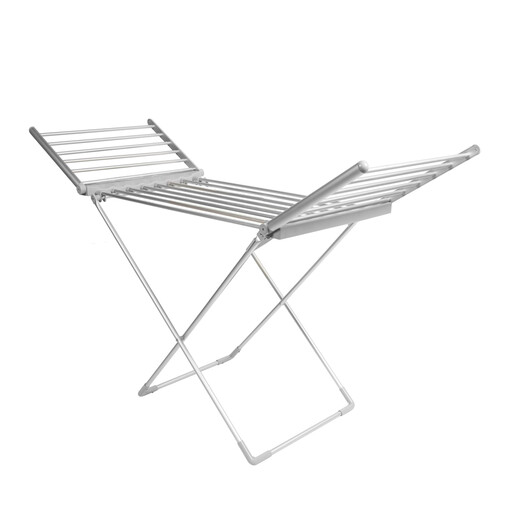 No image available
Consider this three-tier winged layout if swimwear will share the airer with other laundry and you have room to open its wings.
Check the open dimensions against your utility room, and keep the space ventilated while drying.
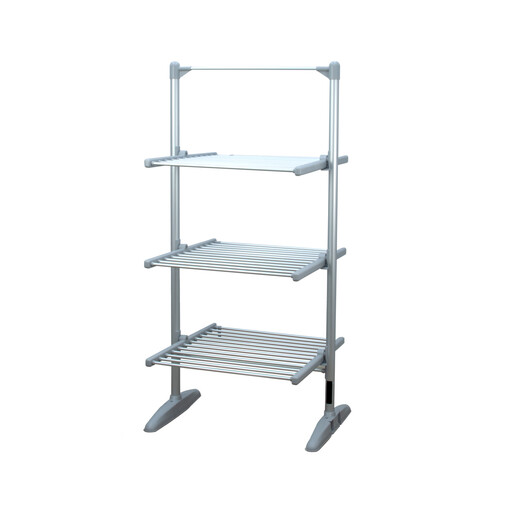 No image available
Consider this folding three-tier airer when you want a rail layout for swimwear alongside other laundry.
Confirm its open and folded dimensions for your room, and check whether a cover is included if covered drying matters to you.
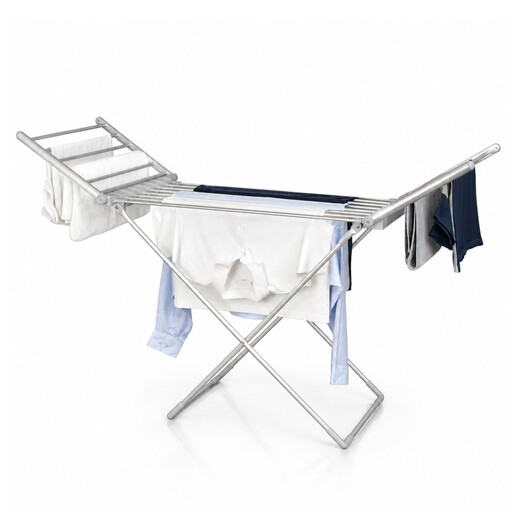 No image available
Consider this winged folding layout if you want to hang swimwear and towels apart and put the airer away afterwards.
Check its footprint with the wings open and its folded size before choosing a place for it.
No: drying swimwear indoors still releases moisture into the room. Energy Saving Trust advises increasing ventilation to address condensation; damp that persists may need separate investigation.
Rinse it, remove excess water and check its care label before hanging it. Keep garments from dripping onto the appliance, plug or lead, and follow the placement and load instructions for your exact model.
Not necessarily: rated wattage describes electrical input, while total use also depends on running time. Compare the airer’s power rating with the load you plan to dry and the controls you would use, rather than treating wattage as a whole-cycle comparison.
Yes, check the exact model and article number against the Office for Product Safety and Standards recalls and alerts service. Its recall published on 29 January 2025 concerned a specific Dunelm Heated Winged Airer with an identified overheating risk, not all winged airers.