Housemates sharing one laundry area
Compare rail length and the stated wet-load rating against the loads residents expect to dry in turns. Leave enough space between T-shirts rather than treating a load rating as a drying-speed promise.


For housemates drying cotton T-shirts in turns, a covered three-tier heated airer offers shared rail space without committing to a larger four-tier rack. Consider a four-tier model if larger mixed loads are frequent and it can stay open; a heated-pod setup suits smaller, scheduled loads. Whichever format you choose, check its open and folded size, stated load, room ventilation and access to a suitable socket.
Compare rail length and the stated wet-load rating against the loads residents expect to dry in turns. Leave enough space between T-shirts rather than treating a load rating as a drying-speed promise.
Check both the open footprint and folded dimensions. A tiered airer may use vertical space, but it still needs a place to stand during use and somewhere to go afterwards.
Choose a location where the home’s ventilation can be used and the lead can reach a suitable socket safely. A heated rack does not remove the moisture released by indoor laundry.
Choose it when: Several housemates need turns for T-shirts and everyday laundry, but the rack must be put away afterwards.
Allow for: An open rack that still occupies communal space; check that its cover belongs with the exact frame.
Choose it when: Larger mixed loads are frequent and the household has a place where the rack can remain open.
Allow for: More floor and storage space than a compact option needs.
Choose it when: Housemates prefer smaller assigned loads and timer-controlled drying turns.
Allow for: A lower stated load capacity than the larger examples here, and check that the pod fits its intended airer.
| Concern | What to check | Who this matters to |
|---|---|---|
| Shared-load capacity | Compare drying length and stated wet-load capacity for the exact model; leave room between garments. | When several housemates have T-shirts to dry on the same day, I need enough rail space for separate turns without crowding them; around 36% of consumers put shared-load capacity first. |
| Floor space and storage | Measure the open footprint, folded size and clearance around doors and walkways. | If I have to clear the communal room after my turn, I need a rack I can store without blocking the space; roughly 28% of consumers prioritise footprint and storage. |
| Moisture and electrical safety | Plan room ventilation and a suitable socket arrangement; check the exact model against recall notices. | With laundry drying indoors near a shared socket, I want to manage moisture and avoid overloaded leads; about 36% of consumers put ventilation and electrical safety first. |
UK product recalls identify particular items. The Office for Product Safety and Standards recalled Dunelm Heated Winged Airer article 30752153 and Lakeland Dry:Soon Airer with Heater model 53432; neither name identifies every airer sold by those brands.
Check the exact model, article number and any batch details against UK recall notices before using a new or second-hand airer. If yours matches a recall, stop using it and follow the notice.
A cover does not remove moisture from the room. UK government home-ventilation guidance explains that trapped moisture can cause condensation and contribute to damp and mould.
Choose a location where you can use the home’s ventilation as intended, and keep fitted trickle vents unblocked.
Overloaded extension equipment can overheat. This matters when housemates also need the nearest socket for other appliances.
Use an accessible wall socket where possible. If an extension is needed, check its rating and the combined load; Electrical Safety First advises one extension device per socket and fully unwound cable reels.
A higher-capacity rack may be awkward to leave open or store in shared space. Minky lists its SureDRI four-tier airer as 147 cm × 73.5 cm × 71 cm when open, while Dunelm states that its cited A-frame bundle folds to 7.3 cm deep.
Mark out the intended drying and storage positions, allowing for doors, walkways and the power lead.
Lakeland’s covered Dry:Soon Deluxe three-tier bundle is one reference point for shared loads.
Dunelm offers an A-frame covered-airer format for households weighing drying space against storage depth.
Beldray has both a larger three-tier airer and a smaller heated-pod bundle.
Minky’s covered SureDRI four-tier model is an option to assess where larger shared loads are frequent.
These three indoor heated airers are options to consider for housemates drying T-shirts in turns. Compare their rail layout and room fit individually; their presence here does not establish which will dry a shared load fastest.
 No image available
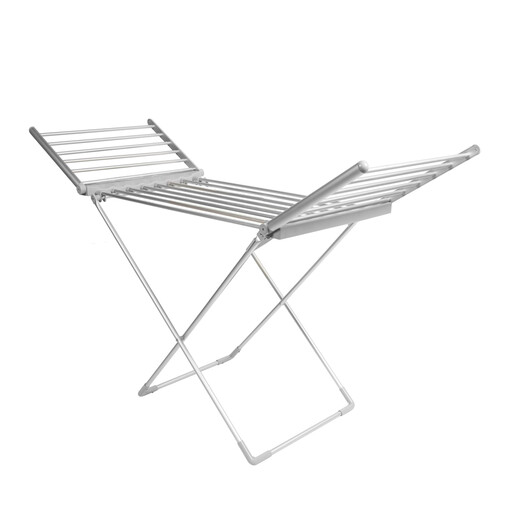
For shared T-shirt drying turns, check how the three-tier winged layout fits your available floor space and the garments you need to hang.
If you plan to use a cover, follow the instructions for this airer and keep the room ventilated.
 No image available
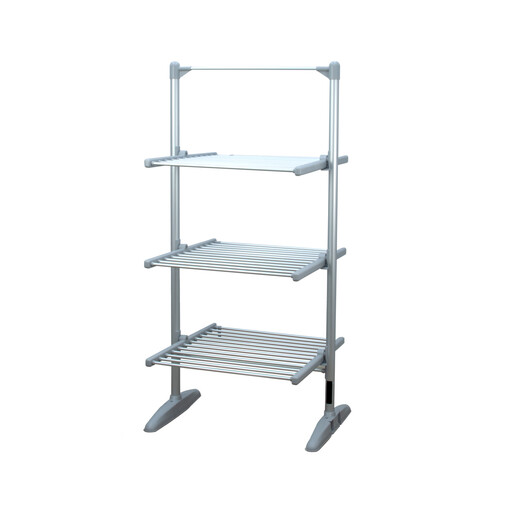
For housemates taking turns with indoor laundry, check its usable rail space and both the drying and storage positions before choosing it.
The product name states a 248 W rating; that figure alone does not determine drying time.
 No image available
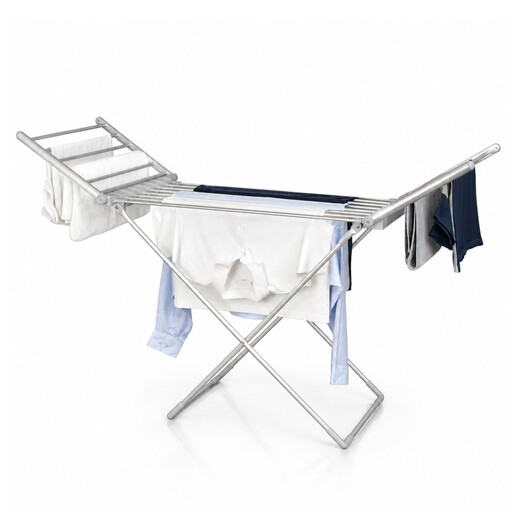
If communal space must be cleared between laundry turns, check the winged airer’s open and folded fit as well as its usable rail space.
The product name specifies aluminium construction and a 230 W rating; arrange room ventilation for indoor drying.
Choose by how many residents need drying space at once, then compare the exact airer’s stated drying length and wet-load rating. For scale, Lakeland states 21 m and up to 15 kg for its covered Dry:Soon Deluxe three-tier bundle, while Beldray states 15 m and up to 7 kg for its heated-pod bundle. Leave gaps between garments; a load rating is not a drying-time guarantee.
No: drying clothes indoors still releases moisture into the room. UK government home-ventilation guidance warns that trapped moisture can lead to condensation, damp and mould, so use the home’s ventilation as intended and keep fitted trickle vents unblocked.
Only if the extension equipment is suitable for the combined load and used correctly; an accessible wall socket avoids relying on one. Electrical Safety First advises against daisy chaining, recommends only one extension device per socket and says cable reels should be fully unwound.