A folding winged heated airer makes sense for occasional tea-towel loads if it fits both your drying spot and storage space. Consider a three-tier model when housemates will also use it for larger loads; a covered system needs enough clear space and a cover intended for that model. Check accommodation rules and your electrical setup before buying, and plan for ventilation because indoor drying still releases moisture.
Who is this for?
Students who need to check permission first
If you live in halls or managed accommodation, check the written appliance rules before ordering. Newcastle University lists electric clothes airers among prohibited items in its own accommodation policy; that restriction should not be assumed to apply to every student house. Electrical Safety First also advises students to pay attention to electrical safety and avoid overloaded sockets.
Households with small loads and little storage
If tea towels, dishcloths and occasional clothing are your usual load, measure where an airer will stand and where it will go afterwards. The winged examples described by Beldray and Joybuy offer 12m and 11.5m of stated drying space respectively, while the cited tiered models offer more rail length that a small load may not need.
Housemates sharing one drying space
If several people will add clothing to the tea-towel load, compare usable rail length, the open frame's position and whether a timer suits your routine. Lakeland and Dunelm state 21m and 20m of drying space respectively for their cited three-tier models; those figures describe particular models, not every airer from either brand.
What matters when choosing?
For a student house, establish whether a heated airer can be used safely and is permitted before deciding how much rail space the household needs.
| Concern |
What to check |
Who this matters to |
| Permission and safe indoor use |
Read accommodation rules, check the intended socket and appliance instructions, and choose a position where moisture can be managed. |
If my accommodation prohibits the appliance, or the available position creates an electrical or condensation concern, its size is beside the point. Around 42% of consumers would put permitted, safe use first. |
| Small loads and storage |
Measure the open footprint, walking clearance and folded storage space; compare rail space with your usual load. |
I mainly dry a few tea towels and need the shared room clear afterwards, so an oversized frame would be awkward. For around 33% of consumers, fitting small loads and storage would be the primary concern. |
| Shared-load capacity |
Compare stated drying length, open dimensions and load limit; check whether a timer or model-specific cover is included. |
When several housemates use one airer for clothing as well as tea towels, I need room to separate their items and a manageable drying routine. Shared-load capacity would come first for around 25% of consumers. |
Buying pitfalls
-
Assuming a small appliance is allowed everywhere
Newcastle University explicitly lists electric clothes airers among prohibited items in its own accommodation policy. Other providers may set different rules.
Check your residence handbook, tenancy terms or accommodation team before ordering.
-
Expecting heat to remove indoor moisture
Damp tea towels still release moisture into the room as they dry. UK Government guidance identifies condensation as a common cause of damp and mould in homes.
Choose a place where ventilation is possible without obstructing vents, and raise persistent condensation or mould with your landlord or accommodation provider.
-
Using wattage as a drying-time promise
A power rating describes electrical consumption while an airer is running; it does not establish how long a particular load will take to dry. Load size, spacing and room conditions also matter.
Use the exact model's wattage to assess electricity use, and consider how you will space the usual load rather than choosing on the rating alone.
-
Choosing maximum capacity before measuring the room
The cited Lakeland, Dunelm and Minky tiered models offer 20m to 23m of stated drying space, but a tall frame needs a clear position while open. That extra capacity may serve shared clothing loads better than tea towels alone.
Measure both the open position and folded storage space, leaving the clearance needed to move through the shared room.
Brands to consider
These model examples show how heated-airer formats differ; check the specifications of the particular version you are considering.
Lakeland Dry:Soon
Lakeland's cited Dry:Soon Deluxe is a three-tier option for a household planning regular, larger drying loads.
- Lakeland states 21m of drying space, capacity up to 15kg and a 1–12 hour timer for this model.
- Its stated height is 132.5cm. Lakeland describes a dedicated cover as an additional accessory, so check the complete setup and available space.
Dunelm
Dunelm's cited three-tier airer offers more stated rail length than the winged examples for shared laundry.
- Dunelm states 20m of drying space and a load limit of up to 15kg for this model.
- At a stated 138cm high when open, it needs a measured position and may offer more capacity than tea towels alone require.
Beldray
The cited Beldray models offer two different approaches: a winged rack and a covered pod system.
- The cited winged model states 12m of drying space, 18 heated bars and 230W rated power.
- Beldray's covered pod is designed around its matching three-tier airer; do not assume its components or cover fit a winged model.
Minky
Minky's cited sureDRI four-tier model is a covered option for households intending to dry larger shared loads.
- Minky states 23m of drying space, a 20kg load capacity, an included cover and programming up to nine hours.
- Its stated open dimensions are 147 × 73.5 × 71cm, making room fit an important check for a small shared space.
BLACK+DECKER
The cited BLACK+DECKER examples include an X-frame model and a winged model, with specifications that differ by version.
- The 63189 X-frame model is listed with 24 heated bars and a stated 15kg load capacity.
- Joybuy's cited winged model instead states 11.5m of drying space and a 10kg capacity. Check the exact model rather than applying either set of figures across the brand.
Joybuy options for small and shared loads
These winged and three-tier airers address different load sizes: consider the winged formats for occasional tea towels, or a tiered format if housemates also need space for clothing. Check each model's fit and your accommodation rules before choosing.
 No image available
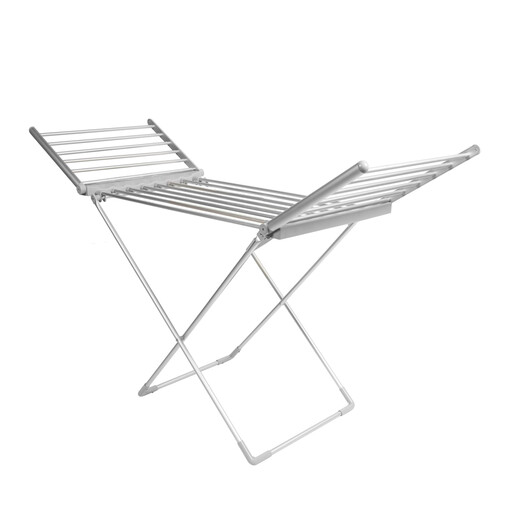
Pifco 3 Tier Winged Heated Airer
Consider this winged format for occasional tea towels if its open position leaves enough room to move around it.
If using the cover described for this airer, follow its instructions about covering the frame and keeping the controls unobstructed.
View on Joybuy
 No image available
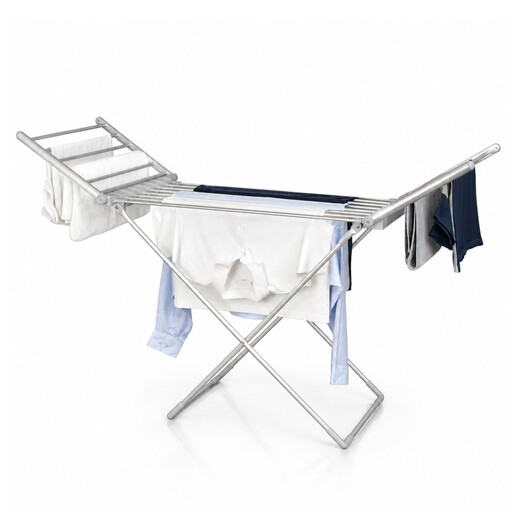
STATUS 230W Foldable Aluminium Heated Airer with Wings, Silver
The winged format is relevant to smaller loads where the airer also needs to be stored between uses.
Joybuy describes 20 heated bars and a stated maximum load of 15kg for this model. Check its dimensions against both the drying spot and storage space.
View on Joybuy
 No image available
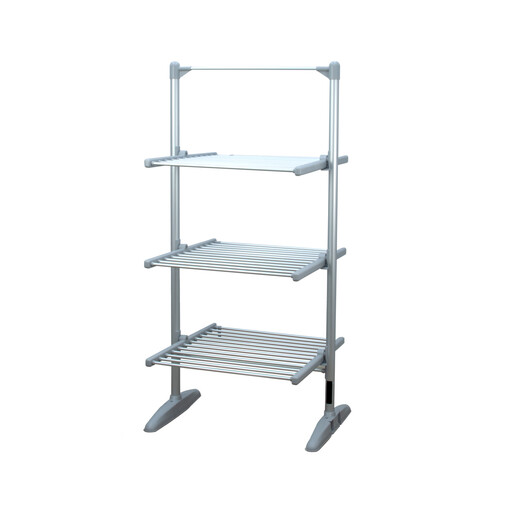
Status Three-Tier 248W Foldable Aluminium Heated Airer
Consider a three-tier frame if housemates intend to dry clothing as well as tea towels, rather than buying extra tiers for a few small items.
Measure the intended open position and folded storage space before choosing a place for it.
View on Joybuy
Questions about heated airers
Can I use a heated airer in student accommodation?
Check your own accommodation rules before buying; permission is not automatic. Newcastle University lists electric clothes airers as prohibited items in its own accommodation policy, but that is a provider-specific restriction, not a rule for every student property.
How does wattage relate to a heated airer's electricity use?
Multiply the rating in kilowatts by the hours the airer runs to estimate electricity consumed. A 230W airer running for one hour uses 0.23kWh; its rating alone does not tell you how long a load will take to dry.
Will a heated airer prevent condensation while tea towels dry?
No. Water from damp tea towels still enters the room as they dry, so choose a suitable ventilated location. UK Government guidance identifies condensation as a common cause of damp and mould; raise persistent problems with your landlord or accommodation provider.
Can I plug a heated airer into an extension lead?
Only use an extension lead if its marked rating accommodates the total connected load and its instructions permit the setup. Electrical Safety First warns against overloaded sockets and daisy-chained extension leads; avoid damaged equipment and follow the airer's instructions about positioning it away from water.


