For mainly underwear, start with a compact covered or tiered rail airer that lets you space small garments apart, rather than assuming you need a family-load model. An enclosed warm-air dryer is worth considering if a timed, covered cycle matters more to you than lower rated power. Check the appliance’s open dimensions and ventilate the room whichever format you choose.
Who needs which setup?
Underwear-only and small-load dryers
If underwear, socks and other small garments make up most loads, focus on room to separate them and on whether peg or mesh accessories suit the way you dry them. A large stated load capacity may be less useful to you.
Households short on indoor space
If the airer must be put away between loads, compare its open footprint with its folded dimensions. Check where it can stand safely while the room’s ventilation remains usable.
Frequent mixed-load dryers
If underwear shares the airer with regular household laundry, drying space and load capacity matter more. Larger tiered models take up more room, while an enclosed warm-air model has a different power requirement.
What matters when choosing?
Start with the space your underwear needs on the airer, then check where the appliance will stand and be stored. Compare rated power alongside the time you expect to run it; wattage alone does not establish drying time.
| Concern |
What to check |
Who this matters to |
| Small-garment layout |
Check usable rail spacing and whether compatible peg or flat-mesh accessories are included or sold separately. |
I want to spread underwear and socks apart rather than crowd them onto broad rails. Around 33% of consumers would put small-item layout first. |
| Electricity use |
Compare rated wattage and likely running hours using your own electricity unit rate. |
For recurring small loads, I want to judge electricity use without buying capacity I rarely use; roughly 25% of consumers would make running cost their primary concern. |
| Room and storage fit |
Measure the open footprint, height and folded dimensions; check for a dry, stable position that does not block ventilation. |
I need the airer to fit while it is open and disappear between loads. Space and storage would come first for around 25% of consumers. |
| Frequent mixed loads |
Check the stated load limit and drying-space length, plus the cover and timer if those features matter to you. |
When underwear shares the rack with larger household loads, I need room to keep garments apart; about 17% of consumers would prioritise mixed-load capacity and cycle features. |
Checks before buying and using
-
Comparing electricity use by the hour alone
A higher-wattage appliance draws more electricity per hour at its rated power, but the total also depends on how long you run it. The cited rail-airer examples are rated at 220W and 300W; JML specifies 850W for DriBUDDi Compact.
Compare wattage and likely operating time using your own electricity unit rate rather than assuming that different appliances will finish a load in the same time.
-
Assuming heat removes the need for ventilation
Wet laundry still adds moisture indoors. UK government guidance for England explains that moisture trapped without effective ventilation can contribute to condensation, damp and mould.
Use the room’s existing ventilation as intended, keep fitted vents unblocked and follow the airer’s instructions. Investigate persistent condensation rather than assuming the airer is its only cause.
-
Overlooking an alert for the exact model
The Office for Product Safety and Standards has issued safety notices for specific heated airers; a notice about one identified product does not establish a fault across a whole category or brand.
Check the model and identifying numbers against product-safety alerts. If you own the recalled Dunelm Heated Winged Airer with barcode 5057722844042 and article number 30752153, stop using it and follow the recall instructions.
-
Assuming every cover or accessory is included
Minky specifies a supplied cover for its 4 Tier sureDRI, while Lakeland lists the cover and small-item accessories separately for its cited Dry:Soon 3-Tier model.
Check the contents and accessory compatibility for the exact model before deciding how you will hang or lay out underwear.
A compatible cover, peg accessory or mesh shelf may require a separate purchase.
Relevant brands and ranges
Lakeland Dry:Soon
A tiered rail-airer range to consider if you want flexible hanging space and optional accessories for small garments.
- Lakeland specifies 21m of drying space, a 15kg load limit and an 8cm folded depth for its cited 3-Tier model.
- Its cover, mesh shelves and peg accessories are optional rather than part of that airer’s standard package.
Minky sureDRI
A covered multi-tier format to consider when underwear is part of larger, frequent laundry loads.
- Minky specifies 23m of drying space, a 20kg load limit, a supplied cover and a timer of up to nine hours for its cited 4-tier model.
- At 147cm high and 73.5cm wide, that model needs its operating position measured before purchase.
JML DriBUDDi
An enclosed warm-air format for consumers who want a covered, timed cycle rather than exposed heated rails.
- JML specifies a zipped cover, a 10kg load limit and automatic switch-off at the end of the selected cycle for DriBUDDi Compact.
- Its 850W rating means more electricity use per operating hour at rated power than the cited 220W and 300W rail airers; it does not establish how long an underwear load will take to dry.
BLACK+DECKER
A winged, foldable rail format relevant to consumers considering a smaller drying setup.
- Joybuy’s listing for model BXAR0001GB describes 18 bars, 11.5m of drying space and a 10kg load limit.
- That specific listing was marked unavailable; check availability before planning around this model.
Joybuy products for this setup
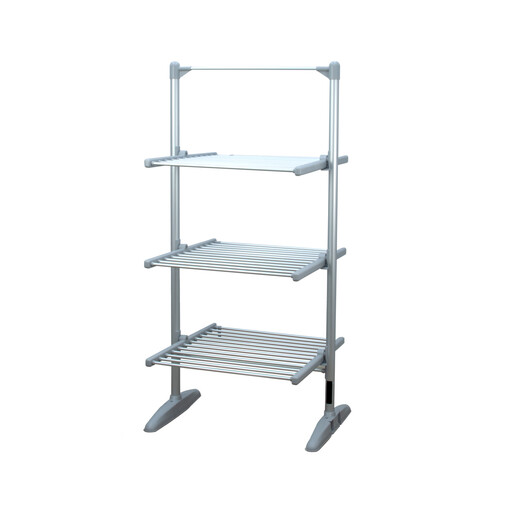
This tiered rail airer is a choice to examine if you want a foldable setup for drying underwear indoors. Check its open dimensions and rail spacing against your room and the garments you usually wash.
 No image available
Status 3-Tier 248W Foldable Aluminium Heated Airer
Consider this foldable tiered airer if underwear is your main indoor load and storage matters between uses. Its stated rating is 248W. Before choosing it, check the open and folded dimensions, rail spacing and whether the cover or small-item accessories you want are compatible and included.
View on Joybuy
Common questions
Should I choose heated rails or an enclosed warm-air dryer for underwear?
Choose heated rails if spacing individual small garments and lower rated power are your priorities; consider an enclosed warm-air dryer if you prefer a timed, covered cycle and accept its higher rated power. The cited JML DriBUDDi Compact is rated at 850W, while the cited Dunelm two-tier and Minky four-tier rail airers are rated at 220W and 300W respectively. Those ratings alone do not establish drying time.
Do I need to ventilate the room while using a heated airer?
Yes. UK government guidance for England explains that moisture from indoor laundry can become condensation when ventilation is ineffective. Use existing ventilation as intended, including keeping fitted vents unblocked, and follow the appliance instructions.
Can I use a stated hourly running cost to compare airers?
Only if you also check the wattage, electricity-rate basis and likely running time. Your electricity unit rate and the length of a drying cycle affect what you pay, so an hourly figure alone cannot settle which format will cost less for your load.
Is there a heated-airer recall I should check?
Check the identifying details of the exact appliance you own or plan to buy. The Office for Product Safety and Standards recorded a recall for the Dunelm Heated Winged Airer with barcode 5057722844042 and article number 30752153; owners of that identified product were told to stop using it and return it to Dunelm. The notice does not apply to every heated airer.


