Choose a heated airer by the space it occupies while towels are drying, not just by how thinly it folds. A three-tier airer can use height when floor space is tight, while a winged model gives towels wider rails but needs more clear width; a compact towel rail is another option for a smaller load. Whichever format fits, check the towel arrangement, socket reach and ventilation: heating the airer does not remove moisture from the flat.
Who needs to consider the fit?
Flat dwellers short on storage
If the airer must be put away after each use, measure both its open position and the gap where it will be stored. Lakeland describes folding models with different open layouts; a slim folded depth alone will not tell you whether towels can dry without blocking the room.
Small households drying thick towels regularly
Check the stated wet-laundry capacity and whether towels can be spread across accessible rails without crowding. Heavier fabrics such as towels need extra time, so capacity is not a promise of drying speed.
Indoor dryers dealing with condensation
A heated rack still releases the towels’ moisture into the home. Energy Saving Trust links good ventilation with a lower risk of condensation, damp and mould, while Islington Council advises using an indoor clothes rack in a well-ventilated room.
What matters when choosing?
Decide where the airer can stand while loaded, then check how your towels will hang and how you will ventilate the room.
Three-tier airer
Consider it when: You can use height more easily than a long stretch of floor.
Trade-off: Towels need space between rails, and the open frame must fit the drying spot.
Winged airer
Consider it when: You have clear width to spread towels across broad rails.
Trade-off: The wings may obstruct a walkway even if the airer folds flat for storage.
Covered drying pod
Consider it when: A compact square floor area is easier to spare than a long wall.
Trade-off: Check the towel load and the model’s own power rating rather than assuming it behaves like a heated-rail airer.
| Concern |
What to check |
Who this matters to |
| Open space and storage |
Measure the open width, depth and height, then check the folded size and cable reach. |
If I have to leave a clear route through the room, the loaded airer must fit without getting in the way. Around 31% of consumers put usable space and storage first. |
| Towel capacity and layout |
Check the stated load limit and whether towels can hang across the rails without bunching or touching the floor. |
When several thick towels need drying, I want enough accessible rail space rather than capacity stated for laundry I cannot arrange comfortably. Towel capacity is the main concern for around 38% of consumers. |
| Moisture and electricity use |
Plan suitable ventilation; compare rated watts and likely hours of use for the load. |
If towels dry indoors regularly, I need a way for moisture to leave the room and a clear picture of electricity use. Roughly 31% of consumers make those operating conditions their primary concern. |
What can make an airer impractical?
-
Choosing by folded size alone
An airer that stores in a narrow gap may still take up much of the room when opened. A cited winged example is around 148cm wide while open.
Mark out the open width and depth before ordering. Allow room to hang towels, walk past and reach a suitable socket without pulling the cable taut.
-
Expecting heat to solve condensation
Water leaving wet towels enters the indoor air. Energy Saving Trust advises that ventilation lowers the risk of condensation, damp and mould.
Dry towels in a well-ventilated room and address recurring condensation or mould rather than relying on the airer to manage moisture.
-
Assuming every cover fits or comes with the airer
Cover arrangements differ by model: the cited Minky Wing includes a cover, whereas Lakeland lists a matching cover separately for its Dry:Soon Mini.
Check the exact model and bundle contents. Use only a cover specified as suitable for that airer, following its operating instructions.
-
Judging electricity use from wattage alone
Rated power describes electrical input, not the time a bath towel will take to dry. Different loads and run times prevent a wattage figure alone from establishing electricity use per load.
For a planning calculation, multiply the rated watts divided by 1,000 by the expected hours of use. Assess that result alongside towel capacity and the room’s ventilation.
Relevant brands for reference
Dry:Soon
Lakeland’s Dry:Soon Mini illustrates a three-tier format for a home with limited floor and storage space.
- For this Mini model, Lakeland states 13m of drying space, a 15kg wet-laundry capacity, configurable shelves and an 8cm folded depth.
- Lakeland lists its matching cover separately; check the full open dimensions and bundle contents before choosing a covered setup.
Status
Status lists a three-tier 248W foldable aluminium airer, a 230W winged version and a 100W five-bar towel rail.
- The foldable models state 248W and 230W; the five-bar rail states 100W.
- Check rail layout and capacity against the towels you intend to dry, and confirm what comes in the box.
Minky
The cited Minky Wing is a covered winged format for consumers who can set aside width to spread out towels.
- This model is listed with 12m of drying space, a stated 16kg capacity and an included zip cover.
- Its approximately 148cm-wide, 54cm-deep open footprint needs measuring against the intended room.
JML
The cited JML DriBUDDI Compact illustrates an enclosed pod that stands on a square footprint.
- This model is listed with a 64cm by 64cm footprint, an included cover and a stated 10kg capacity.
- It is rated at a maximum of 850W; assess electricity use using that rating and your expected run time, rather than a heated-rail model’s rating.
Joybuy heated airers and towel rails
These choices cover tiered and winged heated airers, plus a freestanding heated towel rail. Match each one to your available drying space and towel load; the format alone does not establish how long your towels will take to dry.
 No image available
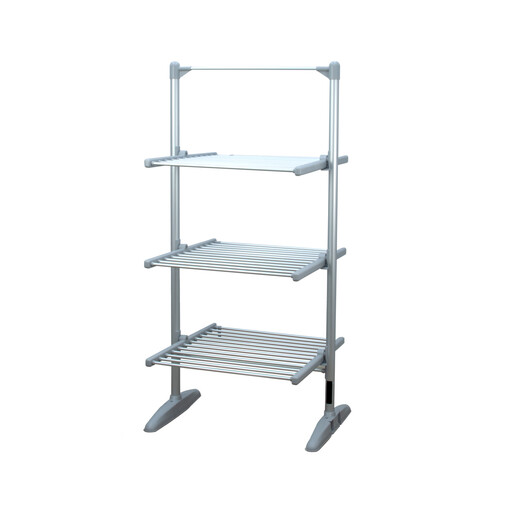
Status 3-Tier Foldable Aluminium Heated Clothes Airer, 248W
Consider this three-tier format if you would rather use height than leave a winged airer spread across the room.
The product name specifies a foldable aluminium design and a 248W rating. Check its open dimensions, towel spacing and cable reach for your intended position; ventilate the room while towels dry.
View on Joybuy
 No image available
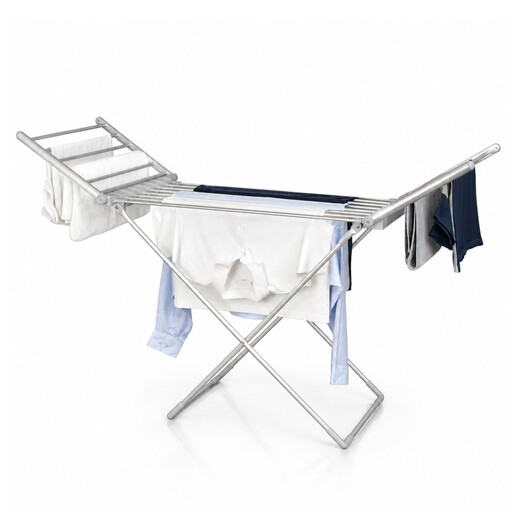
STATUS Foldable Aluminium Heated Clothes Airer with Wings, 230W, Silver
Consider the winged layout if you have enough clear width to arrange towels across it.
The product name specifies a foldable aluminium design and a 230W rating. Measure its open position and check cable reach before choosing a drying spot. If you want a cover, confirm whether one is suitable for this exact model and follow its operating instructions.
View on Joybuy
 No image available
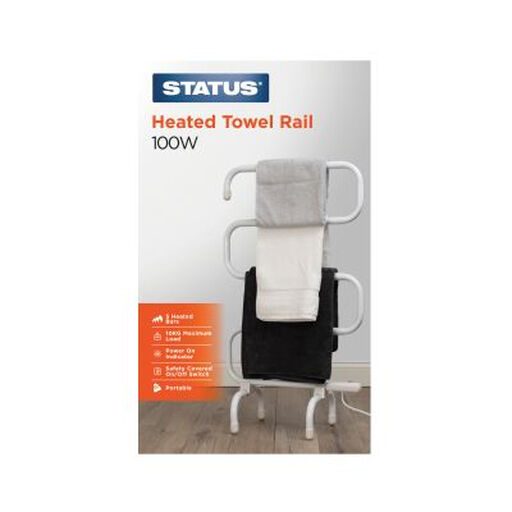
STATUS 5-Bar Freestanding Aluminium Heated Towel Rail, 100W, White
Consider this towel rail for a defined towel-drying spot, provided its bars give your towels enough room without crowding.
The product name specifies five bars, a freestanding aluminium design and a 100W rating. Check its footprint, storage fit and cable reach; follow the product instructions on leaving the heated bars uncovered during use.
View on Joybuy
 No image available
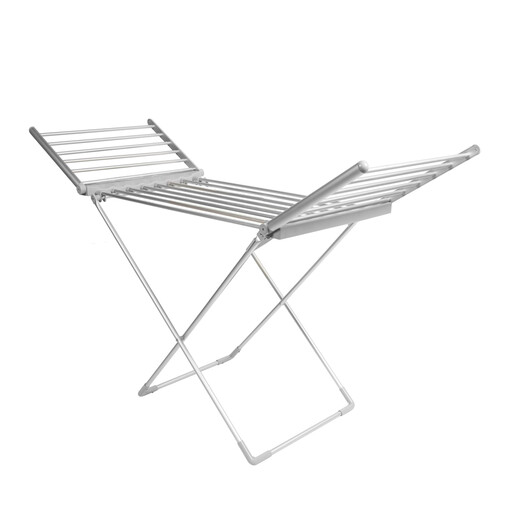
Pifco 3-Tier Winged Heated Airer
Consider this format if you want tiered rails but can also accommodate the wings when they are open.
Its name identifies a three-tier, winged design. Confirm the open and folded measurements against your room, and check the rating label if electricity use is important to your choice. Keep the drying room ventilated.
View on Joybuy
Common questions
Does a heated airer remove moisture from bath towels?
No: moisture from the towels still enters the room air. Islington Council advises placing an indoor clothes rack in a well-ventilated room, closing that room’s door and opening a window so moisture can leave.
What size heated airer works for bath towels in a small flat?
Choose by the open space available and by how the towels will hang, rather than folded depth alone. The cited examples include a covered pod with a 64cm by 64cm footprint and winged models around 148cm wide; allow extra drying time for heavier fabrics such as towels.
Can I put a cover on any heated airer?
No: check that a cover is intended for the exact model and whether it comes with the airer. The cited Minky Wing includes a zip cover, while Lakeland lists the matching Dry:Soon Mini cover separately.
Can a heated airer run from an extension lead?
Only use an extension lead if the connected appliances remain within its marked rating and the airer’s instructions permit that setup. Electrical Safety First warns against overloading extension leads or plugging one extension into another because overheating can create a fire risk.


