Choose a heated airer by the space it occupies while towels are drying, not by rail length alone. A tiered frame uses height, while a winged frame needs room to open at the sides; an enclosed dryer offers a different setup whose power use and required space need checking on the exact model. Before buying, compare the towel load, open and stored dimensions, cover instructions and rated power.
Who needs a compact towel airer?
People drying towels in a small flat
If one or two bath towels need drying in a tight corner, check where the airer will stand while open and where it will go afterwards. A tall frame or compact rail may be more practical than choosing the longest advertised rail length.
Households with several towels to dry
A narrow spot can still demand enough bars to keep towels apart. Compare the stated load limit and the room needed around an open frame, especially if a winged rack would obstruct access.
People using an airer regularly
Frequent indoor drying makes rated power and likely running time useful checks. Compare them for the models you are considering, alongside the manufacturer’s instructions for loading and placement.
What matters when choosing?
Start by measuring the space available while the airer is open, then check whether your usual towels can be spread across it without exceeding its stated load limit.
| Concern |
What to check |
Who this matters to |
| Floor space and storage |
Compare open dimensions with the actual drying spot, including access around the frame; check its stored dimensions too. Lakeland lists its Dry:Soon 3-Tier model at 73 × 75 × 137 cm open and 8 cm deep when folded. |
I need to walk past the airer and put it away after use, so its open and stored size matter more to me than maximum rail length. Around 31% of consumers put space and storage first. |
| Room for towels |
Check the stated load limit and whether the bars let you separate your usual towels. Lakeland lists 15 kg and 21 m of drying space for its Dry:Soon 3-Tier; Dunelm lists 10 kg and 13 m for its 2-Tier-and-Cover bundle. |
Several bath towels need room to hang without being crowded together, even if the frame fits the floor. Around 31% of consumers put towel capacity first. |
| Covered drying |
Check whether a compatible cover is included and how it must be ventilated. Dunelm specifies a mesh-bottom cover for its 2-Tier bundle; JML describes a zipped cover and timed shut-off for its DriBUDDi Compact. |
When towels are drying indoors, I want to assess a covered setup without blocking the ventilation it requires. For around 23% of consumers, the drying setup is the primary concern. |
| Electricity use and safe placement |
Compare rated power and expected operating time, then follow the model’s instructions for a dry, stable location. Dunelm lists its 2-Tier bundle at 220 W; JML lists its DriBUDDi Compact at 850 W. |
If I will use the airer often, I need to understand both how long it may run and where I can use it safely. Around 15% of consumers put electricity use and safe placement first. |
Common buying mistakes
-
Choosing by drying length without measuring the frame
Metres of rail do not show whether an open frame or its wings will fit without blocking the room. Lakeland publishes both drying length and open dimensions for its Dry:Soon 3-Tier model.
Mark out the open footprint where you intend to use the airer, leave access around it and check its stored size before ordering.
-
Treating a load limit as a drying-time promise
A stated capacity helps you screen for the size of your towel load; it does not say how quickly thick towels will dry. Heavier fabrics such as towels need extra time.
Check that your usual towels can hang with space between them, and allow for longer drying than you would for thin clothing.
-
Judging electricity use by wattage alone
Rated power tells you the appliance’s electrical rating, but a completed drying load also depends on how long it runs. Dunelm’s cited 2-Tier bundle is rated at 220 W, while JML’s DriBUDDi Compact is rated at 850 W; those figures alone do not establish which uses less electricity per load.
Compare the rated power and the operating time you expect for your towels, rather than assuming a lower wattage settles the whole comparison.
-
Using a cover without checking its instructions
Dunelm specifies a mesh bottom for ventilation on its 2-Tier bundle cover, and rooms used for indoor drying need ventilation. A cover is not a reason to ignore either the room conditions or the airer’s manual.
Use only the setup permitted for the exact model, keep its required ventilation clear and place the airer on a dry, stable surface.
Brands to consider for heated-airer formats
Dry:Soon by Lakeland
Lakeland offers stacked and other heated-airer formats. Its 3-Tier model provides a concrete size reference for shoppers considering a vertical frame.
- Lakeland states 21 m of drying space, a 15 kg capacity, 73 × 75 × 137 cm open dimensions and an 8 cm folded depth for the Dry:Soon 3-Tier.
- The compatible cover is sold separately from that base airer.
Dunelm
Dunelm lists winged and tiered heated airers, including a 2-Tier bundle for shoppers who want a cover supplied with the frame.
- Dunelm specifies 13 m of drying space, a 10 kg washing load, 220 W rated power and a mesh-bottom cover for its 2-Tier-and-Cover bundle.
- Check that bundle’s open dimensions against your drying spot before choosing it for a tight room.
Minky
Minky’s sureDRI XL Winged airer is a wider-rail option to consider where towels can be spread out and the wings have room to open.
- Minky describes this model as suitable for towels and longer items, with a cover included and flat-folding storage.
- Check the selected model’s open width: a winged frame needs lateral clearance while in use.
JML DriBUDDi
JML’s DriBUDDi Compact uses an enclosed warm-air arrangement rather than exposed heated rails.
- JML lists a zipped cover, a 10 kg damp-load capacity and automatic shut-off at the end of the selected drying time.
- Its stated 850 W rating and fold-out-leg setup make operating time and the permitted placement important checks.
Joybuy heated airers and towel rails
These tiered and winged airers and freestanding towel rails offer different ways to arrange towels indoors. Compare the space each needs while open with the number of towels you usually dry; a model’s name or wattage alone cannot establish that it will fit.
 No image available
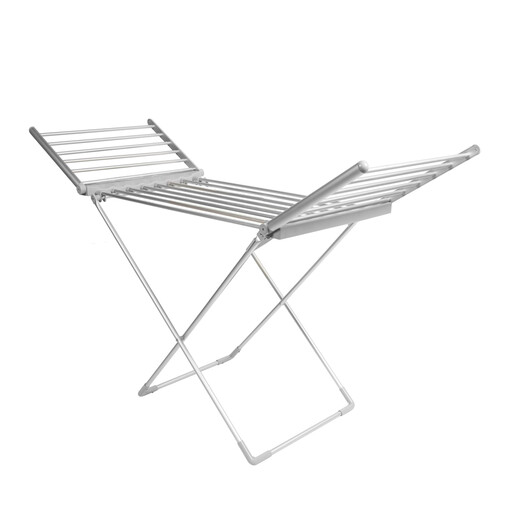
Pifco 3 Tier Winged Heated Airer
Consider this three-tier winged layout if you want to arrange towels across a frame that can be put away between uses.
Check its open dimensions, the clearance needed for the wings and the instructions for any cover before using it in a small room.
View on Joybuy
 No image available
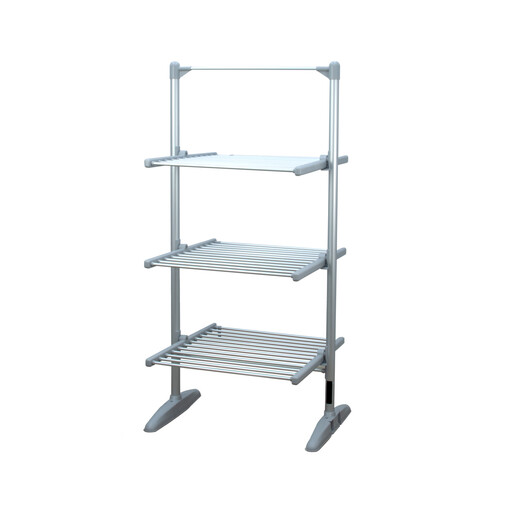
Status 3 Tier 248 W Foldable Aluminium Heated Clothes Airer
The three-tier format is worth considering if you need vertical drying space and intend to fold the frame away afterwards.
Rated power is 248 W. Check the open footprint and folded depth against your room and storage space before buying.
View on Joybuy
 No image available
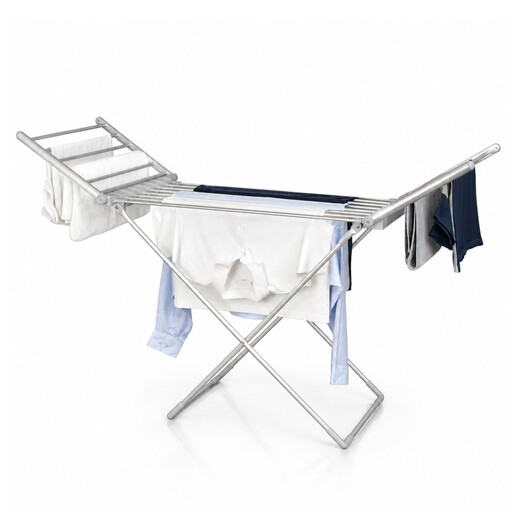
STATUS 230 W Foldable Aluminium Heated Clothes Airer with Wings
Consider the winged format if spreading towels across a wider frame matters more than keeping the drying setup narrow.
Rated power is 230 W. Confirm the space needed with the wings open and the dimensions when folded.
View on Joybuy
 No image available
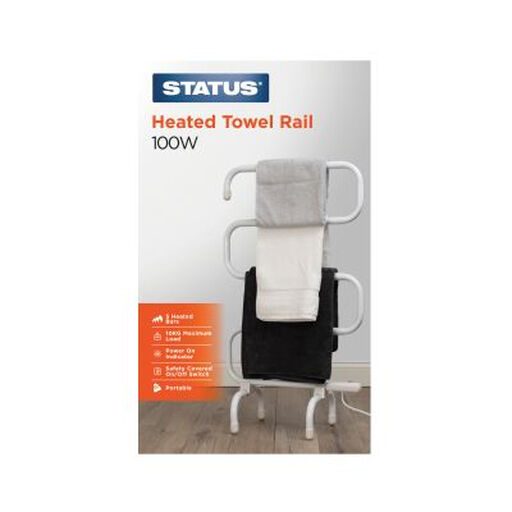
STATUS 100 W Freestanding Aluminium 5-Bar Heated Towel Rail
This freestanding towel rail may suit a smaller towel arrangement if five bars give you enough room to separate the items you dry.
Rated power is 100 W. Check its placement and storage dimensions against the space available between uses.
View on Joybuy
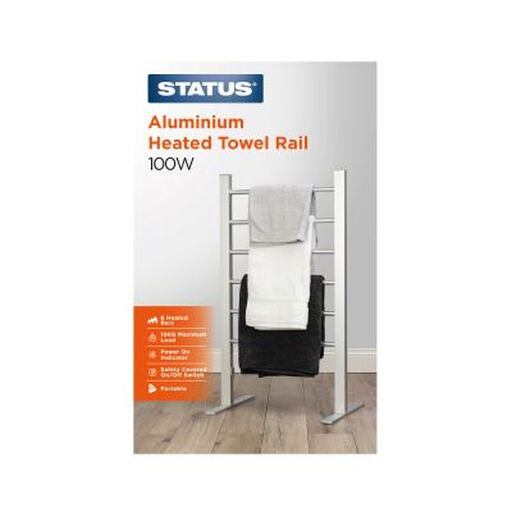 No image available
STATUS 100 W Freestanding Aluminium 6-Bar Heated Towel Rail
The six-bar arrangement is another towel-rail option to assess against your usual load, particularly if you prefer a freestanding rail to a tiered rack.
Rated power is 100 W. Confirm its overall dimensions and where it can be stored before choosing it for a tight room.
View on Joybuy
Questions about drying towels indoors
Which heated-airer format takes up the least floor space?
No format is automatically the smallest in your room: compare the open dimensions of the exact models. Three-tier frames are an option for larger loads in small spaces, but a winged frame also needs clearance at the sides, and every model needs a suitable place to stand.
Will a cover dry bath towels quickly?
A cover can retain heat around a compatible airer, but it does not promise a short drying time for thick towels. Dunelm’s 2-Tier bundle has a mesh-bottom cover for ventilation, and heavier fabrics need extra time; follow the cover instructions and ventilate the room.
Does a lower-wattage airer use less electricity for a load of towels?
Not necessarily: electricity used over a drying session depends on both rated power and operating time. Compare those two factors for your usual towel load rather than using wattage alone to judge completed-load use.
Can I leave a heated airer running overnight?
Check the exact model’s manual before deciding whether it may run unattended or overnight; do not assume that a timer permits either use. Joybuy’s BLACK+DECKER Heated Winged Airer listing instructs users to keep it on a stable surface, away from water and wet surfaces, and to unplug it when not in use.


