Small-flat sock dryers
If socks, underwear and other small loads are the main job, check the rack’s open footprint and folded depth before paying for more drying length. Lakeland’s Dry:Soon Mini is one compact format to measure against your space.


For routine sock drying in a small flat, start with a folding heated rack that fits both your drying spot and your storage space; extra rail length matters more if socks are part of larger loads. Consider a covered rack or fan-heated pod when enclosed drying or a priority load matters more, but keep the room ventilated and follow the appliance’s loading and supervision instructions.
If socks, underwear and other small loads are the main job, check the rack’s open footprint and folded depth before paying for more drying length. Lakeland’s Dry:Soon Mini is one compact format to measure against your space.
A covered rack or fan-heated pod may suit an occasional load that needs attention sooner. Check its timer, permitted operating time and supervision instructions rather than assuming it can run overnight.
When socks dry alongside larger laundry loads, a longer rack can be useful if its open dimensions still leave the room usable. Dunelm and Minky list covered models with more drying space than the cited Dry:Soon Mini.
Measure where the airer will stand and fold away, then decide whether small-item spacing, a cover or capacity matters most for your usual load.
| Concern | Buying checks | Who this matters to |
|---|---|---|
| Footprint and storage | Measure open width and depth as well as folded depth; allow access to the plug and room to move past the rack. | If the drying spot is also a walkway, I need an airer I can use without blocking it and put away afterwards. Around 29% of consumers put fit and storage first. |
| Drying small items | Check how socks can be spaced on the bars and whether a suitable cover or small-item accessory is included or compatible. | When a few pairs of socks need drying, I want room to separate them rather than bunch them together. For around 24% of consumers, handling small loads is the primary concern. |
| Indoor moisture | Check how the drying room is ventilated and whether condensation or damp already needs attention; a cover is not a moisture extractor. | If laundry dries in my main living space, I need a way for the released moisture to leave the room. Keeping indoor moisture under control comes first for around 29% of consumers. |
| Capacity and power | Compare drying length, maximum load, rated wattage and likely running time for the exact model; read its loading and supervision instructions. | If socks share the rack with regular laundry, I need enough space without overlooking how long the appliance will run. Around 18% of consumers make capacity and running power their main priority. |
More rail length can help with larger loads but does not mean an airer will fit a small room. Lakeland lists the Dry:Soon Mini at 60 × 63 cm across its open footprint; Minky lists its covered four-tier airer at 147 × 73.5 × 71 cm when open.
Measure the intended drying spot and storage gap before comparing drying length.
A cover encloses the laundry; it does not remove the water evaporating from it. GOV.UK guidance for homes in England explains that ventilation exchanges moisture-laden indoor air with outside air.
Keep suitable ventilation in use while drying and investigate persistent condensation or mould rather than relying on more heat.
Beldray’s heated-pod manual specifies a 1,000 W drying unit and a maximum operating time of three hours. The cited Minky four-tier rack is rated at 300 W and Dunelm’s A-frame at 330 W; wattage alone does not establish the electricity used for a completed load.
Compare rated power alongside expected running time and your electricity tariff. Follow the chosen model’s timer, loading and cool-down instructions.
Electrical Safety First warns that an overloaded extension lead, cable reel or adaptor can overheat, and advises against daisy-chaining extension leads.
Use a suitable wall socket where possible. If an extension lead is necessary, check its marked rating against the appliance and follow the appliance manual.
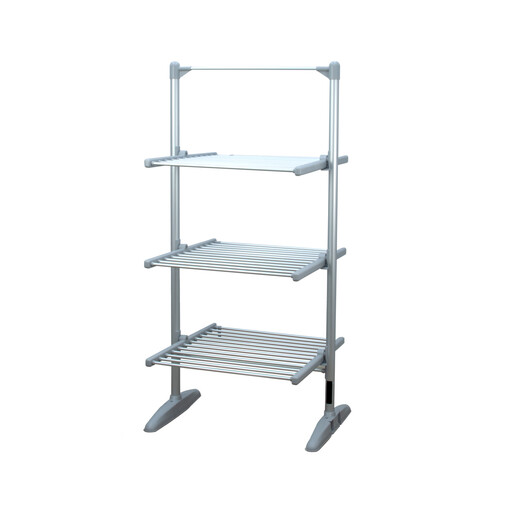
The range includes a Mini three-tier heated airer for smaller spaces and a standard three-tier model with more drying length.
Beldray’s covered heated-pod set is an alternative for priority loads where a timer matters.
Minky offers several airer formats, including a covered four-tier model intended for larger loads.
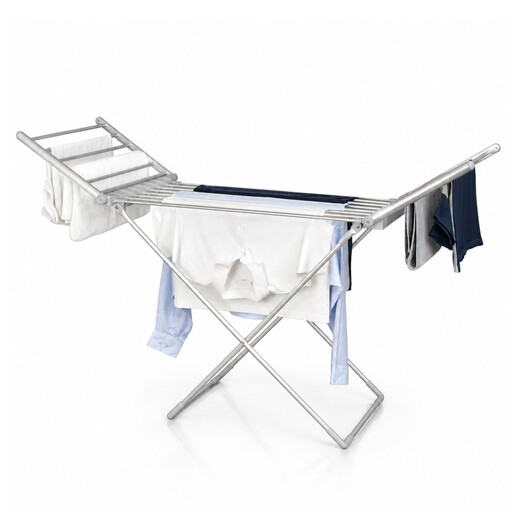
Dunelm’s cited A-frame bundle pairs a heated rack with a dedicated cover.
These folding heated racks are options to consider for indoor sock drying. Compare their open dimensions and folded depth with your flat before choosing between the three-tier design and the winged design.
 No image available
A folding three-tier format to consider if you want to put the rack away between small indoor loads.
Compare its open dimensions and folded depth with your available space, and check how you would space socks on the rack. Confirm the plug and supply requirements and follow the product’s operating instructions.
 No image available
A folding winged format to consider if its open shape fits your drying spot and lets you space out small items.
Compare its open dimensions and folded depth with your available space. Check the plug and supply requirements and follow the product’s operating instructions.
No. Water evaporating from socks enters the indoor air unless ventilation or another moisture-removal method deals with it. GOV.UK guidance for homes in England identifies clothes drying as a source of indoor moisture and explains the role of ventilation.
A cover is worth considering if enclosed drying matters more to you than keeping the setup as small as possible. Check whether it comes with the exact airer or is compatible with it; it does not replace room ventilation.
Not the cited Beldray heated pod. Its manual prohibits unattended and overnight operation, sets a maximum operating time of three hours and requires the unit to cool fully before reuse. Follow the instructions for the exact appliance you choose.
Check the appliance’s plug, supply requirements and operating instructions for your intended setup. Electrical Safety First advises against overloading or daisy-chaining extension leads; if you need one, check its marked rating against the appliance.
Do not rely on a heated airer to resolve an existing damp or mould problem. Investigate the underlying cause; if you rent, report it to your landlord or managing agent. GOV.UK guidance for England emphasises addressing underlying damp and mould issues promptly.