Small-home face-cloth dryers
If you wash face cloths often but need the airer out of the way afterwards, its open footprint and folded size matter more to you than maximum load capacity.


For a few face cloths, choose by the space an airer takes up when open and where it will go afterwards, rather than by laundry capacity alone. A fold-away winged rack suits a small-load routine; a three-tier airer is more relevant if you also dry larger loads, while a covered pod calls for a separate check of setup space and running time. Whichever format you choose, ventilate the room and follow that model’s instructions.
If you wash face cloths often but need the airer out of the way afterwards, its open footprint and folded size matter more to you than maximum load capacity.
If you regularly dry just a few damp items, consider whether heated rails or a covered drying cycle fit the space and routine you have available.
If condensation or damp is already a concern, plan how you will ventilate the room as well as where you will place the airer. Government ventilation guidance for England notes that moisture trapped indoors can become condensation.
For a face-cloth routine, check the space available for the airer first, then decide whether you also need capacity for larger laundry or prefer a covered drying cycle.
Choose it when: You mainly spread out a few small items and want to fold the rack away between uses.
Allow for: Open wings still need floor space; check the exact model’s dimensions rather than judging its fit from its folded appearance.
Choose it when: You also need drying space for towels or larger household loads.
Allow for: The additional capacity may go unused if you dry only a few face cloths.
Choose it when: You prefer an enclosed drying cycle with a timer, as offered by the JML DriBUDDi Compact.
Allow for: Check the space needed to set it up and the likely cycle duration; rated wattage alone cannot tell you the electricity used per cycle.
| Concern | What to check | Who this matters to |
|---|---|---|
| Open footprint and storage | Measure the available floor area and the gap where the airer will be stored. Check open and folded dimensions for the exact model. | If I need the floor clear after drying, an airer that folds away is useful only if it also fits while open. Around 42% of consumers put space and storage first. |
| Small-load routine | Check whether the model uses heated rails or enclosed warm air, and whether it has a timer that suits how you plan to use it. | When I wash face cloths repeatedly, I want a manageable drying routine rather than capacity for a full wash load. For around 33% of consumers, that convenience is the main concern. |
| Moisture and safe use | Plan effective ventilation and read the exact model’s instructions on positioning, damp items, loading and electrical safety. | If I already notice indoor condensation, I need to manage moisture while using an electrical appliance as instructed. This is the primary concern for around 25% of consumers. |
Lakeland states that its Dry:Soon three-tier airer holds approximately 15 kg across 21 m of drying space. That capacity may be useful for household laundry but is more than a few face cloths require.
Measure the open position and storage gap before deciding whether you will regularly use the extra drying space.
A larger airer can create a storage burden even when its capacity goes unused.
Rated power does not show how long an airer will run for your load. Which? notes that the value of a heated airer also depends on your existing drying method and how often you use it.
Compare rated watts alongside the timer setting or drying time you expect to use, rather than comparing hourly claims alone.
Government ventilation guidance for England explains that moisture trapped indoors can become condensation and contribute to damp and mould.
Maintain effective ventilation while drying face cloths indoors. If damp or mould is already present, address its underlying cause rather than relying on the airer to resolve it.
Covers, timers and operating precautions vary by airer. Instructions for one heated model cannot establish what is suitable for another.
Check accessory compatibility with the exact model and read its supplied instructions before use.
Lakeland’s range includes three-tier, mini, winged and pod formats. Its standard three-tier airer is worth considering if face cloths are only part of a larger laundry routine.
Minky’s winged heated airer offers a fold-away, horizontal-rack format.
The DriBUDDi Compact is a covered warm-air option for shoppers who prefer an enclosed cycle to heated rails.
The BXAR0001GB winged airer has published open dimensions that make it possible to check its fit before purchase.
These two fold-away heated airers cover different routines: a winged rack for small items and a three-tier format to consider if you also dry larger loads. Check each one’s open dimensions against your available space.
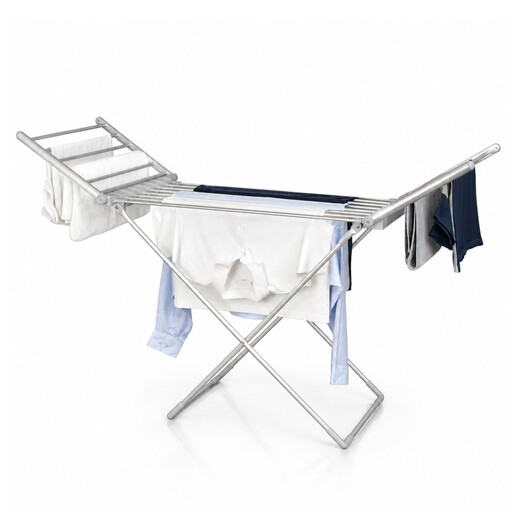 No image available
Consider the winged format if you mainly dry face cloths and want to put the airer away afterwards. Its stated rating is 230 W; that figure alone does not indicate electricity use for a drying session. Check its open dimensions, folded size and model-specific instructions before purchase, and ventilate the room during indoor drying.
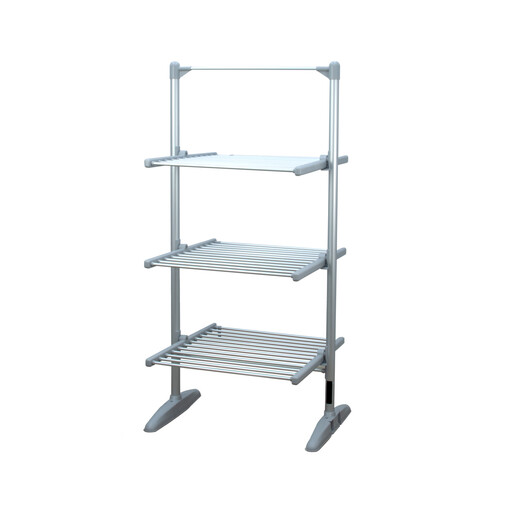 No image available
Consider the three-tier format if you also dry larger household loads, rather than face cloths alone. The product name states a 248 W rating and a foldable aluminium design. Check its open dimensions, folded size and model-specific instructions before purchase, and ventilate the room during indoor drying.
No: a heated airer does not remove the need to manage indoor moisture. Government ventilation guidance for England explains that moisture trapped without effective ventilation can become condensation and contribute to damp and mould.
No conclusion follows from wattage alone: electricity use also depends on how long the airer runs. When comparing models for face cloths, consider your likely running time as well as the rated power; Which? also notes that an airer’s value depends on how often you dry laundry and what method you currently use.
Follow the instructions for the exact airer, including any rules about how wet items may be. A heated-airer manual from Coopers of Stortford instructs users to ensure laundry does not drip before use and to keep the cord dry; those instructions should not be assumed to cover a different model.