Households drying small batches of reusable napkins
If table napkins and tea towels are the usual load, leaving space between items and finding somewhere to store the airer may matter more than a large maximum capacity.


Choose a compact winged heated airer if reusable table napkins and other small batches are its main job; consider a three-tier tower if it must also accommodate family laundry. Check the declared load and drying space against what you actually wash, then measure where the airer will stand and be stored. A fitted cover may help drying according to product makers, but it does not replace effective room ventilation.
If table napkins and tea towels are the usual load, leaving space between items and finding somewhere to store the airer may matter more than a large maximum capacity.
If the same airer must take ordinary wash loads, towels or bedding, compare its declared drying length and maximum wet-load capacity with your largest intended load.
A foldaway airer still needs a suitable place to operate. GOV.UK advises that moisture from drying clothes can become trapped indoors without effective ventilation.
Choose it when: Napkins, tea towels and small batches are the main load, and storage space takes priority over family-wash capacity.
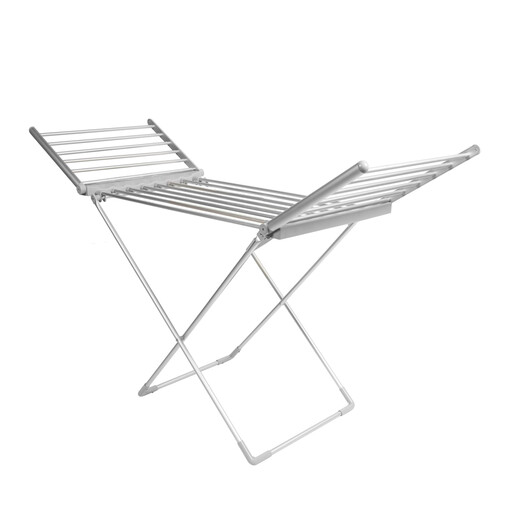
Trade-off: Joybuy lists a BLACK+DECKER winged example with 11.5 m of drying space and a 10 kg capacity, less than the 20–21 m and 15 kg stated for the cited three-tier examples from Dunelm and Lakeland.
Choose it when: The airer must regularly hold napkins alongside larger household laundry loads.
Trade-off: Check its open dimensions as well as folded storage space; a cover may be a separate, model-specific accessory.
| Concern | What to check | Who this matters to |
|---|---|---|
| Laundry capacity | Compare the exact model’s declared wet-load limit and drying length with your largest intended load. | If napkins must share the airer with a family wash, I need enough rail space to spread everything out; around 40% of consumers put capacity first. |
| Storage and small batches | Measure the open footprint and all folded dimensions; check cable reach for the intended position. | When I mainly dry a few napkins between meals, I want an airer that is easy to put away; around 30% of consumers prioritise small-batch use and storage. |
| Drying pace and controls | Check cover compatibility and whether the exact model offers the timer or temperature settings you want. | If napkins are needed again soon, I care about arranging a load for drying and choosing a run time; roughly 20% of consumers make turnaround their primary concern. |
| Moisture and electrical setup | Plan effective ventilation and a dry, level position near a suitable socket. | Where indoor drying could leave moisture trapped, I need a workable room and socket arrangement; about 10% of consumers place moisture and electrical setup first. |
A three-tier airer’s extra capacity is useful when it also takes household laundry, but it may take up more open space than a small-batch load warrants.
Decide on the largest load you expect to dry, then measure the available floor and storage space before choosing a format.
A larger airer can take up room while it is open and when it is put away.
Product makers say fitted covers can help drying. GOV.UK advises that moisture from drying clothes can become trapped in a home without effective ventilation.
Use only a cover specified for the airer, follow its instructions and keep the home’s ventilation working as intended.
Electrical Safety First warns that overloaded extension leads and adaptors can overheat.
Prefer a suitable wall socket. If an extension is needed, check its rating and condition, avoid daisy-chaining and fully unwind any cable reel.
A model’s stated capacity or full-load drying time does not tell you how quickly spaced napkins, thick towels and densely arranged laundry will dry.
Follow textile care labels, leave room between items and stay within the exact airer’s stated load limit.
Lakeland lists a Dry:Soon three-tier airer with 21 m of drying space and an 8 cm folded depth, aimed at households considering a tower format.
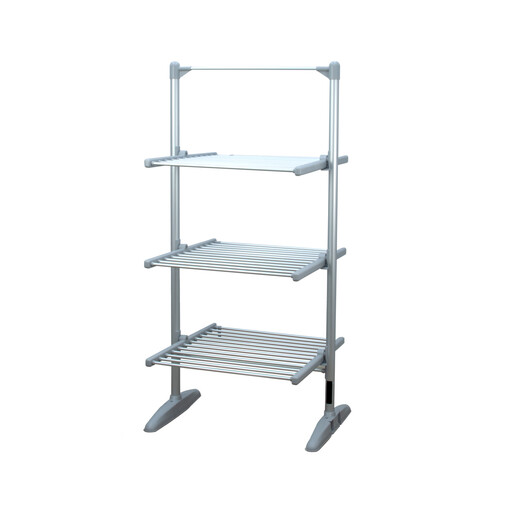
Dunelm lists a three-tier airer with 20 m of drying space, a stated 15 kg capacity and 300 W power.
The Glamhaus GL300 is a three-tier model for consumers who want selectable controls.
Igenix lists the IGHA02236S three-tier model with 36 heating tubes, a declared 30 kg capacity and an included cover.
These three-tier airers are choices for households drying table napkins alongside other laundry. Compare their layout and the stated features of each model with the space where you will use it.
 No image available
Consider its winged, three-tier layout if you want to space out napkins and other small textiles while retaining an airer for wider laundry use. Measure the open and stored positions before deciding whether it fits your home.
 No image available
Consider this three-tier model if napkins will share the airer with larger laundry loads. Joybuy states a 30 kg maximum load and 248 W power; the wattage alone does not establish the energy used to dry a load. Check that the airer fits its intended position and follow its instructions on arranging textiles.
A compact winged model is the more relevant format if napkins, tea towels and small batches are its usual job. Consider a three-tier tower when it will also regularly accommodate family laundry, and leave gaps between items rather than packing the rails tightly.
Product makers say a correctly matched cover can help drying, but the result depends on the load and room conditions. Confirm that the cover is specified for the exact airer and follow its airflow and use instructions.
Yes: moisture from drying textiles still enters the room air. GOV.UK advises that ineffective ventilation can allow moisture to become trapped, so use the home’s ventilation as instructed and keep vents unblocked.
Use one only if it is suitable for the appliance, undamaged and not overloaded. Electrical Safety First advises against daisy-chaining extensions and says cable reels should be fully unwound before use.