What matters when choosing?
Choose a layout that can hold your usual small-item load without crowding, then check whether it fits both the room and its storage spot. An unheated airer remains an option if avoiding electricity use matters more than drying speed; Which? reports that heated airers dry clothes more quickly than unheated air drying.
Full-size three-tier airer
Choose when: Frequent family loads need more places to separate underwear, socks and other garments; Minky and Lakeland each describe a three-tier format with 21m of drying space.
Allow for: Its open footprint and the need to leave gaps between garments, even when the stated capacity looks generous.
Compact three-tier airer
Choose when: Storage or room space takes priority and you can divide a larger wash into smaller loads. Lakeland states that its Dry:Soon Mini provides 13m of drying space and folds to 8cm deep.
Allow for: Less hanging length than the cited 21m formats; check the exact model’s open size and wet-load limit.
Cover or drying-pod conversion
Choose when: You already own a suitable three-tier rack and want to consider an enclosed heated setup instead of replacing the rack.
Allow for: Model-specific fit and installation requirements. Minky describes its Heat Pod Pro as fitting standard three-tier airers, while Beldray describes its unit as fitting most; neither wording establishes compatibility with every rack.
| Concern |
What to check |
Who this matters to |
| Usable drying space |
Compare drying length, wet-load limit and whether bars or shelves let small garments sit apart. |
When underwear and socks come through the wash frequently, I need room to spread them out rather than stack them together. Around 36% of consumers put usable capacity first. |
| Room fit and storage |
Measure the open footprint and the storage spot; check the folded dimensions of the exact model. |
If the airer has to be put away after each load, I need it to fit both places without obstructing the room. Space is the primary concern for around 29% of consumers. |
| Indoor moisture |
Plan effective ventilation and watch for persistent condensation; do not treat heating as a damp remedy. |
Where laundry dries indoors regularly, I want to manage the moisture it releases as well as dry the clothes. Around 21% of consumers prioritise damp management. |
| Electricity use and controls |
Check rated power, likely operating time and what the exact model’s timer actually controls. |
If I expect to run the airer often, I want to understand how long it needs to operate and when it switches off. Electricity use and control come first for around 14% of consumers. |
Heated airers on Joybuy
These heated airers offer three-tier or winged layouts to consider for family small-item laundry. Compare their actual bar arrangement and room fit before deciding how much of your usual load you can spread out at once.
 No image available
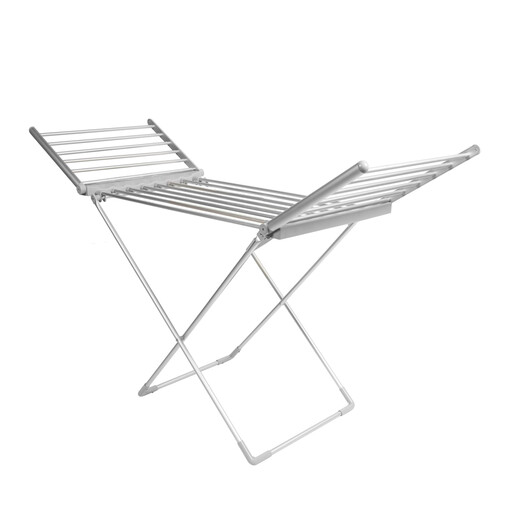
Pifco 3 Tier Winged Heated Airer
Consider this three-tier, winged layout if you want separate positions for a family’s small garments. Check its open dimensions and how the wings and tiers can be arranged for your usual load.
If you plan to use a cover, follow the exact model’s instructions for the permitted arrangement. Ventilate the room while drying laundry indoors.
View on Joybuy
 No image available
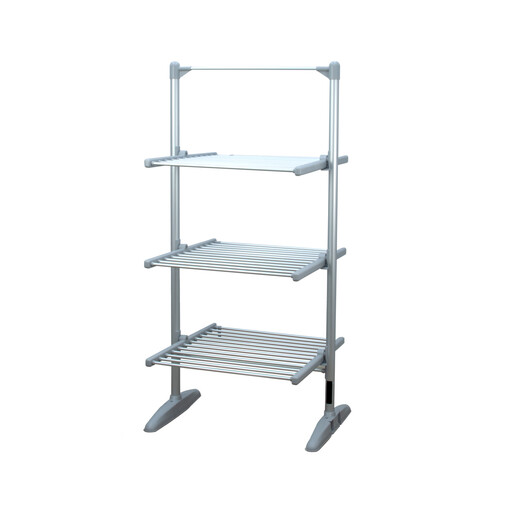
Status 3 Tier 248W Foldable Heated Clothes Airer
Its three-tier, foldable format is worth considering if you need several levels for small garments but put the airer away between loads. The product name states a 248W power rating; that figure alone does not tell you how long a load will take to dry.
Check the open dimensions and bar spacing against your room and laundry, and ventilate the space during indoor drying.
View on Joybuy
 No image available
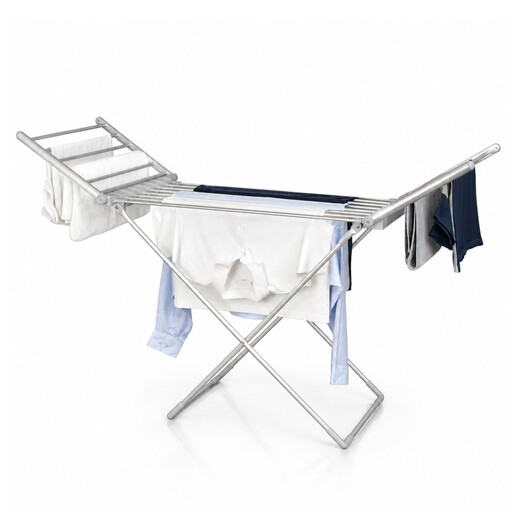
STATUS 230W Foldable Aluminium Heated Airer with Wings, Silver
A winged, foldable airer is another layout to assess if you want to spread small items out and store the rack after use. The product name states a 230W power rating, which does not establish electricity use for a complete drying session.
Check the wing span, open dimensions and bar spacing before deciding whether it suits your usual underwear load. Indoor drying still calls for effective ventilation.
View on Joybuy
Frequently asked questions
What size heated airer works for family underwear and socks?
A three-tier airer is a useful starting point for frequent small-item loads, provided its bars or shelves let you separate garments. Minky and Lakeland describe family-oriented three-tier formats with up to 21m of stated drying space, while Lakeland’s compact Dry:Soon Mini has 13m; compare the exact layout and room fit rather than choosing by length alone.
Will a heated airer stop condensation or mould?
No: heating laundry does not prevent it from releasing moisture indoors. GOV.UK identifies laundry drying as a source of household moisture, so ventilate the drying room effectively and address persistent damp or mould rather than relying on an airer to resolve it.
How can I compare electricity use between heated airers?
Compare the exact models’ rated power alongside how long you expect to run each one; a wattage figure by itself cannot describe a complete drying session. To calculate energy use in kilowatt-hours, divide rated watts by 1,000 and multiply by operating hours, allowing for any controls that change power during use.
Can I plug a heated airer into an extension lead?
Use an extension lead only if the airer’s instructions permit it and the lead is suitable for the combined electrical load. Electrical Safety First advises checking ratings and avoiding overloaded sockets; position the cable where it cannot be trapped, damaged or tripped over.
How should I clean and store a heated airer?
Follow the instructions for your exact model and let it cool before cleaning or folding it. For its three-tier sureDRI, Minky advises unplugging it, allowing it to cool fully, cleaning with a soft damp cloth and drying it thoroughly before storage.


