For repeated loads of cotton T-shirts between guest stays, consider a covered three-tier heated airer if the rack and its compatible cover fit the drying room. A winged airer may suit smaller loads or a tighter space; a timed hot-air cover system makes sense only if you already have a compatible rack. Whichever route you choose, check the stated load limit, room ventilation and electrical setup before making the appliance available to guests.
Who is this for?
High-turnover holiday-let operators
If several cotton T-shirts need drying between bookings, usable rail length and the rack’s stated load limit matter more than whether it holds a single shirt. Check whether the open rack and any compatible cover fit the space available.
Hosts with limited utility space
If the drying area doubles as a passage or storage space, compare open and folded dimensions before choosing between a winged frame and a taller three-tier rack.
Hosts planning guest access
If guests may use the airer, its position, socket arrangement, instructions and the room’s ventilation need to fit the property’s fire-risk and maintenance routines.
What matters when choosing?
Choose the rack format around the usual T-shirt load and the space where it will operate. Treat a cover or hot-air unit as a separate compatibility decision, not a substitute for checking the room and electrical setup.
Covered three-tier airer
Consider it when: Several T-shirts need space on the rails and the property can accommodate a tall freestanding rack.
Bear in mind: Check the open footprint and buy a cover designed for the exact frame; a cover is not automatically included or interchangeable.
Winged heated airer
Consider it when: Loads are smaller and a lower-profile frame suits the drying and storage areas.
Bear in mind: Check the exact model’s rail length and load limit rather than assuming its wings provide enough room for a turnover load.
Timed hot-air cover system
Consider it when: You already have a compatible rack and want a timed hot-air unit rather than heated rails alone.
Bear in mind: Beldray says its Quick-Dry system does not include an airer. Confirm rack fit, included parts and the unit’s electrical rating before choosing this route.
| Concern | What to check | Who this matters to |
|---|
| Turnaround capacity |
Compare usable drying length and the exact rack’s stated load limit. |
If I have several cotton T-shirts to dry before the next booking, I need enough room to spread them out without exceeding the load limit. Around 25% of consumers would put that capacity need first. |
| Drying-time planning |
Check cover fit or timer features, then allow for the room conditions and how the garments are spaced. |
When turnover time is tight, I need a drying routine that leaves time to check the shirts before storing them. Around 31% of consumers would make that timing need their main concern. |
| Property care and safety |
Check socket and lead loading, the appliance instructions and ventilation at the drying location. |
If guests might use the airer, I need a workable electrical setup and a way to manage moisture indoors. For around 25% of consumers, those property-care needs would come first. |
| Space and storage |
Measure the open footprint and folded size against the room and storage space. |
With no dedicated laundry room, I need the rack to fit without obstructing normal access and to store away between stays. Around 19% of consumers would prioritise that space constraint. |
What should you avoid?
-
Assuming a similar-looking airer has the same safety history
The Office for Product Safety and Standards reported a serious fire risk involving the wiring of one specific Mini 3 Tier Electric Heated Airer. That report does not establish a fault across heated airers.
Identify the exact model, keep its instructions and proof of purchase, and check official product-safety alerts for that model.
-
Choosing rail capacity without considering room moisture
Drying laundry indoors adds moisture. Government guidance on damp and mould identifies inadequate ventilation as an important property-management concern.
Choose a suitably ventilated drying position, watch for condensation and address persistent damp rather than relying on a larger or hotter airer.
-
Assuming a cover fits any three-tier rack
Cover dimensions, rack format and the included parts vary. A timed hot-air system also has its own setup and electrical requirements.
Check the cover’s stated compatibility and dimensions against the exact rack, and follow both products’ instructions.
Beldray says its Quick-Dry hot-air system does not include the airer, so using it requires a compatible rack.
-
Connecting extension leads together
Electrical Safety First warns that plugging one extension lead into another can cause overheating.
Plan the drying position around a suitable socket where possible. If the appliance instructions permit an extension lead, check its rating and the combined load, and do not daisy-chain leads.
Brands to consider
These named product lines illustrate different rack and accessory choices; compare the specifications of the exact model you intend to use.
Dry:Soon by Lakeland
Lakeland’s fold-flat three-tier range includes model-specific covers for indoor drying.
- Lakeland states that its standard three-tier airer has 21 m of drying space, a 15 kg load limit and an 8 cm folded depth.
- A cover must fit the chosen model, and the open three-tier frame still needs an appropriate position in the room. Lakeland describes its cover as trapping heat; that is not a guaranteed drying time for T-shirts.
BLACK+DECKER
The named three-tier and winged listings offer two frame formats to compare.
- A BLACK+DECKER three-tier airer is listed with 21 m of drying space and a 15 kg load limit; the BXAR0001GB winged listing states 11.5 m and 10 kg.
- Those figures belong to the named listings, not every BLACK+DECKER airer. Compare the exact model’s dimensions and load limit with the property’s needs.
Beldray
Beldray lists both a large three-tier heated airer and a separate timed hot-air cover system.
- Beldray states that its researched three-tier airer provides 20 m of drying space and holds up to 30 kg of laundry.
- Its Quick-Dry hot-air system does not include an airer. Check rack compatibility and the system’s stated 1200 W input; neither figure establishes a universal drying time.
Joybuy product choices
These heated airers offer three-tier or winged frames to consider for indoor T-shirt drying. Compare their open size, stated load limit and instructions with the space and routine in your holiday let.
 No image available
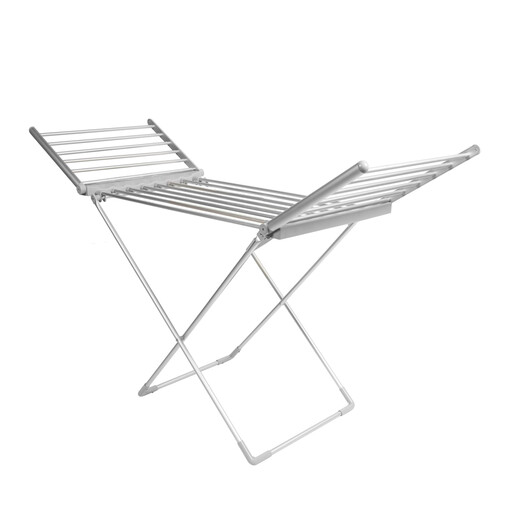
Pifco 3 Tier Winged Heated Airer
Consider this three-tier winged format if you want rails for a T-shirt load but need to assess how the opened wings fit the room.
Check the usable drying length, stated load limit and electrical rating for your turnover routine. Follow the product instructions on covering the airer rather than assuming it can be completely covered.
View on Joybuy
 No image available
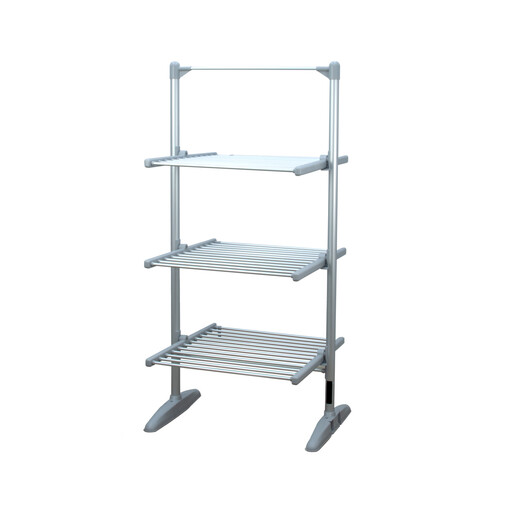
Status 3 Tier 248W Foldable Aluminium Heated Airer
Consider this three-tier frame when you need to assess a larger rack for repeated T-shirt loads and want it to fold away between stays.
The product name specifies 248 W and foldable aluminium construction. Check usable drying length and open and folded dimensions against the load and available space; confirm any cover or timer separately.
View on Joybuy
 No image available
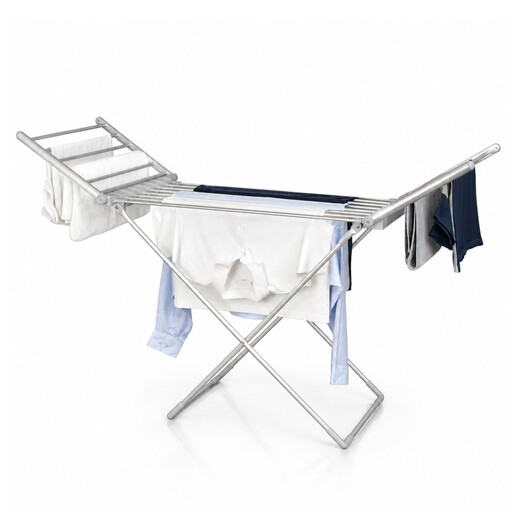
STATUS 230W Foldable Aluminium Heated Airer with Wings, Silver
Consider this winged frame if its opened size and rail arrangement suit a smaller drying area, while its foldable design suits storage between stays.
The product name specifies 230 W, aluminium construction and a silver finish. Check usable drying length, load limit and open and folded dimensions; confirm cover or timer compatibility separately.
View on Joybuy
Frequently asked questions
Will a heated airer get cotton T-shirts dry before the next guests arrive?
Do not rely on a fixed drying time for every load. Fabric thickness, spacing, room conditions and the airer’s format all affect planning; follow any cover or timer instructions, allow contingency time and check that each shirt is fully dry before storing it.
How should I manage condensation when drying T-shirts indoors?
Include ventilation and checks for condensation in the drying routine rather than treating the heated airer as a solution to damp. Government guidance on damp and mould identifies inadequate ventilation as a concern; investigate persistent moisture and address the property issue.
Can I use an extension lead with a heated airer?
Use one only if the appliance instructions allow it and the lead’s rating covers the combined connected load. Electrical Safety First advises against exceeding an extension lead’s rating or plugging one extension lead into another; position the airer near a suitable wall socket where possible.
What must I check before offering a heated airer to holiday-let guests?
Start with the rules and fire-risk arrangements for the property’s actual location, alongside the appliance instructions and a suitable drying position. Government guidance for self-catering holiday homes in England addresses electrical safety, while the Scottish Fire and Rescue Service states that short-term-let licensing is mandatory in Scotland. Confirm the applicable local requirements and insurance conditions before making the airer available to guests.


