Small-home uniform dryers
If a full-width rack cannot stay open in your main room, compare the space an airer takes up in use and where it will go afterwards. A vertical layout may be more practical than choosing by stated load capacity alone.


Choose a heated airer by the space it occupies while uniforms are drying, not just its stated load capacity. A compact vertical model can make better use of limited floor area; a winged rack needs room to spread out, while a larger multi-tier model needs space both in use and in storage. Check garment clearance and keep the drying room ventilated.
If a full-width rack cannot stay open in your main room, compare the space an airer takes up in use and where it will go afterwards. A vertical layout may be more practical than choosing by stated load capacity alone.
When uniforms must be ready for the next school day, look at garment spacing and whether a cover or timer suits your routine. Drying time still depends on the load and the room.
Choose a drying position in a room you can ventilate. Energy Saving Trust advises that ventilation lowers the risk of condensation, damp and mould; heating the airer does not remove moisture from the room.
Consider it: When a recurring uniform load needs to occupy less floor area while drying.
Allow for: Long garments may need careful positioning, and a compact frame still needs somewhere to stand when folded.
Consider it: When a lighter load suits a spread-out rack and you have enough clear width.
Allow for: Fold-away storage does not make the rack narrow while it is open.
Consider it: When uniforms and PE kit need more places to hang in the same load.
Allow for: The larger frame needs a suitable position in use and adequate storage space afterwards.
For school-uniform drying in a small home, decide which of these needs matters most before comparing individual models.
| Concern | What to check | Who this matters to |
|---|---|---|
| Space and storage | Check open width and depth against the intended position, then check folded dimensions against your storage space. | If a rack would block the room while uniforms dry, usable floor space becomes my deciding factor. Around 31% of consumers put space and storage first. |
| Room for uniforms | Check usable drying length and whether trousers or shirts can hang clear without crowding other items. | I need to hang shirts, trousers and smaller kit together without bunching them on the rails. This is the primary concern for around 25% of consumers. |
| Next-day turnaround | Check whether a cover fits the exact model and whether its layout leaves room for airflow. | When tomorrow's uniform is in the wash, I need a setup that suits a short drying window. Around 25% of consumers chiefly prioritise turnaround. |
| Electricity use and room moisture | Check the model's wattage and likely time in use; choose a room that can be ventilated. | I want to manage electricity use without leaving the drying room damp. For around 19% of consumers, those considerations take priority. |
A rack that folds neatly may still obstruct a doorway or walking route while in use. Dunelm lists its winged airer at 148cm wide when open, illustrating why the open measurements matter.
Mark out the proposed position on the floor and check door clearance before choosing a model.
Indoor laundry releases moisture into the room. Energy Saving Trust advises that ventilation lowers the risk of condensation, damp and mould.
Use a room you can ventilate and address persistent condensation rather than extending drying time alone.
A cover must suit the exact airer, and an overall load figure does not replace any limits for individual tiers or arms.
Check the model's cover compatibility, bundle contents and loading instructions before drying a full uniform wash.
Lakeland offers Mini and larger tiered airers, alongside model-specific covers and accessories.
Minky's range includes winged and multi-tier airers. Its sureDRI four-tier model includes a cover and programmable timer.
Dunelm's own-brand range includes winged and A-frame three-tier layouts, useful for comparing wide and vertical formats.
These three-tier airers offer two layouts to assess for indoor uniform drying: a winged frame and a foldable tiered frame. Check the open footprint and clearance for longer garments against your room before choosing.
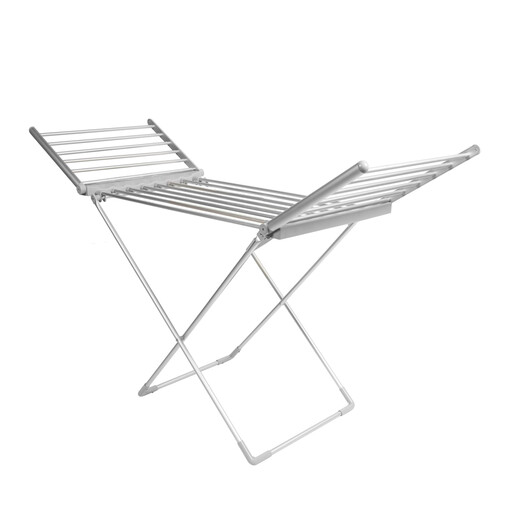 Image unavailable
Consider this winged layout if you can leave enough width clear while drying uniforms.
Three-tier design. Confirm its open and folded measurements, and check that longer uniform items can hang clear.
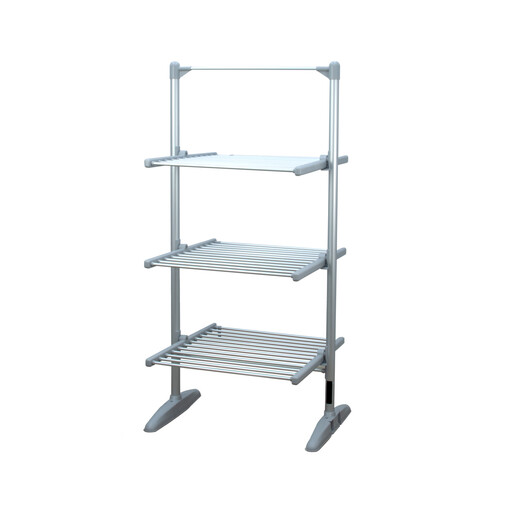 Image unavailable
Consider this foldable tiered airer if you need to put the frame away after indoor laundry dries.
Three-tier design with a stated 248W rating and aluminium construction. Check its open dimensions, folded storage size and clearance for uniform trousers.
Not necessarily: its width while open matters more than how neatly it folds. Dunelm lists its winged model at 148cm wide when open; measure your drying position and nearby door clearance before deciding.
A compatible cover may help retain warmth, but it does not guarantee a particular drying time. Lakeland and Dunelm describe covers as helping evaporation; garment thickness, spacing and room ventilation still matter. Use a cover designed for the exact airer.
Yes. Drying clothes indoors releases moisture, and Energy Saving Trust advises that ventilation lowers the risk of condensation, damp and mould. A heated airer does not remove that moisture from the room.
Follow the instructions for your exact model. For its sureDRI four-tier airer, Minky says to unplug it, let it cool, wipe it with a soft damp cloth and dry it thoroughly; it also advises against immersion, scourers and harsh detergents.