Housemates short of bedroom space
If you dry a few pyjamas and everyday clothes but cannot leave an airer open in a shared room, compare its open footprint with its folded depth. A rack that stores neatly may still obstruct a doorway while loaded.


Choose a compact tiered heated airer if you need to put it away between personal loads but sometimes dry more than pyjamas. A covered hanging pod makes more sense for a small set of garments you can hang; consider a larger rack only if housemates have agreed where it will stand and how they will share it. Whichever format you choose, check its dimensions, load limit, ventilation needs and electrical instructions against the space where you will use it.
If you dry a few pyjamas and everyday clothes but cannot leave an airer open in a shared room, compare its open footprint with its folded depth. A rack that stores neatly may still obstruct a doorway while loaded.
If the next set of pyjamas or work clothes needs to be ready soon, a covered hanging pod is worth considering when the garments can go on hangers. Check that its stated capacity accommodates your usual wash.
If several residents will use the same appliance, agree on its location and a drying schedule. Rail space, the stated wet-load limit, ventilation and access to a suitable socket matter more than choosing the smallest rack.
Decide whether you are drying your own garments or sharing the airer before comparing formats. The space available while it is open can change that decision as much as its storage size.
Consider it when: You need rails for pyjamas and occasional larger personal washes, then want to fold the rack away.
Trade-off: It still takes floor space while open, even if it stores slimly.
Consider it when: Your loads consist mainly of a few garments that can hang inside an enclosed dryer.
Trade-off: Which? notes that pods generally dry faster but hold less than rail airers and are not suited to bedsheets or duvets.
Consider it when: Housemates have agreed to share the space and need rails for mixed laundry loads.
Trade-off: It needs a suitable place to stand without blocking communal access, as well as an agreed schedule.
| Concern | What to check | Who this matters to |
|---|---|---|
| Footprint and storage | Measure the space with the airer open and loaded, then compare its folded dimensions with your storage gap. | If I only have room for an airer during a wash, I need it out of the way afterwards; around 24% of consumers put storing a personal airer first. |
| Shared-load capacity | Compare the stated wet-load limit and usable rail space with the garments residents intend to dry. | When several housemates use one rack, I need enough space for their laundry without exceeding its load limit; roughly 29% of consumers prioritise shared capacity. |
| Garment turnaround | Check whether your pyjamas can hang in the chosen format, along with its item capacity and timer settings. | If I need a small wash ready soon, I care more about drying those garments than fitting a large load; around 18% of consumers put quick garment turnaround first. |
| Moisture and electrical use | Choose a ventilated location and check the appliance instructions, socket arrangement and exact model against recall notices. | I do not want drying clothes to add condensation to a shared room or an overloaded socket to create a hazard; approximately 29% of consumers put moisture and electrical safety first. |
A foldable rack may still be difficult to live around while open. Lakeland lists its Dry:Soon Mini 3-Tier at 60 × 63 × 113.5 cm and 8 cm deep when folded; Dunelm lists its three-tier rack at 138 × 72 × 78 cm when open.
Measure the intended position with doors, wardrobes and communal walkways in mind, as well as the route to a suitable socket.
Airer covers can be model-specific: Minky describes its SureDri cover as made for its own three-tier airer, while Lakeland lists a matching cover separately for its Mini 3-Tier.
Check the cover against the exact rack model and follow its fitting and use instructions.
Buying a separate cover that does not fit means arranging a suitable replacement before you can use the covered setup.
Water from drying clothes still enters the indoor air. Watford Borough Council advises keeping the room ventilated when drying clothes indoors to help manage condensation.
Choose a ventilated drying location rather than an enclosed cupboard, and agree with housemates how available windows or extraction will be used.
In January 2025, the UK Office for Product Safety and Standards recalled a specific Dunelm Heated Winged Airer because it could overheat. That notice does not identify every Dunelm airer as affected. Electrical Safety First also warns against overloading or daisy-chaining extension devices.
Check the brand and article number against recall notices, particularly for a second-hand airer. Follow the appliance instructions and keep any extension device within its marked rating.
These ranges illustrate different heated-airer formats; compare individual models and their instructions rather than treating a brand name as a substitute for checking fit.
Lakeland offers tiered heated racks and a hanging drying pod, covering both personal rail loads and smaller loads of hanging garments.
Dunelm offers several airer formats, including three-tier racks, winged airers and drying pods. Check the specifications of the particular model you are considering.
JML’s DriBUDDi Compact uses a covered hanging format for smaller loads of garments rather than broad rails for household laundry.
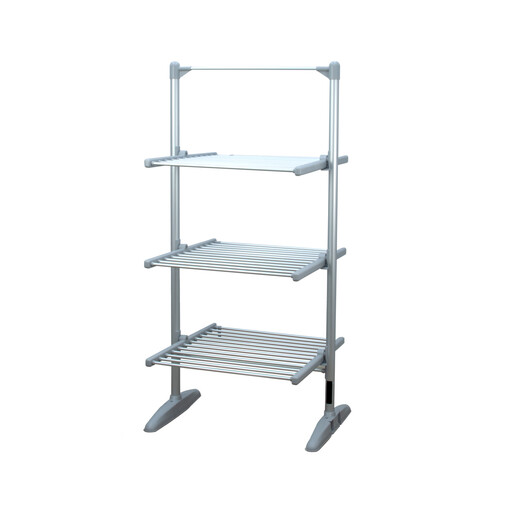
This foldable three-tier model is a rack-format option if housemates plan to dry garments in an agreed shared space. Check that it fits both its drying position and its storage spot before choosing it.
 No image available
This foldable rack format may suit pyjamas and other garments dried in an agreed shared area.
The model is described as aluminium and rated at 248 W. Check its open and folded dimensions against your space, and confirm its timer or shut-off arrangement in the instructions. Use it in a ventilated room with a suitable electrical connection.
A pod suits a small number of pyjamas and other garments you can hang; choose a tiered rack if you also need rails for towels or larger personal washes. Lakeland states that its Drying Pod holds up to 12 hanging items, while Which? notes that pods generally dry faster but hold less and are not suited to bedsheets or duvets.
Dry them in a ventilated room rather than an unventilated cupboard. Watford Borough Council advises ventilation because drying clothes indoors adds water vapour to the air; agree with housemates how you will use available windows or extraction.
Use one only if it is suitable for the appliance and the combined load stays within its marked rating. Electrical Safety First advises against overloading extension devices or daisy-chaining leads; follow the airer’s electrical instructions too.
Follow the instructions for the exact airer rather than assuming that a timer makes unattended use appropriate. Features differ: Lakeland lists an optional timer of up to three hours for its Drying Pod, while JML states that its DriBUDDi Compact switches off at the end of its set cycle. Neither feature replaces safe placement, ventilation or electrical use.
Match its exact brand, model, article number and barcode against UK Office for Product Safety and Standards product-safety alerts and recalls. Its January 2025 recall for the Dunelm Heated Winged Airer identifies article number 30752153 and barcode 5057722844042; do not assume that notice applies to a different model.