Small-home laundry planners
You need enough room to move around the airer while it is open, plus somewhere to put it between loads. Lakeland product dimensions show why both open and folded measurements matter.


Choose by the space the airer occupies when fully open, then by how you need to lay out your pillowcases. A three-tier frame offers drying length above a relatively compact base, while a winged frame can give you a flatter layout but needs room across its full width. Whichever format fits, indoor drying still calls for ventilation and safe electrical use.
You need enough room to move around the airer while it is open, plus somewhere to put it between loads. Lakeland product dimensions show why both open and folded measurements matter.
You want to spread or separate pillowcases rather than crowd damp fabric together, and may occasionally need space for other bedding. The layout matters as much as the stated drying length.
You need to consider room ventilation and the electrical set-up alongside the rack itself. UK government guidance explains that trapped indoor moisture can become condensation.
Measure the space with the airer open before comparing drying layouts and load capacity; leave room for doors, walkways and access to a socket.
| Concern | What to check | Who this matters to |
|---|---|---|
| Open footprint and storage | Measure open width, depth and height as well as folded depth. Check clearance around doors and walkways. | I need the rack to fit while I dry pillowcases and to go away afterwards without taking over the room. Around 40% of consumers put fit and storage first. |
| Pillowcase layout | Look for enough usable rail or flat-drying space to separate the pillowcases in a typical load; check whether any cover fits the exact model. | If I dry several pillowcases together, I want room to spread them rather than layer damp fabric. For around 30% of consumers, that layout is the main priority. |
| Useful capacity | Compare stated drying length and maximum load with the laundry you usually wash together; neither figure establishes drying time. | I often wash pillowcases with other items, so I need a workable load without filling the room with an oversized rack. Capacity comes first for around 20% of consumers. |
| Moisture and electrical safety | Plan for ventilation, check the cable arrangement and look up safety alerts for the exact model. Electrical Safety First warns against overloaded extension equipment. | Because I dry indoors frequently, I need to manage condensation and use the appliance safely. Around 10% of consumers give these checks first priority. |
A rack that stores thinly can still obstruct the room in use. The cited winged model is 148cm wide when open; Lakeland lists its cited three-tier model with a 73 × 75cm base and a height of 137cm.
Mark out the fully open footprint where you intend to use it, and check that doors, walkways and the socket remain accessible.
Drying laundry adds moisture to indoor air. UK government ventilation guidance says moisture trapped without effective ventilation can become condensation and contribute to damp and mould.
Use the room’s ventilation features as intended, keep trickle vents clear where fitted and reassess the set-up if condensation appears regularly.
The cited winged rack has a maximum rating of 220W, while JML specifies 1200W for DriBUDDi. Rated power alone does not establish the cost of a load: running time and your electricity tariff also matter.
Check the exact model’s wattage and estimate usage against the hours you expect to run it and your own tariff.
A recall concerns the product identified in its notice, not every airer of the same format. Electrical Safety First also warns against overloading or daisy-chaining extension equipment.
Check UK product-safety alerts against the exact model, and do not use damaged leads or overloaded extensions. Stop using an item identified in a recall notice.
Lakeland’s cited Dry:Soon three-tier airer arranges drying space vertically: Lakeland specifies 21m of drying length and a 73 × 75 × 137cm open size.
Minky’s cited winged airer offers a flatter arrangement; Minky states 12m of drying space and a 16kg wet-load capacity for that model.
JML’s DriBUDDi is a covered warm-air format rather than an exposed heated-rail rack. JML specifies a 1200W element and capacity for up to 10kg of damp clothing.
Status lists foldable aluminium airers in both a three-tier and a winged format, with stated ratings of 248W and 230W.
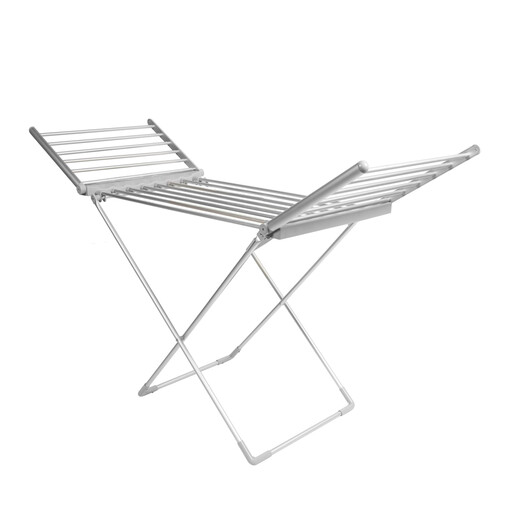
These winged and three-tier heated airers offer two layouts to consider for pillowcases. Check each model’s fully open dimensions against your available space before choosing.
 No image available
Consider the winged layout if you want to separate pillowcases across the airer. Its three-tier design also needs enough vertical clearance; confirm the fully open footprint and height against your room.
 No image available
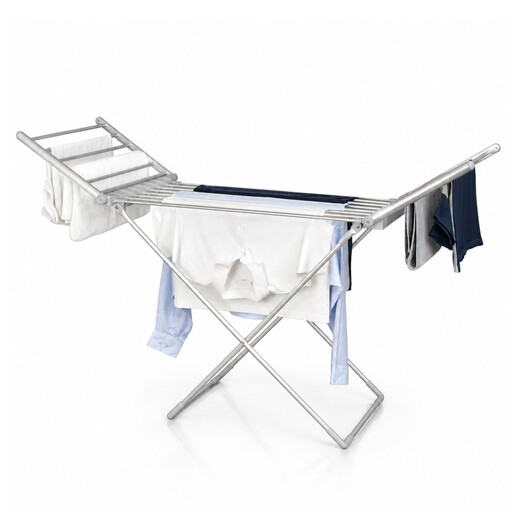
The winged layout is worth considering if you want to spread out a smaller pillowcase load and fold the airer away afterwards. Its named power rating is 230W; check the open footprint and folded size for your intended space.
 No image available
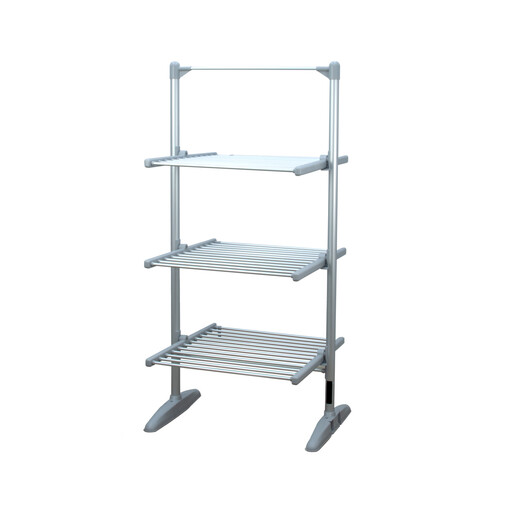
Consider the three-tier layout if you would rather arrange pillowcases and other laundry vertically than spread a winged frame across the room. The named power rating is 248W; check its open footprint, height and folded storage size before buying.
It depends on the room’s usable width, depth and height. Lakeland lists its cited three-tier model with a 73 × 75cm base and 137cm height; The cited winged model is 148cm wide and 52.5cm deep. Measure the airer fully open, not just folded.
Yes. Indoor drying adds moisture regardless of whether the rack is heated. UK government ventilation guidance says trapped moisture can turn into condensation, so use the room’s ventilation as intended and leave trickle vents clear where fitted.
A compatible cover can retain warmth around laundry, but it does not guarantee a particular drying time. Check that the cover is made for the exact airer and whether it is included in the bundle; continue to ventilate the room.
Use a wall socket where practical. If an extension is necessary, follow the appliance and lead instructions; Electrical Safety First warns against overloading or daisy-chaining extensions and advises fully unwinding cable reels.
Match the notice against your exact product identification, including its model or article number and any specified batch. A recall of one heated winged airer does not apply automatically to every winged model; if your item is identified in the notice, stop using it and follow its instructions.