For a few summer dresses, start with a winged heated airer if its open layout lets the garments hang without bunching and it folds away where you need it. A three-tier airer makes more sense when housemates need greater total drying capacity; a covered pod is another option if an enclosed setup matters more, but compare its rated wattage and expected running time. Whichever format you choose, check room fit, ventilation and safe access to a socket.
Who needs which setup?
Dress-first renters with little floor space
If you dry a few longer, lightweight garments and need to put the airer away afterwards, look at the open rail layout as well as its folded size. Winged designs are a starting point, but measure the space your dresses need to hang freely.
Housemates sharing one drying station
A larger rack may be more useful than several small personal ones when loads overlap. Lakeland lists three-tier examples with 21m of drying space and a stated 15kg capacity; check whether their tier arrangement also works for longer dresses.
Renters managing moisture and electrical risks
Indoor laundry adds moisture to the home, according to GOV.UK. Plan where the airer can be ventilated, and follow Electrical Safety First’s advice not to exceed an extension lead’s marked current rating.
What matters when choosing?
Choose the layout around the garments and the number of people using the airer, then check that it can operate safely in the space available. A model combining wings and tiers may draw on both layouts.
Winged airer
Consider it when: A few dresses need room to spread out and the rack must fold away between uses.
Trade-off: Check actual hanging clearance; the cited winged model lists 11m of drying space, compared with 21m for the cited three-tier model.
Three-tier airer
Consider it when: Several housemates need more rail space for shared loads.
Trade-off: Long dresses may need an unobstructed outer rail rather than space between closely loaded tiers.
Covered drying pod
Consider it when: An enclosed drying arrangement matters more to you than exposed rails.
Trade-off: The cited JML DriBUDDI Compact is listed at 850W, so account for its expected running time rather than assuming it uses electricity like a heated-rail model.
| Concern |
What to check |
Who this matters to |
| Dress layout and room fit |
Measure the open footprint and available hanging clearance; check the folded size for storage. |
If I dry longer dresses in a small room, I need space to spread them out without leaving a rack permanently in the way. Around 42% of consumers would put garment layout and room fit first. |
| Shared-load capacity |
Compare stated drying space and load capacity, then check access to the rails when the rack is loaded. |
When housemates share a drying station, I need enough usable space for overlapping laundry days. Shared-load capacity would come first for around 33% of consumers. |
| Safe indoor use |
Check rated wattage and cable reach; plan ventilation and a socket arrangement that stays within its marked limits. |
I want to dry clothes indoors without adding to a damp room or overloading an extension lead. For around 25% of consumers, moisture, electrical safety and controllable running time would be the primary concern. |
Common buying mistakes
-
Choosing by drying-space metres alone
An 11m winged rack and a 21m three-tier rack arrange their rails differently. Total length does not tell you whether a long dress can hang without bunching or whether the rack fits the room.
Measure the open space and the hanging path of your longest dress, then compare the stated load capacity.
-
Assuming every airer includes a cover
Cover arrangements differ by model: the cited three-tier cover is separate, while the Tower winged model and JML pod are listed with covers.
Check what comes with the exact model and follow its instructions for cover use.
A compatible cover may be a separate accessory.
-
Treating heat as a substitute for ventilation
Drying laundry indoors adds moisture to the home, as GOV.UK explains. Heating the airer does not remove the need to manage that moisture.
Choose a ventilated drying location and report persistent damp or mould to the landlord or accommodation manager.
-
Overloading an extension lead
Too much connected load can overheat electrical fittings and create a fire risk.
Use a suitable wall socket where possible. If an extension lead is needed, check its marked current rating and the total connected load; do not connect extension leads to one another.
Brands to consider
These product lines illustrate different airer formats; compare the specifications and included accessories of the particular model you intend to use.
Dry:Soon
Lakeland’s Dry:Soon line includes winged and three-tier formats. Its Deluxe three-tier model is relevant when a house needs substantial stated rail space.
- Lakeland states 21m of drying space and a capacity of up to 15kg for the Deluxe three-tier model.
- Check the open layout against dress length and confirm whether the cover you want is included.
Status
Status lists winged and three-tier heated airers, offering a choice between layouts for lighter personal loads and a shared drying station.
- The product titles identify a 230W foldable aluminium winged model and a 248W foldable aluminium three-tier model.
- Check the open dimensions, dress clearance and cover provision for the exact model.
Tower
Tower’s T25003 is a winged format for consumers considering a cover alongside fold-out rails.
- Tower states 12.6m of drying space, a 15kg capacity and a 230W rating for this model.
- Check its open dimensions and rail clearance before relying on it for longer dresses.
JML
The DriBUDDI Compact represents an enclosed drying-pod alternative to exposed heated rails.
- A cover and a stated 10kg capacity are listed for the DriBUDDI Compact.
- Its maximum wattage is listed as 850W; consider the intended running time when comparing it with rail airers.
Heated airers on Joybuy
These winged and three-tier airers offer layouts to consider for dresses or shared-house laundry. Before choosing one, check the space a dress can occupy, the room available when the rack is open and the route to a suitable socket.
 No image available
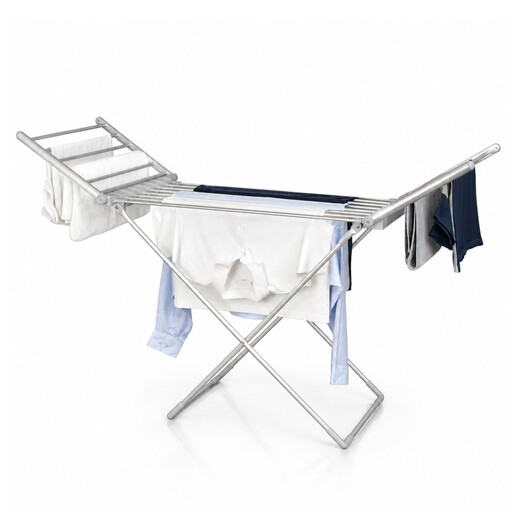
STATUS 230W Foldable Aluminium Winged Heated Airer
Consider the winged layout for a few longer dresses if its rails give them enough room to hang freely.
Rated at 230W; the title identifies a foldable aluminium design. Check its open dimensions, dress clearance and cable reach against your intended drying spot.
View on Joybuy
 No image available
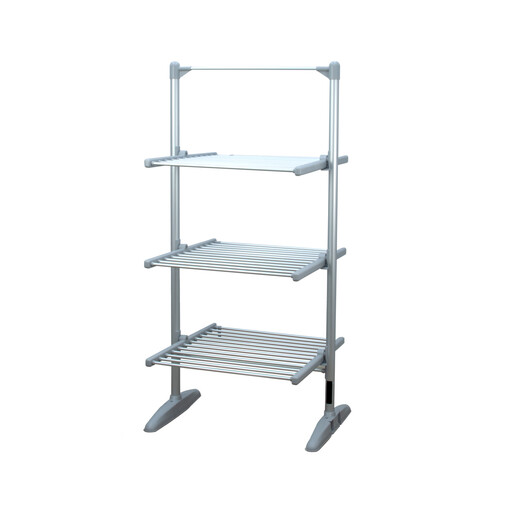
Status 3-Tier 248W Foldable Aluminium Heated Airer
The three-tier layout is worth considering when housemates want one drying station for several garments.
Rated at 248W; the title identifies a foldable aluminium design. Check the open footprint and whether longer dresses can hang without bunching between tiers.
View on Joybuy
 No image available
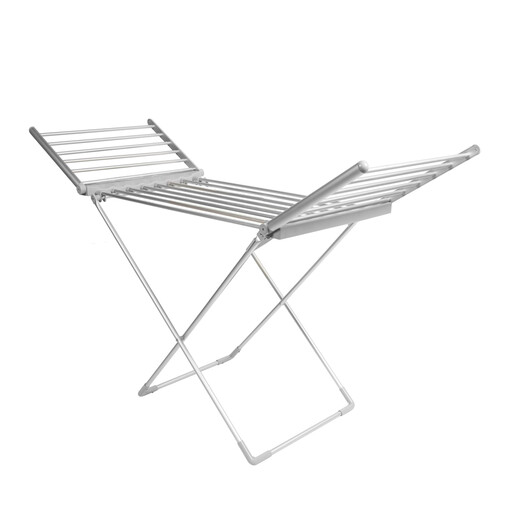
Pifco 3-Tier Winged Heated Airer
Consider this combined winged and three-tier layout if you need places for both dresses and other shared-house laundry.
Check usable dress clearance, open dimensions and rated wattage before comparing it with other airers. If using a cover, follow the product instructions for safe use.
View on Joybuy
Frequently asked questions
Which airer shape works for long summer dresses?
Start with a winged airer if you have a few longer garments and need compact storage, but check the usable hanging length on the exact model. A three-tier airer may suit a larger shared load if a dress can hang on an unobstructed rail rather than being folded tightly over several bars.
Can I use a heated airer with an extension lead?
Use one only if its marked current rating accommodates the combined connected load and the airer’s instructions allow the arrangement. Electrical Safety First advises against overloading extension leads; do not connect one extension lead to another.
Will a heated airer prevent condensation?
No: drying laundry still adds moisture to indoor air. GOV.UK identifies indoor laundry as a source of household moisture, so choose a ventilated location and raise persistent damp or mould with the landlord or accommodation manager.
How can I compare electricity use between airers?
Compare rated wattage alongside the number of hours you expect to run each appliance. Divide watts by 1,000 to get kilowatts, then multiply by hours to estimate energy used in kilowatt-hours; actual use depends on how and for how long you operate the model.


