Swimmers short of shared space
If your load is usually a swimsuit and a few other items, look for a rack you can put away rather than one that permanently occupies the communal room.


Choose a compact rack for one swimmer’s small load, or a folding tiered airer when several housemates need rail space, provided it fits in a room that can be ventilated. A heated airer is not automatically suitable for powered drying of swimwear: Freya UK advises air-drying suits away from direct heat, so follow each garment’s care label and leave the airer switched off if heat is prohibited or uncertain.
If your load is usually a swimsuit and a few other items, look for a rack you can put away rather than one that permanently occupies the communal room.
When towels and everyday laundry need space alongside swimwear, compare rail length and stated load capacity. Agree on a ventilated place to use the rack before choosing its size.
If a suit has sensitive stretch fabric, padding or supportive components, let its care label determine whether added heat is acceptable. An unpowered rack remains an option when it is not.
For swimwear drying in a shared house, settle on a ventilated location and the amount of rail space you need before considering timers or stated wattage. Check the garment label separately: an airer’s laundry capacity says nothing about a swimsuit’s tolerance of heated rails.
| Concern | What to check | Who this matters to |
|---|---|---|
| Ventilation and moisture | Identify a room you can ventilate and a position that keeps vents usable. Check that the open rack will fit there. | If I dry laundry indoors, I need somewhere its moisture can escape rather than letting it build up in a shared room. Around 36% of consumers put ventilated placement first. |
| Capacity and storage | Compare drying length, stated load limit, open dimensions and folded size against the household’s usual load. | When housemates need space for towels as well as suits, I want enough rails without leaving the rack in everyone’s way. For around 29% of consumers, shared capacity and storage come first. |
| Powered-use controls | Check stated wattage, timer features and socket location. If an extension is necessary, check its rating and setup. | If several people use the appliance, I want a clear way to manage when it is switched on and off. Around 21% of consumers prioritise that electrical-use routine. |
| Swimwear care | Read each suit’s care label before using heat; use the rack unpowered if heat is prohibited or compatibility is unclear. | For a suit whose shape or construction I want to protect, I would put its care instructions ahead of drying speed. Garment compatibility is the primary concern for around 14% of consumers. |
Freya UK advises air-drying swimwear away from direct heat. A clothes airer’s ordinary-laundry specifications do not establish whether powered use suits a particular garment.
Check the suit’s care label, rinse it after swimming and leave the airer switched off when heat is prohibited or uncertain.
UK government guidance explains that indoor laundry drying adds moisture to the home; without effective ventilation, it can contribute to condensation. Islington Council advises using a clothes rack in a well-ventilated room.
Agree where the rack can stand and how that room will be ventilated before choosing its size.
The open size matters as well as the folded size: Lakeland lists the Dry:Soon Deluxe 3-Tier at 70 × 74 × 132.5 cm when open, while the Minky SureDri 4 Tier measures 1470 × 720 × 670 mm.
Measure the intended position, access to the socket and storage gap before ordering.
Electrical Safety First warns against overloaded or daisy-chained extension devices and wound cable reels.
Use a suitable wall socket where possible. If an extension is needed, check its rating, use one extension device per socket and fully unwind a cable reel.
Lakeland’s Dry:Soon Deluxe 3-Tier illustrates a folding, timer-equipped format for a household with room for a taller rack.
Minky has several airer formats; the SureDri 4 Tier is relevant when more than one resident needs rail space.
Its winged and larger X-frame formats offer different layouts to assess for personal loads or shared laundry.
A STATUS three-tier model is worth considering when a shared household wants a fold-flat layout with a stated high load limit.
These options cover tiered airers, a winged format and a small freestanding towel rail for different shared-house loads. Choose a place that can be ventilated, then check each swimsuit’s label before deciding whether to switch on the heat.
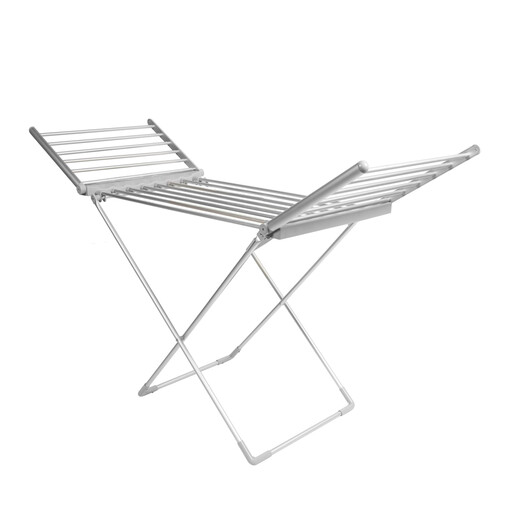 No image available
Consider this format when several items need rail space but the rack must be cleared from a shared room after use.
Check its open footprint and storage space against the room you can ventilate. For swimwear, use it unpowered if the care label prohibits heat or leaves its suitability unclear.
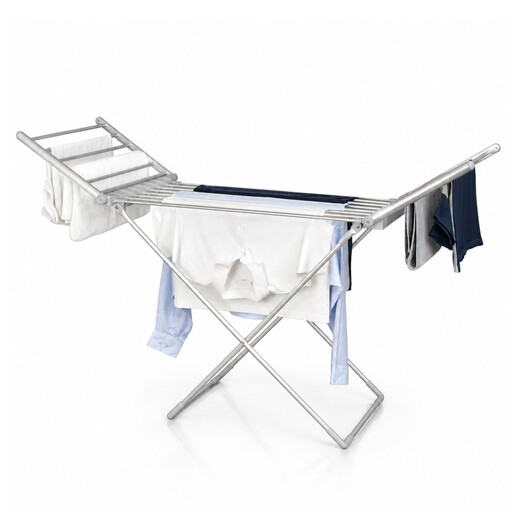 No image available
The foldable winged format may suit housemates who need to put their drying rack away between uses.
Its stated 230 W is a power rating, not a drying-time result. Confirm the open and folded measurements for your space, and leave it unpowered for swimwear when heat is prohibited or uncertain.
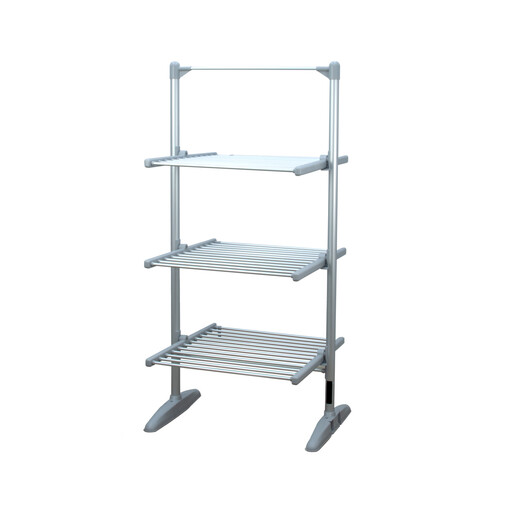 No image available
Consider a tiered layout if housemates need space to spread out towels and ordinary laundry alongside swimwear.
The title states 248 W and a foldable design; measure the available room and storage gap before choosing it. Follow each suit’s care label rather than assuming powered drying is suitable.
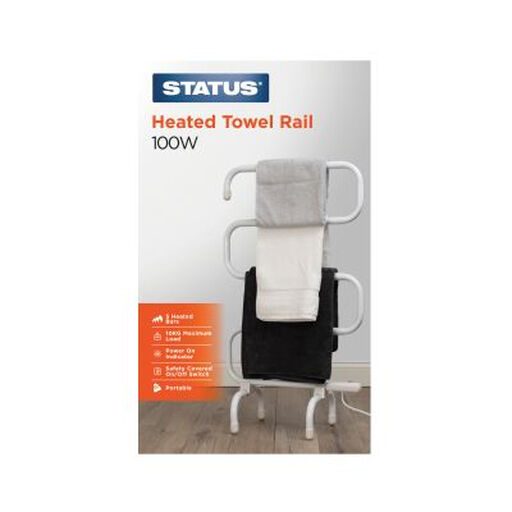 No image available
This towel-rail format is a small-load option, not a tiered clothes airer; check whether five bars provide a suitable layout for your items.
Its stated power is 100 W. Keep it on a dry surface away from water, follow its instructions about covering heated bars, and do not use heat for a suit whose care instructions prohibit it or are unclear.
No: suitability depends on the individual suit’s care instructions. Freya UK advises rinsing swimwear after use and air-drying it away from direct heat and sunlight. If heat is prohibited or you cannot establish that it is suitable, use the airer switched off.
Put it in a room that can be ventilated, with enough clearance for the open rack. UK government guidance explains that indoor drying adds moisture and that ineffective ventilation can allow condensation to form; keep existing vents usable and agree on a location that does not obstruct the shared space.
Use one only if it is suitable for the appliance and its rating will not be exceeded. Electrical Safety First advises against overloading or daisy-chaining extension devices and using a cable reel while it is wound up. A suitable wall socket avoids the need for an extension.
A timer can provide a defined switch-off period for shared use. Lakeland states that the Dry:Soon Deluxe 3-Tier has a 1–12 hour timer and switches off after the selected period; housemates still need to follow the appliance instructions and agree when the rack is in use.