Frequent kitchen-textile dryers
If you wash tea towels and dishcloths regularly, a rail layout that is straightforward to load and store may matter more than space for a full wash. Check that several items can hang without being bunched together.


A compact winged heated airer is worth considering when tea towels and other small loads are the main job and the rack needs to fold away. If it will regularly hold family laundry too, compare larger multi-tier layouts; consider a covered or fan-assisted format only after checking how it holds tea towels. Whichever format you choose, allow for ventilation while textiles dry indoors.
If you wash tea towels and dishcloths regularly, a rail layout that is straightforward to load and store may matter more than space for a full wash. Check that several items can hang without being bunched together.
If the airer must also take recurring clothes and towel loads, compare its stated drying length, wet-load limit and space needed when open. A compact footprint alone will not tell you whether your usual load fits.
If laundry dries indoors regularly, choose a location you can ventilate and pay attention to persistent condensation. Boston Borough Council advises adequate ventilation to help prevent condensation damp.
Start with the load you actually need to dry: a few kitchen textiles, tea towels alongside family washing, or items that need a different loading arrangement. Then check the space, storage and instructions for the particular model.
| Concern | What to check | Who this matters to |
|---|---|---|
| Frequent small loads | Rail layout and the space needed both open and folded. | When I wash tea towels often, I want to hang them without leaving a rack in the way between loads; around 40% of consumers put small-load convenience first. |
| Family-laundry capacity | Stated drying length, wet-load limit and open dimensions for the exact model. | If the same airer must hold tea towels alongside family washing, I need usable room for both rather than a crowded rack. Around 30% of consumers prioritise that shared-load capacity. |
| Turnaround | Whether items sit on heated rails or use a compatible cover or fan-assisted loading arrangement. | When clean tea towels are needed again soon, I want to know how the dryer holds them before choosing a different format; for around 20% of consumers, turnaround is the primary concern. |
| Safe indoor use | Model-specific placement and cable instructions, recall status and room ventilation. | If I dry textiles indoors regularly, I need an undamaged appliance and a way to manage condensation; roughly 10% of consumers place electrical safety and indoor moisture first. |
A quoted rail length does not show whether several tea towels can hang with space between them. Lakeland states 21 m for its Dry:Soon 3-Tier model, while Minky states 12 m for a winged model; the layouts differ as well as the figures.
Picture your usual peak load on the rails, then check the airer’s open dimensions and where it will go when folded.
Tea towels can be placed across rails, but Lakeland’s fan-assisted Dry:Soon Drying Pod is arranged for garments on hangers. A cover for a rail airer is a different arrangement again; none of these descriptions establishes the drying time for your load.
Before choosing a pod or covered rack, check whether your tea towels can be positioned as its instructions require.
Drying textiles indoors adds moisture to the room. Boston Borough Council advises adequate ventilation to help prevent condensation damp, while UK government guidance identifies damp and mould as household health concerns.
Plan where the airer will stand and how the room will be ventilated. Address persistent condensation or mould rather than relying on the airer to resolve it.
The UK Office for Product Safety and Standards recalled a specified Dunelm Heated Winged Airer in January 2025 because of an overheating fire risk; that notice does not apply to every heated airer. Glamhaus also instructs owners of its GL300 not to use it with a damaged power lead.
Check recalls against the exact model, particularly for older or second-hand stock. Do not use an airer with a damaged cable or plug, and follow its own manual.
Lakeland offers both rail-based airers and a hanger-based, fan-assisted drying pod, so the loading format is an important distinction within the range.
Minky’s winged and tower layouts give households different ways to balance small-item access with space for other washing.
The Glamhaus GL300 is an option to examine if adjustable temperature and a timer matter more to you than a basic on/off control.
These rail-based heated airers are relevant if you want to dry tea towels on a rack that can also be assessed for household laundry. Compare their layouts with your usual load; the product selection here is not a comparison of fan-assisted pods.
 No image available
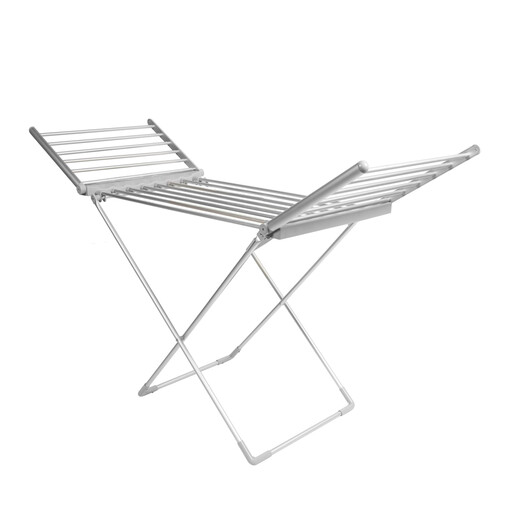
Consider this winged, three-tier layout if you want to place tea towels on rails while retaining room to assess for other laundry. Check its open footprint, the spacing your load will leave between items and its instructions for covering the airer.
 No image available
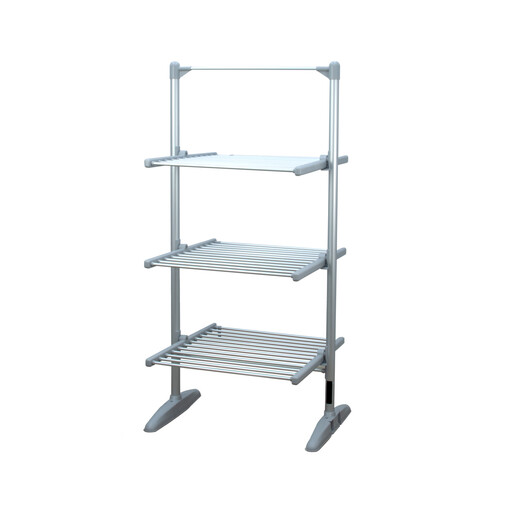
The three-tier, foldable format is worth assessing if the rack will hold tea towels as well as recurring family washing. Its title states 248 W; check the open dimensions, usable rail spacing and model instructions before deciding whether it fits your load and storage space.
 No image available
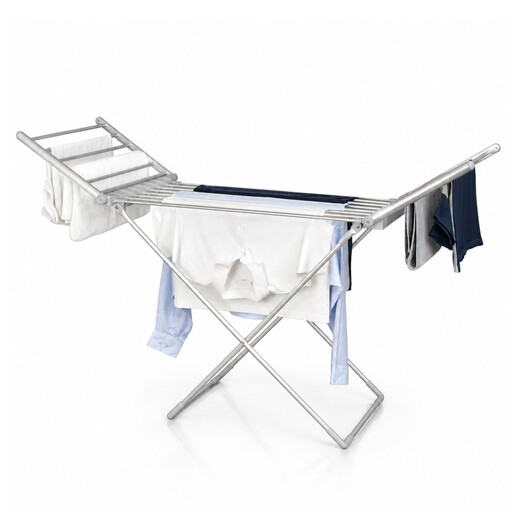
This foldable, winged layout is relevant when you want separate places to hang small kitchen textiles and intend to put the rack away afterwards. Its title states 230 W; check its dimensions, rail arrangement and covering instructions for the way you plan to use it.
It can be if you regularly dry kitchen textiles indoors and want a rack you can put away between loads. Choose by rail layout and available space before paying attention to capacity intended for a full family wash; larger multi-tier formats become more relevant if the airer will routinely handle both.
Use the wattage of each exact model and the length of time you expect to run it: watts divided by 1,000, multiplied by hours, gives kilowatt-hours. Glamhaus states 300 W for its GL300, but wattage alone does not tell you how long your tea towels will take to dry.
Yes, plan for ventilation rather than treating heat as a way to remove moisture from the room. Boston Borough Council advises adequate ventilation to help prevent condensation damp; persistent damp or mould needs attention in its own right.
Check the exact brand and model against UK product recalls, particularly if the airer is older or second-hand. The Office for Product Safety and Standards recalled the specified Dunelm Heated Winged Airer in January 2025 and told owners to stop using it; the notice concerns that identified product, not all heated airers.
Read the instructions for your exact model, including its permitted load, placement, covering and cable requirements. Glamhaus’s GL300 manual, for example, says not to use the appliance if its power lead is damaged; instructions for another model may differ.