For a few tea towels, choose a heated airer by its open dimensions and storage position before considering its maximum drying capacity. A winged frame needs room to extend sideways, while a three-tier tower trades width for height; either way, plan to dry indoors with suitable ventilation and follow the appliance instructions.
Who needs a compact heated airer?
Small-load dryers with little floor space
If you mainly dry tea towels and other small items, the space an airer occupies while open—and where it goes afterwards—may matter more than its maximum load. The winged and tower dimensions published by Dunelm and Robert Dyas illustrate why both measurements are worth checking.
Compact-home dryers with other laundry to handle
If tea towels are only part of your indoor drying, a three-tier frame may offer useful rail space for occasional clothing or towel loads. Check that its height and depth work in the room; the models listed by Robert Dyas and Minky differ in their open dimensions.
Indoor dryers concerned about condensation
If condensation is already a concern at home, make ventilation part of the drying plan. UK government ventilation guidance explains that moisture can become trapped without effective ventilation, while Islington Council advises placing an indoor clothes rack in a well-ventilated room.
What matters when choosing one?
Start with the space available while the airer is open, then decide whether its layout suits a few tea towels or needs to handle other laundry too. Check storage and indoor-use conditions before settling on a model.
| Concern |
What to check |
Who this matters to |
| Open size and storage |
Measure usable width, depth and height, allowing for access around the open airer; compare its folded dimensions too. |
If I need to put the airer away between small loads, it must fit both the drying spot and its storage spot. Around 42% of consumers put open size and storage first. |
| Tea-towel layout |
Check whether the rails let you hang a few tea towels separately without needing to open more of the frame than the room allows. |
When I only have a few tea towels to dry, I want an arrangement that is straightforward to load rather than capacity I will rarely use. For around 25% of consumers, that small-load layout is the primary concern. |
| Other laundry loads |
Compare the exact model’s stated load limit and rail space with the other items you intend to dry; check its open height and depth. |
If the same airer must sometimes take clothes or towels, I may accept a larger frame for more hanging space. Broader laundry use comes first for around 17% of consumers. |
| Indoor operation |
Check the rated wattage and expected time in use, plan for ventilation, and follow the appliance instructions for its electrical connection. |
If I dry indoors regularly, I need a suitable place for moisture to escape and a safe electrical setup. Around 16% of consumers place those operating conditions first. |
Common buying mistakes
-
Choosing by drying length alone
Drying length does not tell you whether an airer will obstruct the room. Dunelm lists its winged model at 148 cm wide when open; the three-tier model listed by Robert Dyas is 70 cm wide but 147 cm high.
Measure the drying position, including walking and door clearance, then check the exact model’s open and folded dimensions.
-
Assuming heating replaces ventilation
UK government ventilation guidance explains that moisture can become trapped indoors and form condensation without effective ventilation.
Dry tea towels in a well-ventilated room, as Islington Council advises for indoor rack drying, and address persistent condensation rather than relying on the airer to resolve it.
-
Judging electricity use by wattage alone
A wattage rating describes power while the airer operates; the length of time it runs also affects electricity use.
Check the exact model’s rating and consider how long a typical tea-towel load would need the appliance switched on, without assuming every load takes the same time.
-
Overloading an extension setup
Electrical Safety First warns that overloaded extension equipment can overheat and advises against plugging one extension lead into another.
Follow the airer’s instructions. If an extension lead is needed, check that it is undamaged and that the connected appliances stay within its marked rating; do not chain leads.
Relevant brands to compare
Dry:Soon
Lakeland’s Dry:Soon range includes three-tier airers, a mini three-tier model and a compact drying pod, offering different layouts to compare for a tea-towel-first use.
- Lakeland states that its Deluxe three-tier model provides 21 m of drying space and holds up to 15 kg of washing.
- Check the dimensions of the particular model: the Deluxe capacity may be more than you need for a few tea towels.
Minky
Minky’s three-tier sureDRI airer is relevant if tea towels share an airer with larger laundry loads and there is room for a tall frame.
- Minky lists its 21 m sureDRI three-tier model at 147 × 72 × 67 cm when open and 15.5 cm deep when folded.
- Allow for its 147 cm open height; do not treat the brand’s drying-speed language as a measured result for your room.
Dunelm
Dunelm’s winged heated airer provides a lower frame to consider if you have width available during drying and want to fold the airer away afterwards.
- Dunelm lists its winged model at 90 cm high, with 11.5 m of drying space.
- At 148 cm wide when open, that model needs substantial clear width despite its lower height.
Highlands Homeware
The three-tier Highlands Homeware DRYER12 listed by Robert Dyas offers a tower layout to compare with wider winged frames.
- Robert Dyas lists the DRYER12 at 147 cm high, 70 cm wide and 73 cm deep, with 18 heated rails.
- Its height and depth still need checking against the intended room; the retailer’s stated load capacity does not establish drying speed.
Joybuy heated airers for tea towels
These heated airers offer tiered or winged layouts to consider for tea towels and occasional other laundry. Compare the dimensions of the exact model before choosing one for a tight drying spot.
 No image available
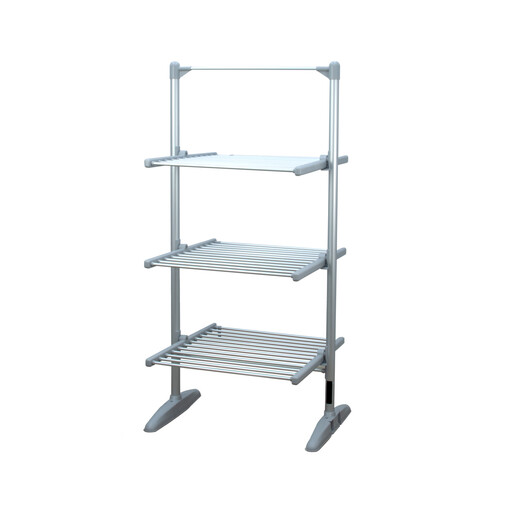
Status 3-Tier 248 W Foldable Aluminium Heated Airer
Consider this three-tier airer if tea towels share drying space with other laundry and a taller frame fits your room. Its stated rating is 248 W. Confirm its open dimensions and folded storage size against the places where you intend to use and keep it.
View on Joybuy
 No image available
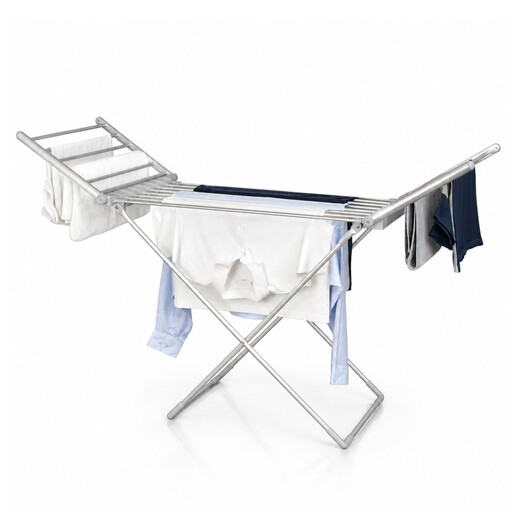
STATUS 230 W Foldable Aluminium Winged Heated Airer, Silver
A winged layout is worth considering for a few tea towels if there is enough clear width to open it. This foldable aluminium model has a stated rating of 230 W and a silver finish. Check its open footprint and folded dimensions before deciding where it will go.
View on Joybuy
 No image available
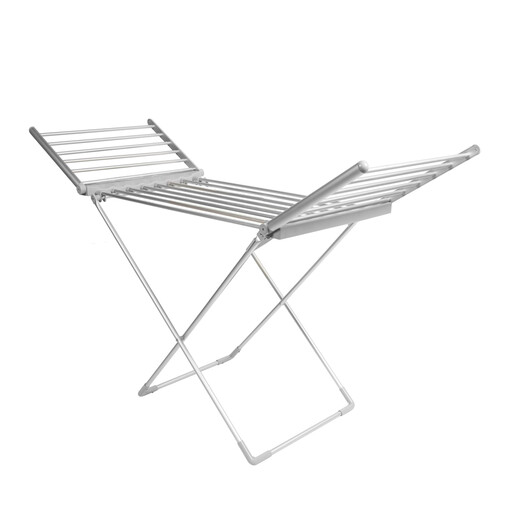
Pifco 3-Tier Winged Heated Airer
This three-tier winged layout is an option if you want places to hang tea towels and sometimes dry other items. Check the labelled height, width and depth of the open airer before judging its fit, and confirm its wattage if electricity use is important to your choice.
View on Joybuy
Questions about heated airers
Is a winged or three-tier airer easier to fit into a small room?
Choose by the exact open dimensions rather than the layout name alone. Dunelm lists a winged example at 90 cm high and 148 cm wide, while the three-tier example listed by Robert Dyas is 147 cm high and 70 cm wide; the first needs more width and the second more height. Measure the intended position and access around it.
Does a lower wattage tell me how much electricity a load will use?
Not by itself: electricity use depends on both the airer’s rated power and how long it runs. Check the rating of the exact model and consider the time needed for your usual load rather than treating a one-hour figure as the total for every drying session.
Should I ventilate the room when drying tea towels indoors?
Yes, use a well-ventilated room for indoor rack drying. UK government ventilation guidance explains that trapped moisture can become condensation, while Islington Council advises ventilating a room used to dry laundry indoors.
Can I use a heated airer with an extension lead?
Use an extension lead only if the airer’s instructions permit the setup and the lead is suitable, undamaged and not overloaded. Electrical Safety First advises checking an extension lead’s maximum rating and not plugging one extension lead into another.


