People drying small loads
If underwear, socks and a few everyday items make up most loads, consider how small items will hang or lie flat, where the airer will stand and how easily it stores.


Choose a heated airer by the space it occupies while open, as well as where it will go when folded. A winged rack needs clear width, a three-tier rack uses height, and a covered warm-air dryer offers timed, enclosed drying. None removes laundry moisture from the flat, so plan for ventilation whichever format you choose.
If underwear, socks and a few everyday items make up most loads, consider how small items will hang or lie flat, where the airer will stand and how easily it stores.
If one airer must also handle larger loads, compare usable drying space and load capacity without overlooking its open dimensions. A vertical rack may offer more hanging space without needing the width of a winged design.
If condensation or existing damp is a concern, decide where laundry can dry with ventilation. A cover or warmer drying method does not take the released moisture out of the flat.
Consider it: For modest mixed loads when you have enough clear width to open the wings.
Allow for: The open rack may obstruct a narrow room even if it folds away afterwards.
Consider it: When you need hanging space arranged vertically and have room for the rack's height.
Allow for: A large rack may be more than you need for a few small items; check whether suitable peg or mesh accessories are available.
Consider it: If enclosed drying and a timed cycle matter more to you than an open-rail layout.
Allow for: The covered format still needs space and room ventilation; compare electricity use over a complete cycle.
| Concern | What to check | Who this matters to |
|---|---|---|
| Open size and storage | Measure open width, depth and height against the intended spot and walking clearance; then check folded dimensions. the Status AHCA-220W1PKB5 winged rack is listed at 1420 mm wide when open, while Lakeland lists a 73 × 75 cm footprint and 137 cm height for its Dry:Soon three-tier rack. | If I have little floor space to spare, I need to keep a clear route through the room and put the airer away afterwards; around 29% of consumers put usable space and storage first. |
| Moisture and ventilation | Choose a position with workable ventilation rather than treating a cover as moisture removal. Manchester University NHS Foundation Trust advises placing an indoor drying rack near an open window. | When condensation is already a worry, I need somewhere to dry laundry without letting damp build up; roughly 29% of consumers make moisture management their main concern. |
| Handling underwear and socks | Check how small items can be pegged or laid flat and whether compatible accessories are available. Lakeland lists peg and mesh accessories for its Dry:Soon system; check what comes with the particular configuration. | If most of my wash is underwear and socks, I need a practical way to keep small items on the airer; about 24% of consumers prioritise how those garments are handled. |
| Electricity use and timing | Compare the exact model's rated power, likely running hours and your electricity unit rate. the Status winged example is listed at 230 W; JML lists its DriBUDDi Compact at 850 W and says it switches off at the end of the selected cycle. | If I expect to run the airer regularly, I need to understand the electricity used over a whole drying cycle; around 18% of consumers put running use and timing first. |
A rack that stores neatly may still block a walkway when loaded. the Status AHCA-220W1PKB5 winged model is listed at 1420 mm wide when open; Lakeland's Dry:Soon three-tier example has a smaller stated footprint but stands 137 cm high.
Measure the open position, walking clearance and storage spot before ordering.
Water released from laundry still enters the indoor environment. UK government guidance explains the health risks associated with damp and mould, making existing damp or limited ventilation a material consideration.
Ventilate the drying area and address persistent damp rather than relying on the airer to solve it.
The UK Office for Product Safety and Standards reported a fire risk involving a specific Mini 3 Tier Electric Heated Airer in November 2024 and recalled a specific Dunelm Heated Winged Airer in January 2025. These notices concern identified products, not every airer with those shapes.
Match the exact model, article number or barcode against the relevant UK recall notice before buying, especially if the airer is second-hand. Follow any instructions in a notice that matches your unit.
A power rating tells you electricity draw while the appliance runs, not how long a particular load will take. Different drying methods cannot be compared on wattage alone.
Use the exact model's rated kW, the hours you expect to run it and your electricity unit rate when assessing a full cycle.
Lakeland's three-tier Dry:Soon rack is a vertical option for households that need more hanging space than a few small items require.
JML's DriBUDDi Compact illustrates the covered warm-air approach for people interested in an enclosed, timed cycle.
Status offers a winged heated-rack option for buyers who can accommodate its open width and want a rack that folds away.
This folding three-tier option is relevant if you want heated rails for indoor laundry and a rack that can be put away. Check its open dimensions and small-item accessories against the space and underwear loads you have in mind.
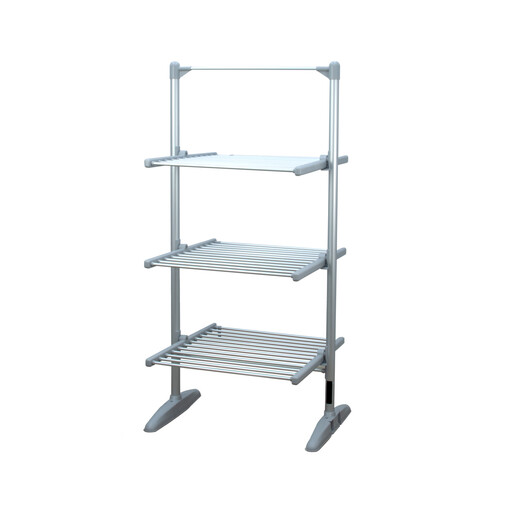 Image unavailable
A three-tier rack to consider if you want heated rails for indoor laundry and folding storage. Its product title specifies an aluminium construction and a 248 W rating. Before choosing it for a small flat, confirm its open and folded dimensions, whether compatible peg or mesh accessories are available, and its exact model identifier for recall checks.
No: heating laundry does not remove the water it releases from the flat. Manchester University NHS Foundation Trust advises placing a rack near an open window when drying indoors; persistent damp needs attention beyond choosing an airer.
Choose the format that fits your room and lets you secure small garments. Check for compatible pegs or mesh support on a rack, the open width of a winged model and whether you would make use of the larger drying space of a three-tier model; a covered dryer is another option if a timed, enclosed cycle matters more.
Compare a full drying cycle using the exact model's rated power in kW, the hours it will run and your electricity rate per kWh. A lower wattage alone does not establish lower use per completed load because running times may differ.
Match its precise model, article number or barcode against UK Product Safety Alerts, Reports and Recalls notices, and follow any notice that applies to your unit. The Office for Product Safety and Standards reported a fire risk for a specified Mini 3 Tier Electric Heated Airer in November 2024 and recalled a specified Dunelm Heated Winged Airer in January 2025; the product shape alone is not enough to identify a match.