People drying small underwear loads
If you usually dry underwear, socks and a few lightweight items between larger washes, check how easily small garments can be spaced out before choosing a frame with more capacity than you need.


For small loads of underwear, start with a compact pod or a smaller fold-flat heated airer rather than assuming you need a full three-tier frame. A larger frame makes more sense if you also dry regular laundry and can accommodate its open footprint; whichever format you choose, plan for ventilation while the laundry dries.
If you usually dry underwear, socks and a few lightweight items between larger washes, check how easily small garments can be spaced out before choosing a frame with more capacity than you need.
A room corner may be available while laundry dries, even if there is little permanent floor space. Compare the airer’s open dimensions with its folded size, and make sure the chosen room can be ventilated.
If windows regularly collect condensation or a room has persistent damp or mould, the drying location matters as much as the airer. Energy Saving Trust advises that ventilation helps lower the risk of condensation, damp and mould.
Choose a place where laundry can dry with appropriate ventilation, then measure the space the airer may occupy while open; capacity and controls come next.
| Concern | What to check | Who this matters to |
|---|---|---|
| Floor and storage space | Measure open width and depth separately from folded depth, allowing room to pass and use doors. | If a drying rack would obstruct the route through my room, its operating size decides what I can use. Around 50% of consumers put floor and storage space first. |
| Moisture and ventilation | Check whether the drying location has workable ventilation; address persistent condensation or mould rather than relying on an airer cover. | When condensation already builds up, I need a suitable place to dry laundry without ignoring the room’s moisture problem. For around 30% of consumers, managing moisture is the primary concern. |
| Small-load convenience | Check garment spacing, timer controls and whether a pod system includes the frame and cover. | If I wash underwear frequently in small batches, easy arrangement and a defined drying period matter more than room for larger loads. Small-load convenience comes first for around 20% of consumers. |
A slim stored frame can still take up substantial floor space in use. The cited 21m three-tier model is 75 × 75cm across the floor when open, although it folds to 8cm deep.
Measure the intended drying position as well as the storage gap, leaving access to doors, ventilation and the power cable.
The described Minky and Beldray conversion products include a heater and cover but exclude the three-tier frame.
Check the contents and the required frame type and dimensions before choosing a conversion kit.
You will need a compatible three-tier airer if you do not already own one.
Indoor laundry adds moisture to a room. UK government guidance identifies drying laundry as one source of indoor moisture, while Energy Saving Trust explains that ventilation helps lower condensation, damp and mould risk.
Choose a location where ventilation is feasible, keep vents clear and investigate persistent damp or mould rather than treating the cover as a remedy.
The cited heated-bar frames and hot-air pod systems have different maximum wattages, but that figure alone does not establish how long a particular load will take to dry or how much energy a drying session will use.
Compare rated wattage alongside the load you intend to dry and the likely operating time; check whether a timer is included.
Lakeland’s Dry:Soon range includes compact Mini and Pod formats alongside larger fold-flat three-tier airers.
Status lists a 248W three-tier foldable heated airer for shoppers considering a foldable shared-load format.
Minky’s Sure Dri Heat Pod Pro is a covered hot-air conversion option for a standard three-tier airer.
Beldray offers heat-pod-and-cover kits intended for use with a compatible three-tier airer.
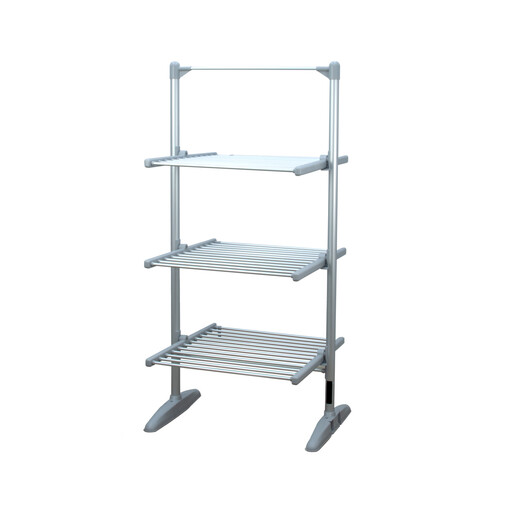
This foldable three-tier heated airer is relevant if you want room for laundry beyond small underwear loads and can accommodate a frame while it is open. Check its dimensions against both your drying position and storage space.
 No image available
Consider this foldable three-tier format if you also need hanging space for larger laundry loads. The product title specifies a 248W rating; check its open and folded dimensions for your space, and how you would arrange small garments on the tiers.
Choose a compact pod for predominantly small loads if its size and contents suit your setup; choose a three-tier heated-bar airer if you also need more hanging space and can fit it while open. For a heat-pod conversion kit, check whether you already have the compatible frame it requires.
No. Drying laundry still adds moisture indoors, whether or not you use a cover. Energy Saving Trust advises that good ventilation helps lower the risk of condensation, damp and mould, so keep the room’s ventilation routes clear.
Compare rated wattage together with the operating time needed for your intended load, rather than treating wattage as energy use per drying session. Rated wattage multiplied by hours of use gives an estimate in watt-hours; maximum wattage alone does not establish a product’s average draw or drying time.
Report persistent damp or mould to your landlord or managing agent rather than assuming a different airer will resolve it. UK government guidance identifies indoor laundry as one source of moisture, but the underlying cause of a persistent problem needs to be investigated.