Small-flat, small-load dryers
If you mainly dry a few cotton shorts and everyday items, check both the space an airer occupies when open and where it will go between loads.


For occasional loads of cotton shorts, start with a fold-flat winged heated airer if its full open width fits your flat. A tiered model makes more sense if you regularly dry larger mixed loads and have room for its height; a cover or timer may be useful for frequent drying, but neither replaces ventilation.
If you mainly dry a few cotton shorts and everyday items, check both the space an airer occupies when open and where it will go between loads.
For regular mixed loads rather than just shorts, drying length, stated load capacity and any timer become more relevant alongside room ventilation.
If condensation, musty smells or existing damp are concerns, plan how you will ventilate the drying space rather than relying on the airer to manage moisture.
Choose a format that fits the room when open and has somewhere to go when folded, then assess your usual load. The Ministry of Housing, Communities & Local Government, Department of Health & Social Care and UK Health Security Agency identify drying laundry as a source of moisture in the home, so ventilation belongs in the decision too.
Choose when: You mainly have smaller loads and can leave enough clear floor width for the open wings.
Trade-off: It folds away, but its wings can occupy a long strip of floor while drying.
Choose when: You regularly dry mixed loads and have space for the rack at its full height.
Trade-off: Stacking the rails reduces the need for a wide winged layout, but a loaded tower can still crowd a small room.
| Concern | What to check | Who this matters to |
|---|---|---|
| Floor and storage space | Measure the complete open footprint and the folded depth against the places you intend to use and store it. | When laundry shares my living space, I need to move the airer out of the way between loads; around 42% of consumers put fit and storage first. |
| Indoor moisture | Check that you can ventilate the drying location without blocking vents, and consider any existing condensation or damp. | If washing dries indoors regularly, I want to avoid adding to condensation or musty smells; moisture management comes first for around 33% of consumers. |
| Load and running control | Compare stated drying length and load capacity; check the exact model's wattage and whether a timer is provided. | When I also dry larger mixed loads, I need enough room for the washing and a way to plan operating time; around 25% of consumers prioritise capacity and control. |
A winged airer can need considerable width when open, while a tiered one may be awkward because of its height and loaded bulk.
Mark out the stated open dimensions before ordering, then check the folded dimensions against the space where you would store it.
Indoor laundry adds moisture to the home. According to guidance from the Ministry of Housing, Communities & Local Government, Department of Health & Social Care and UK Health Security Agency, moisture build-up is relevant to damp and mould.
Use a location you can ventilate, keep vents clear and address persistent condensation or mould as a separate housing or ventilation issue.
Airers have different wattages, and electricity use also depends on how long you run the appliance.
Use the exact model's wattage, your electricity tariff and your intended operating hours when making a comparison.
Electrical Safety First warns that overloading a socket or extension lead can create a fire risk.
Check the extension lead's rating and the total connected load if you need one, and do not connect extension leads together.
Lakeland offers heated airers in compact and tiered formats, with covers and accessories for compatible models.
Minky offers winged and larger tiered heated airers, including a covered four-tier format.
Status offers a foldable aluminium winged airer and a foldable three-tier model, making two layouts comparable within its range.
These choices cover a winged airer with a cover, another foldable winged airer and a three-tier option. For a small flat, start with the layout you can use and store; consider the tiered option if your regular loads extend beyond shorts.
 No image available
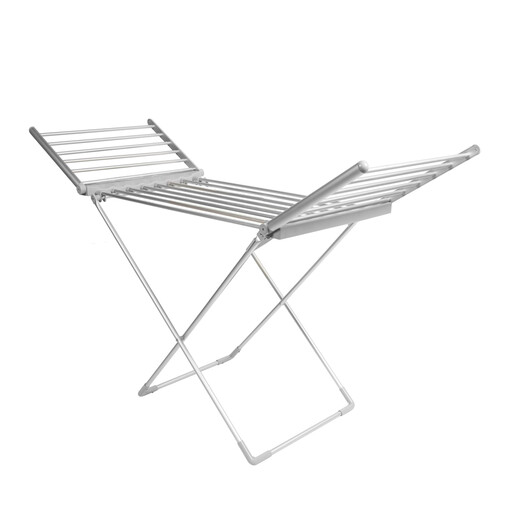
Consider this for shorts and other small loads if you want a winged airer with tiered rails and space to set it up. Check its open and folded dimensions against your room, and follow its instructions when using a cover.
 No image available
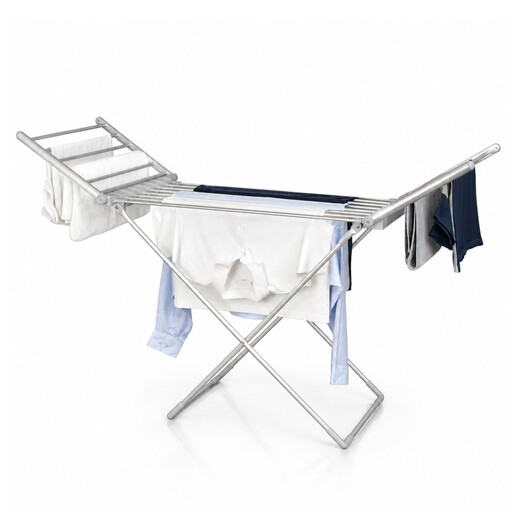
The winged, foldable format is worth considering for a small shorts load if you can accommodate the wings when open. The product name specifies 230 W; check the open dimensions and folded depth before deciding where it will stand and be stored.
 No image available
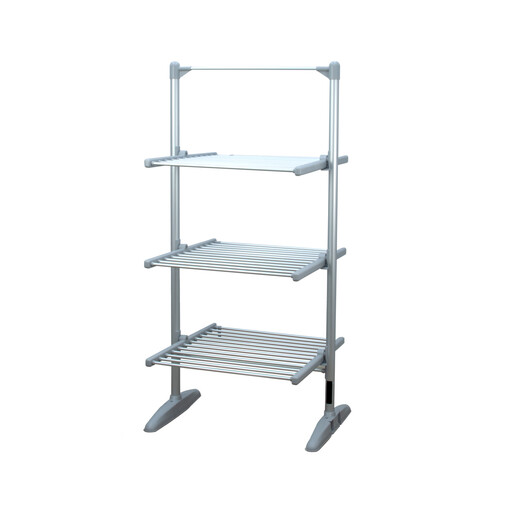
Consider the three-tier layout if you routinely dry more than shorts and have room for its full height. The product name specifies 248 W; check its open footprint and folded dimensions against your floor and storage space.
Start with a fold-flat winged shape if its open width fits and you mainly dry small loads; consider a tiered airer if you regularly need more drying space. As a sizing illustration, an 11 m winged model is listed that opens to 148 cm wide, while the tiered examples discussed here require substantially more height. Measure the space for the exact model you choose.
A cover is not essential for a small load of shorts. If you want one, check that it is specified for your model and follow its fitting instructions; it does not remove the need to ventilate the room.
Follow the model's instructions and stated load limit, and leave enough space to use it without obstructing the room. If you use an extension lead, check its rating and total connected load: Electrical Safety First warns that overloaded sockets and extension leads present a fire risk.
Use the exact model's wattage, your electricity unit tariff and the number of hours you expect to run it. For context, 220 W is listed for the 11 m winged model and 300 W for the 21 m three-tier model; neither rating alone tells you the cost of drying a load.
Check the stated guarantee for the exact airer rather than assuming every model from a brand has the same cover. The listing for the 11 m winged model states a one-year manufacturer's guarantee, while Lakeland states a three-year guarantee for its Dry:Soon Deluxe 3-Tier model.