Small-flat workwear dryers
You regularly wash shirts, trousers, scrubs or other workwear and need the airer to fold into a narrow space between loads.


A folding three-tier rail airer suits several washable work garments if you have room to open it and somewhere narrow to store it afterwards. A covered warm-air pod is an alternative if an enclosed, timed cycle suits your routine, but compare its capacity and rated power with the rail models rather than assuming it will dry every fabric faster. Whichever format you choose, follow garment-care labels and keep the flat ventilated while laundry dries.
You regularly wash shirts, trousers, scrubs or other workwear and need the airer to fold into a narrow space between loads.
You need room to hang workwear alongside ordinary laundry, with space between garments rather than one crowded rail.
You dry laundry in a compact home and need a location with usable ventilation and a suitable electrical setup.
Choose the format before comparing models: open rails give you access to individual garments, while a covered pod offers a timed, enclosed arrangement. In either case, check how the appliance fits your room while open, not just where it will go after folding.
Consider these when: Several washable work garments need separate hanging space and the airer must fold away afterwards.
Allow for: Floor space while the rails are open, even if the folded unit is narrow.
Consider this when: An enclosed, timed cycle suits a smaller batch of workwear. JML lists a timer and automatic shut-off for its DriBUDDi Compact.
Allow for: Less direct access to hanging garments. JML lists the Compact at 850 W; compare actual running time rather than treating its rating as a drying-time result.
| Concern | What to check | Who this matters to |
|---|---|---|
| Open space and storage | Measure the open position, folded depth and distance to a suitable socket. Lakeland lists an 8 cm folded depth for its Dry:Soon 3-Tier; Dunelm lists 10.5 cm for its 3 Tier Heated Airer. | I need to move around the flat while clothes dry and put the airer away afterwards; roughly 31% of consumers put space and storage first. |
| Room for a workwear load | Compare stated load and hanging space, then consider how shirts and trousers will be spaced. Lakeland lists 21 m of drying space and Dunelm 20 m for their cited three-tier models. | If several garments must be ready together, fitting them onto separate rails matters more to me than drying one piece at a time. Around 25% of consumers prioritise load capacity. |
| Timing and garment care | Check each care label, cover compatibility and any timer or automatic shut-off. A fitted rail-airer cover and a warm-air pod are different arrangements; neither establishes a drying time for your garments. | When workwear is needed for my next shift, I want a drying arrangement that fits the time available; around 25% of consumers make timing their primary concern. |
| Electricity, moisture and sockets | Compare rated power alongside likely running hours. Keep ventilation usable and check the rating of any extension lead against the connected load. | I dry indoors often, so I need to plan for electricity use and the moisture released into the room; roughly 19% of consumers put this combined practical setup first. |
Water still leaves the clothes as they dry. UK government home-ventilation guidance says moisture from washing clothes can become condensation without effective ventilation.
Choose a drying position that leaves vents usable, use the home’s intended extraction where applicable and open a window when safe. Investigate persistent damp rather than assuming the airer is its only cause.
Rated power describes electrical draw while an appliance is running, not how long a particular workwear load will take to dry.
Check the current wattage and consider the running time your laundry needs before comparing electricity use between formats.
A stated kilogram limit does not show whether shirts and trousers can hang with enough space between them, or whether the open airer fits the room.
Check hanging space, open dimensions and folded depth against the garments and space you have. Follow each garment’s care label.
Electrical Safety First warns that an overloaded extension lead, cable reel or adaptor can overheat and cause a fire.
Use a suitable wall socket where possible. If you need an extension, check its marked current rating and the combined load, do not connect extensions to each other, and fully unwind a cable reel.
Lakeland’s Dry:Soon range includes folding heated rail airers and model-specific accessories.
Dunelm offers heated-airer formats including a folding three-tier rail model and model-specific covers.
JML’s DriBUDDi Compact is an enclosed warm-air alternative to open heated rails.
These folding heated rail airers are options for hanging washable workwear indoors. Compare their open and stored dimensions with your flat before choosing; a stated load alone cannot tell you how your garments will fit.
 No image available
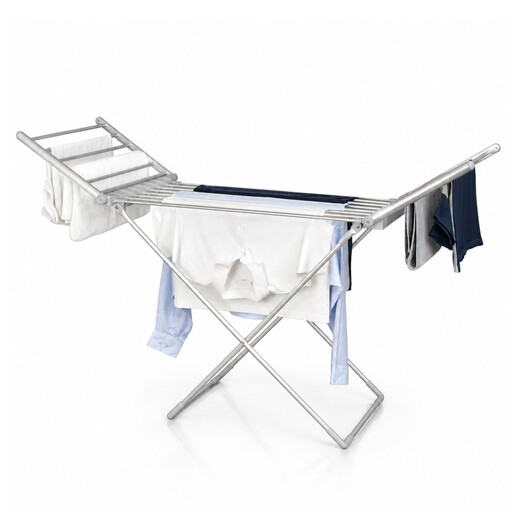
Consider this three-tier rail format if you need to hang several washable work garments and store the airer between loads.
Measure its open and folded size against your space. If using a cover, follow the airer’s instructions and keep its controls unobstructed.
 No image available
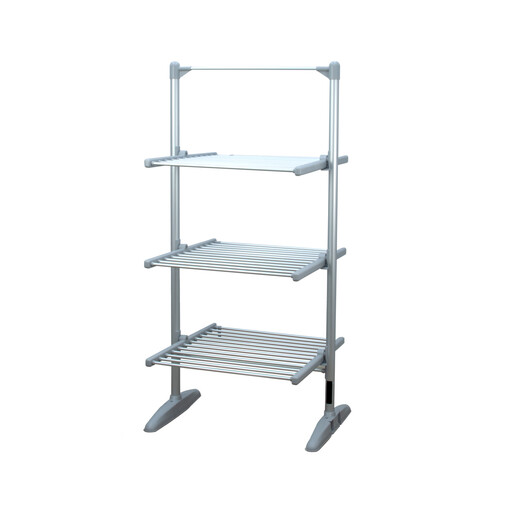
Consider this folding three-tier airer if you need separate hanging space for a workwear load and somewhere to store it afterwards.
Its title states 248 W. Check its open and folded dimensions for your room, and follow the instruction not to cover the heated bars during use.
 No image available
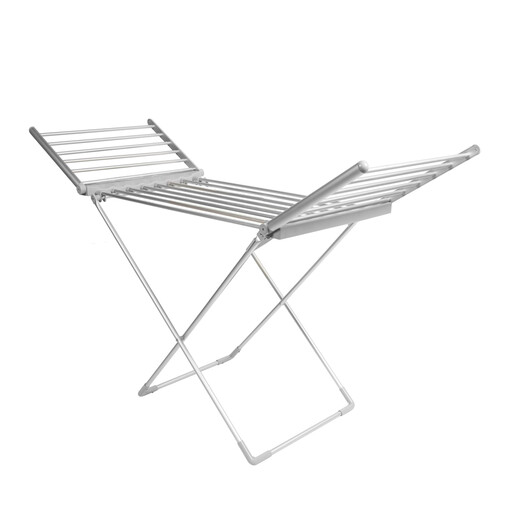
Consider this winged, folding rail airer if you want to hang several washable work garments and put the unit away afterwards.
Its title states 230 W. Check the open and folded dimensions against your available space, and follow the instruction not to cover the heated bars during use.
Choose by its open dimensions and folded depth, not tier count alone. Measure a position that leaves your usual route through the room clear and reaches a suitable socket; Lakeland lists an 8 cm folded depth for its Dry:Soon 3-Tier model, while Dunelm lists 10.5 cm for its 3 Tier Heated Airer.
A cover made for the airer may retain warmth, as Lakeland and Dunelm describe for their compatible covers, but it does not guarantee a particular drying time. Check the exact model’s cover instructions and the garment-care labels; fabric thickness, spacing and room conditions also matter.
Compare rated power together with the time each airer needs for your load. Dividing watts by 1,000 gives kilowatts; multiplying that figure by running hours gives electricity use in kilowatt-hours. Wattage alone cannot tell you which format uses less electricity to finish drying.
Keep the home’s ventilation working while laundry dries. UK government guidance advises leaving trickle vents open and unblocked because moisture can become condensation without effective ventilation; open a window when safe, and investigate damp that persists.
Use one only if its marked current rating can accommodate the connected load. Electrical Safety First advises against overloading or connecting extensions to each other; fully unwind a cable reel before use.