Frequent-turnover holiday-let operators
If several aprons need drying with towels or other light laundry between stays, enough rail space for the whole batch matters more than the size of an apron on its own.


For a holiday let that regularly dries aprons alongside turnover laundry, a three-tier heated airer offers more rail space than the compact winged examples considered here. A winged format makes more sense for small apron-only loads when storage space is the priority. Check the exact model’s load limit, timer, cover and working footprint, and plan how the appliance will be used safely at the property; wattage alone cannot tell you how quickly aprons will dry.
If several aprons need drying with towels or other light laundry between stays, enough rail space for the whole batch matters more than the size of an apron on its own.
If the airer must be put away between uses, compare its folded size with its footprint while open. A compact format still needs room to operate without obstructing the space.
If staff or guests may have access to the airer, a clear switch-off routine and suitable placement matter alongside any timer. The appliance also needs to fit the property’s fire-safety arrangements.
Decide what usually goes on the airer before comparing its open footprint, storage size and operating controls. The model specifications below describe particular airers, not every product in a format.
Consider it when: Aprons regularly share a drying batch with other turnover laundry and staff can follow a clear operating routine.
Trade-off: Confirm the exact model’s timer provision rather than assuming one is built in; the cited example also sells its cover separately.
Consider it when: You want to set a run period for recurring laundry batches. Lakeland specifies a 1–12-hour timer on the Dry:Soon Deluxe.
Trade-off: The cited Deluxe cover is a separate accessory, and a timer does not replace suitable placement or a property-specific safety routine.
Consider it when: The usual load is a few aprons and storage space takes priority over drying a mixed batch at once.
Trade-off: Lakeland’s cited winged example has a 6 kg load limit and 12 m of drying space, compared with 15 kg and 21 m for its standard three-tier model. That winged example is discontinued, so check the specifications of any model currently under consideration.
| Concern | What to check | Who this matters to |
|---|---|---|
| Batch capacity | Compare drying-space length and maximum load with the aprons and other laundry you expect to dry together. | If I need to dry aprons with turnover laundry, I want enough room for the batch without exceeding the load limit. Around 40% of consumers put batch capacity first. |
| Controlled operation | Check the exact timer specification, socket position and how the appliance will fit the property’s fire-safety routine. | When an electrical airer is used at a guest property, I need a workable way to manage where and when it runs. Around 40% of consumers prioritise controlled operation. |
| Space and storage | Check both open dimensions and folded size; a fold-flat airer still needs working space. | If my laundry area is small and apron loads are light, I would accept less batch capacity for an airer I can put away. For around 20% of consumers, compact storage is the main concern. |
Models with similar drying-space figures can have different controls and box contents. The cover for the cited three-tier model is sold separately; Lakeland lists covers as accessories for the cited Dry:Soon models.
Check the exact model’s supplied accessories and timer specification. If a timed run is important, look for an explicitly stated timer range.
Rated power does not establish how quickly your apron load will dry or whether it will fit. The cited three-tier models differ in features such as access, cable length and timer provision.
Compare drying space, load limit, open dimensions and cable reach for the intended location before using wattage to assess electricity use.
The Home Office guidance for small paying guest accommodation addresses fire safety through assessment of the premises. Scottish Government guidance also describes a short-term-let licensing scheme and council-specific conditions in Scotland.
Check the requirements for the property’s nation and local authority, then include the airer’s location and operating routine in the property’s fire-safety arrangements.
A model name or retailer listing does not establish whether an electrical product is subject to a current safety notice. Electrical Safety First directs consumers to the Office for Product Safety and Standards for current recall information.
Keep the complete make and model details, check current recall notices before putting the airer into use, and repeat the check during routine equipment reviews.
Lakeland lists winged and three-tier Dry:Soon formats, including a Deluxe three-tier model with a built-in timer.
The cited three-tier airer is a 21 m, 15 kg option for comparing mixed-laundry capacity.
Homebase lists a three-tier BLACK+DECKER model with swivel arms for considering longer items alongside aprons.
The cited Homebase listing offers a higher stated load limit as a point of comparison for larger laundry batches.
These Joybuy choices include three-tier and winged heated airers for drying aprons. Compare the load you plan to dry, the space available when the airer is open and how it will be operated at the holiday let.
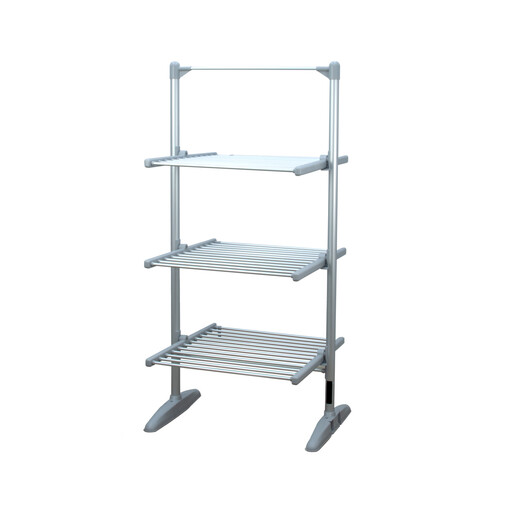 No image available
Consider this three-tier format if aprons regularly share an airer with other laundry and you need to fold it away between uses.
Check its drying-space length, open dimensions, timer and cover details against your batch and operating routine before buying.
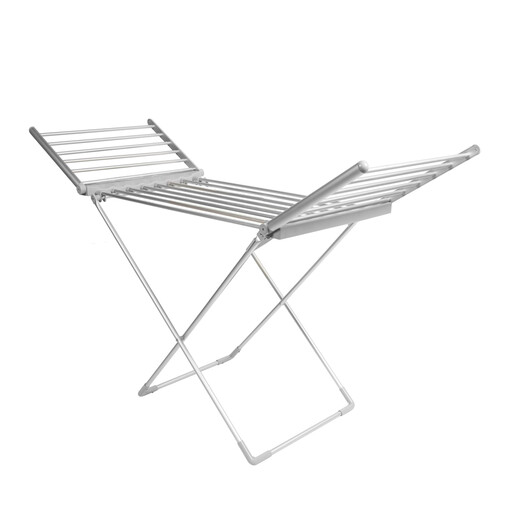 No image available
Consider this winged format if storage space matters more than fitting a larger mixed-laundry batch on one airer.
Confirm the working footprint, drying-space length and timer provision for the location and routine you have planned. Follow the manufacturer’s instructions for any cover used with it.
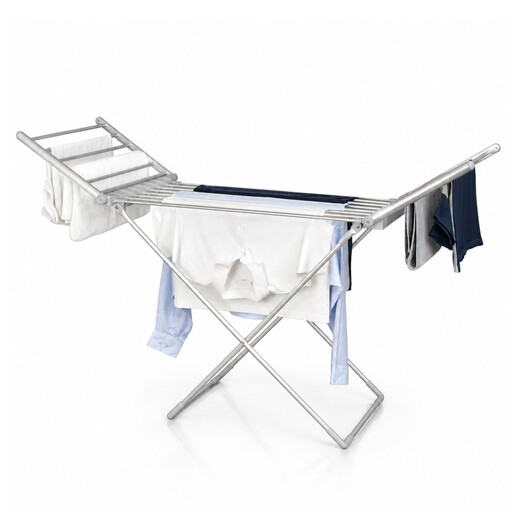 No image available
This winged airer is worth considering when the apron load is modest and folding the appliance away is important.
Check drying-space length, open dimensions, cable reach, timer and cover details before deciding whether it suits the planned location.
Choose a winged format for small apron-only loads when storage is the main constraint; consider a three-tier airer when aprons regularly share space with turnover laundry. Check each model’s stated drying space and load limit rather than assuming all products of either shape have the same capacity.
It depends on the exact model and its box contents. The cover for the cited three-tier model is sold separately, while Lakeland lists covers as accessories for the cited Dry:Soon models. Confirm what is supplied and follow the manufacturer’s cover-use instructions.
Include the airer’s placement and operating routine in the property’s fire-safety arrangements and check the rules applicable to its location. The Home Office publishes fire-safety guidance for small paying guest accommodation; Scottish Government guidance describes licensing for short-term lets in Scotland, with council policies that may add conditions.
No drying-time conclusion follows from wattage alone. Rated power helps compare electricity use: a 300 W airer running at its rated power for one hour would use 0.3 kWh. The load and conditions of use also matter when assessing drying time.