
24/7 Customer Support

Free returns

Same-day & Next-day Delivery

Quality Guaranteed

Unlock Your Welcome Offers: FREE Delivery | Up to 80% OFF | Free 30-day JoyPlus trial
Download the APP
A heated hair brush can simplify everyday styling, but choosing the wrong one may leave you with uneven results, limited battery life or more heat exposure than necessary. UK shoppers often compare temperature settings and ionic technology first, yet the more practical details are easy to miss.
The following guide explains the main buying pitfalls, the specifications worth checking and which type of heated styling brush may suit different routines.
Negative-ion technology is commonly used in an ionic heated brush to help reduce static and support a smoother-looking finish. However, it does not replace suitable heat protection, careful sectioning or appropriate temperature selection. Hair condition, humidity and styling technique still affect the result.
Treat ionic functions as one feature among several rather than a guarantee of glossy, frizz-free hair in every situation.
A tool may advertise a high maximum temperature, but that is not necessarily useful for every hair type. Fine, coloured or fragile hair generally requires a lower setting, while thick or coarse hair may need more heat and smaller sections.
Look for adjustable temperature settings with clearly stated values. Stable heating is also important: temperature fluctuations can make styling inconsistent and encourage repeated passes over the same section.
A heated hair brush is not automatically a hot-air brush. Some models use solid heated bristles or a heated barrel and must only be used on dry hair. Using a non-dryer tool on wet hair can affect styling performance and may create a safety risk.
Always check whether the product is designed for drying, styling or both. The Wavytalk thermal brush options featured below are heated styling tools, not hairdryer brushes.
For everyday versatility, check both the number of settings and the actual temperature range. A tool offering settings from around 130°C can provide a lower starting point for fine hair, while options reaching 200°C or above may be more suitable for thicker hair when used carefully.
Do not select a setting solely by hair thickness. Consider bleaching, colouring, dryness and how frequently you style. Use the lowest temperature that produces the finish you want and follow the manufacturer’s instructions.
A ceramic heated brush or tourmaline ceramic barrel is designed to distribute heat across the styling surface. PTC heating elements are commonly used for rapid warm-up and temperature regulation.
Heating speed is convenient, but stable temperature control matters just as much. If a brush cools noticeably as you work, you may need repeated passes. Check the product specification for warm-up time, heating technology and whether the display shows the selected temperature.
The shape determines the type of styling possible:
For UK use, check that the product includes a compatible UK plug or the correct charging arrangement. Also look for anti-scald comb teeth, insulated sections, an automatic shut-off function where specified and clear safety instructions. A UKCA or CE marking, where applicable, should be checked on the product packaging and documentation rather than assumed from a listing title.
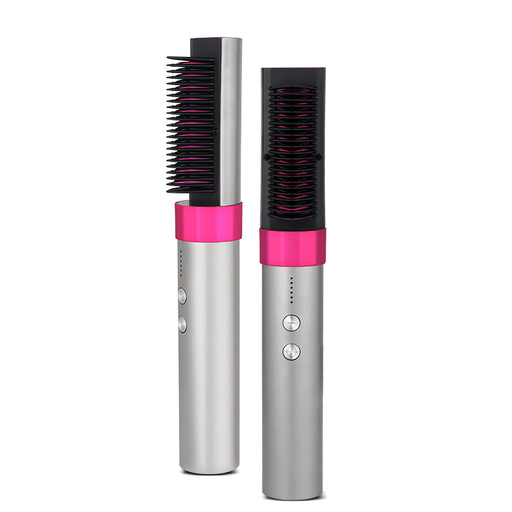
Why This Fits Their Persona: A cordless design suits quick morning styling, office touch-ups and compact storage in smaller UK homes. It focuses on smoothing rather than complex curling.
Its six selectable settings range from 130°C to 200°C, helping users avoid relying on one excessively high temperature. Anti-scald comb teeth are also specified for safer handling.
PTC ceramic heating reaches the selected temperature in approximately one minute; the built-in 3000mAh battery provides approximately 30 minutes of cordless use per full charge.
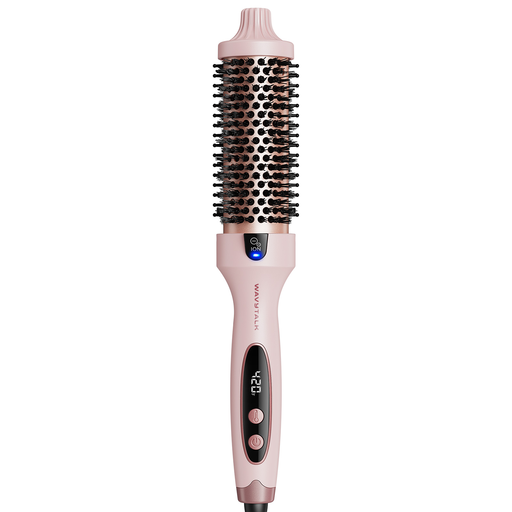
Why This Fits Their Persona: The round-barrel format suits shoppers who want more than straightening, including volume, soft curls and a shaped fringe using one corded tool.
The listing clearly states that it is not a hairdryer brush, reducing the risk of buying the wrong tool. Five displayed temperatures provide more control than a single fixed setting.
The 38mm tourmaline ceramic barrel, elongated heated bristles, LED temperature display and 360° swivel cord support controlled styling.
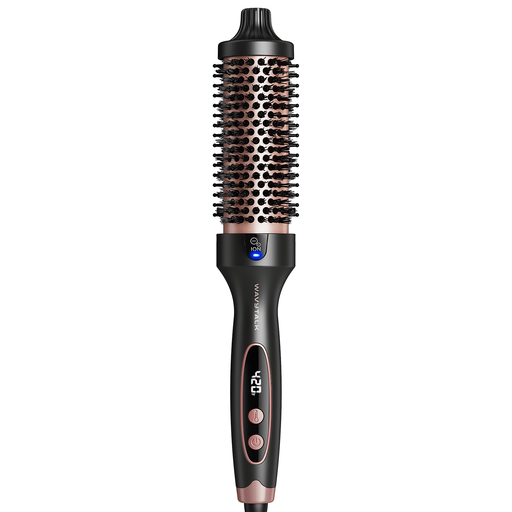
Why This Fits Their Persona: Frequent stylers and travellers may value dual-voltage compatibility, while the 38mm barrel works for larger sections, movement and volume-led looks.
The five temperature choices cover 150°C to 215°C, and the LED display shows the selected level. Dual voltage is stated, but users should still check destination plug requirements.
Two PTC heaters, a tourmaline ceramic barrel, ionic function, 68W operation and a 360° swivel cord are specified in the product description.
We have compiled a complete, real-time list of products that fully satisfy these strict selection criteria and UK safety regulations.
A cordless model should be fully charged before first use and recharged according to the instructions. For corded models, keep the appliance away from sinks, baths and other water sources, even when not actively styling.
It can be, provided it has a lower temperature setting and is used on dry hair with heat protection. Start at the lowest practical temperature, work in small sections and avoid repeated passes. A brush with six settings from 130°C may offer more adjustment than a model beginning at a higher temperature.
Runtime varies with temperature, hair thickness and usage pattern. The K·SKIN KD382 specification states approximately 30 minutes of use from its built-in 3000mAh battery per full charge. This may suit touch-ups or short styling sessions rather than extended styling of very thick hair.
Corded consumption depends on wattage and how long the appliance is switched on. The Wavytalk thermal brush is listed at 68W; using it for a short session generally consumes less electricity than running a high-wattage appliance for a longer period. Unplug it after use rather than leaving it connected unnecessarily.